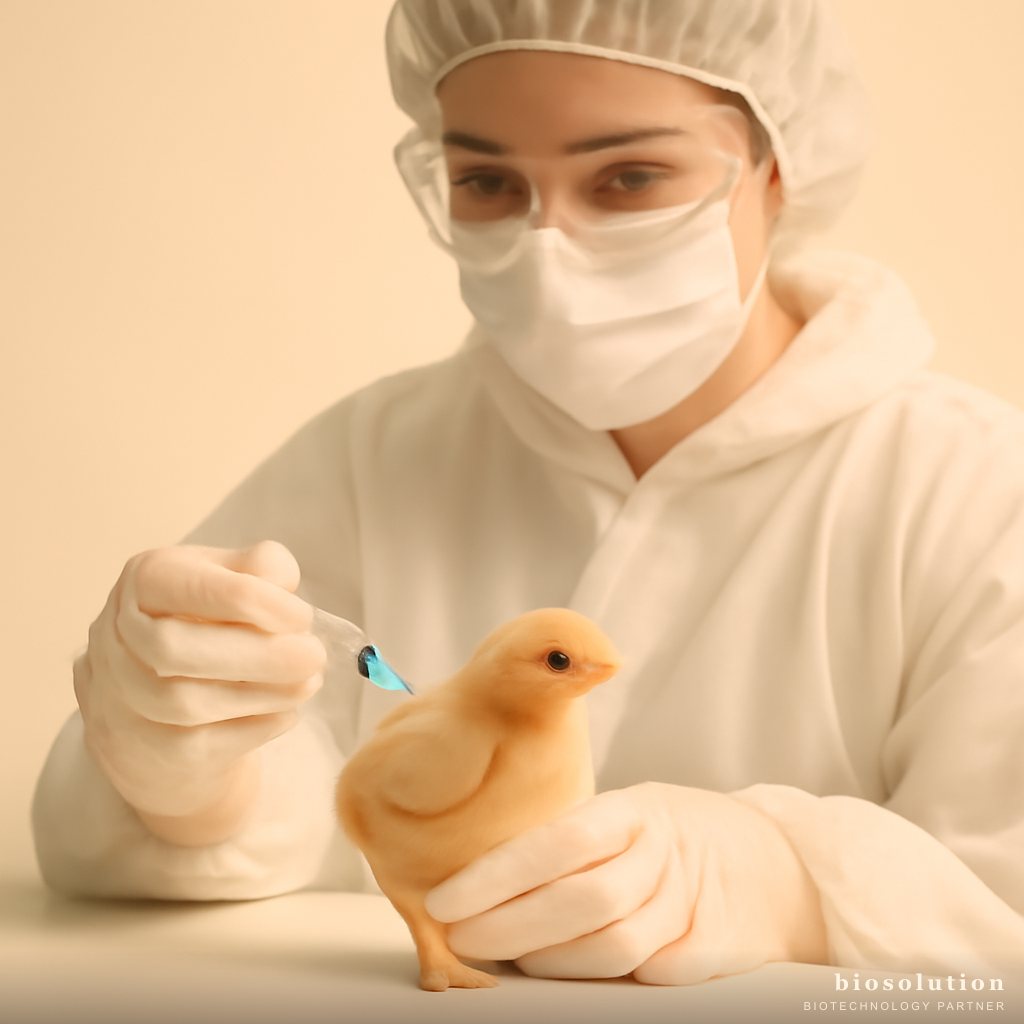
Case Study: Integrator Successfully Prevents Newcastle Disease (ND) in Chickens with Broiler Probiotic Formula
Newcastle disease (ND) is one of the most detrimental viral diseases in broiler farming in Indonesia. Despite mass vaccination, ND outbreaks still frequently occur, especially during seasonal transitions or when flock immunity is suboptimal. A medium-scale broiler integrator in West Java successfully reduced ND incidence and improved production performance through a preventive management approach integrating Biosolution's Broiler Probiotic Formula. This article reviews the strategy, results, and scientific mechanisms behind this success.
Why Is Newcastle Disease (ND) Still a Threat?
ND, also known as tetelo, is caused by Avian paramyxovirus serotype 1 (APMV-1), which attacks the respiratory, digestive, and nervous systems. In broilers, ND can cause sudden death, decreased feed intake, and significant economic losses. Key risk factors include:
- Incomplete vaccination: Uneven vaccine coverage or delayed boosters.
- Low immunity: Heat stress, high density, or poor feed management.
- Hygiene: Poor sanitation, inadequate ventilation.
- Secondary infections: Pathogenic bacteria such as E. coli and Salmonella worsen symptoms.
According to data from the Ministry of Agriculture, losses due to ND in the broiler sector reach billions of rupiah per year. Therefore, integrated prevention is key.
Integrator Strategy: Probiotics as an ND Prevention Tool
The integrator in this case study has 20 houses with a capacity of 10,000 birds per house. Previously, they experienced ND outbreaks every rainy season with mortality reaching 15%. After consulting with Biosolution's technical team, they implemented a probiotic-based ND prevention program with the following protocol:
- Routine ND vaccination (live and killed according to schedule).
- Broiler Probiotic Formula administered via drinking water from day-old chick (DOC) to harvest.
- Strict biosecurity management: vehicle disinfection, footbaths, and all-in all-out.
The product used is the Broiler Probiotic Formula containing three superior strains: Lactobacillus acidophilus, Bacillus subtilis, and Bacillus coagulans. The applied dosage: 1 ml/L of drinking water daily during the starter phase (0–14 days), then 3 times per week during the grower-finisher phase (15–35 days).
Scientific Mechanism: How Probiotics Reduce ND Risk?
Probiotics work through several mutually supportive mechanisms to strengthen the chicken's defense against ND virus infection:
1. Competitive Exclusion
Lactobacillus acidophilus and Bacillus subtilis compete with pathogenic bacteria such as E. coli and Salmonella for adhesion sites on the intestinal mucosa. By occupying intestinal receptors, probiotics prevent pathogens from triggering secondary infections that often worsen ND symptoms.
2. Lactic Acid Production and pH Reduction
Lactobacillus acidophilus produces lactic acid, lowering intestinal pH. This acidic environment is unfavorable for Gram-negative pathogenic bacteria like E. coli and Salmonella, suppressing their populations. Studies show that low intestinal pH can also indirectly inhibit ND virus replication through activation of proteolytic enzymes.
3. Immunomodulation via Mucosal IgA
Probiotics stimulate the production of secretory immunoglobulin A (IgA) in the intestinal mucosa. IgA is the first-line antibody against viruses and bacteria in the digestive and respiratory tracts. Research in Poultry Science (2020) proved that Bacillus subtilis supplementation increases specific IgA titers against ND virus after vaccination.
4. Digestive Enzymes and Improved Nutrition
Bacillus subtilis and Bacillus coagulans produce protease, amylase, and cellulase enzymes that improve feed digestibility. Better nutrition strengthens the adaptive immune system, optimizing the response to ND vaccination.
Real Results: Performance Data After Probiotic Application
After 5 cycles of application, the integrator recorded significant results:
| Parameter | Before Probiotic | After Probiotic | Change |
|---|---|---|---|
| Total mortality | 12–15% | 4–6% | Decrease 50–60% |
| FCR | 1.65–1.70 | 1.50–1.55 | Improvement 8–12% |
| ADG (grams/day) | 45–48 | 50–53 | Increase 5–10% |
| Clinical ND cases | 2–3 times/cycle | 0–1 times/cycle | Dramatic |
The data above shows that probiotics not only reduced ND-related mortality but also improved feed efficiency and growth. This aligns with the product claims of 8–12% FCR improvement and 5–10% ADG increase.
Why Is the Broiler Probiotic Formula Suitable for ND Prevention?
This product is specifically formulated for broilers, considering their physiological characteristics and feed management. Some advantages:
- Spore strain Bacillus coagulans: Resistant to pelleting heat and stable in the digestive tract.
- Combination of Lactobacillus and Bacillus: Synergy between lactic acid bacteria and enzyme producers for comprehensive effects.
- Practical dosage: Via drinking water or feed, easy to integrate into house routines.
- Antibiotic residue-free: Supports AGP-free programs and meets consumer demand for healthy meat.
Integrated ND Prevention Steps for Broiler Farmers
Based on the integrator's experience, here are recommended ND prevention steps:
- Vaccinate ND according to schedule – monitor antibody titers.
- Administer probiotics consistently – from DOC to harvest.
- Maintain strict biosecurity – regular disinfection, control of people and vehicle traffic.
- Optimize feed and water management – ensure good drinking water quality.
- Monitor early symptoms – immediately isolate if any chickens are lethargic, gasping, or have torticollis.
Conclusion
Preventing Newcastle Disease (ND) in broilers requires an integrated approach combining vaccination, biosecurity, and immune strengthening through nutrition. This integrator case study proves that Biosolution's Broiler Probiotic Formula can reduce ND risk while significantly improving production performance. With Lactobacillus acidophilus, Bacillus subtilis, and Bacillus coagulans, this probiotic works through competitive exclusion, lactic acid production, immunomodulation, and improved digestion. Results: mortality decreased by up to 60%, FCR improved by 8–12%, and ADG increased by 5–10%.
For farmers wanting to implement a similar strategy, consult with Biosolution's technical team via WhatsApp to get dosage and schedule recommendations tailored to your house conditions. See product details Broiler Probiotic Formula for more information.
FAQ
Can probiotics replace ND vaccine?
No. Probiotics do not replace vaccination but support immunity. Vaccination remains mandatory to form specific antibodies against ND virus. Probiotics help improve vaccination response through IgA stimulation and strengthen mucosal immunity.
How long does it take to see the effect of probiotics on ND prevention?
Performance improvements like FCR and ADG are usually seen after 1–2 cycles of consistent use. For ND risk reduction, optimal effects are achieved after 2–3 cycles due to stable gut microbial populations.
Is it safe to give probiotics together with medication or vaccines?
Yes, probiotics are generally safe. However, avoid simultaneous administration with oral antibiotics as they can kill probiotic bacteria. Allow at least a 2-hour gap. For live vaccines, probiotics can be given on the same day as they do not interfere with vaccine virus replication.
How should the Broiler Probiotic Formula be stored?
Store in a cool, dry place at room temperature (25–30°C) and avoid direct sunlight. After opening, use within 30 days to maintain bacterial viability.
Are there any side effects of using probiotics in chickens?
Probiotics are very safe with minimal side effects. Initially, some chickens may experience slight fecal adjustment due to changes in gut flora, but this normalizes within 2–3 days. No toxic effects or harmful residues.