How to Fix Hard and Dry Soil Caused by Chemical Fertilizer Overdose
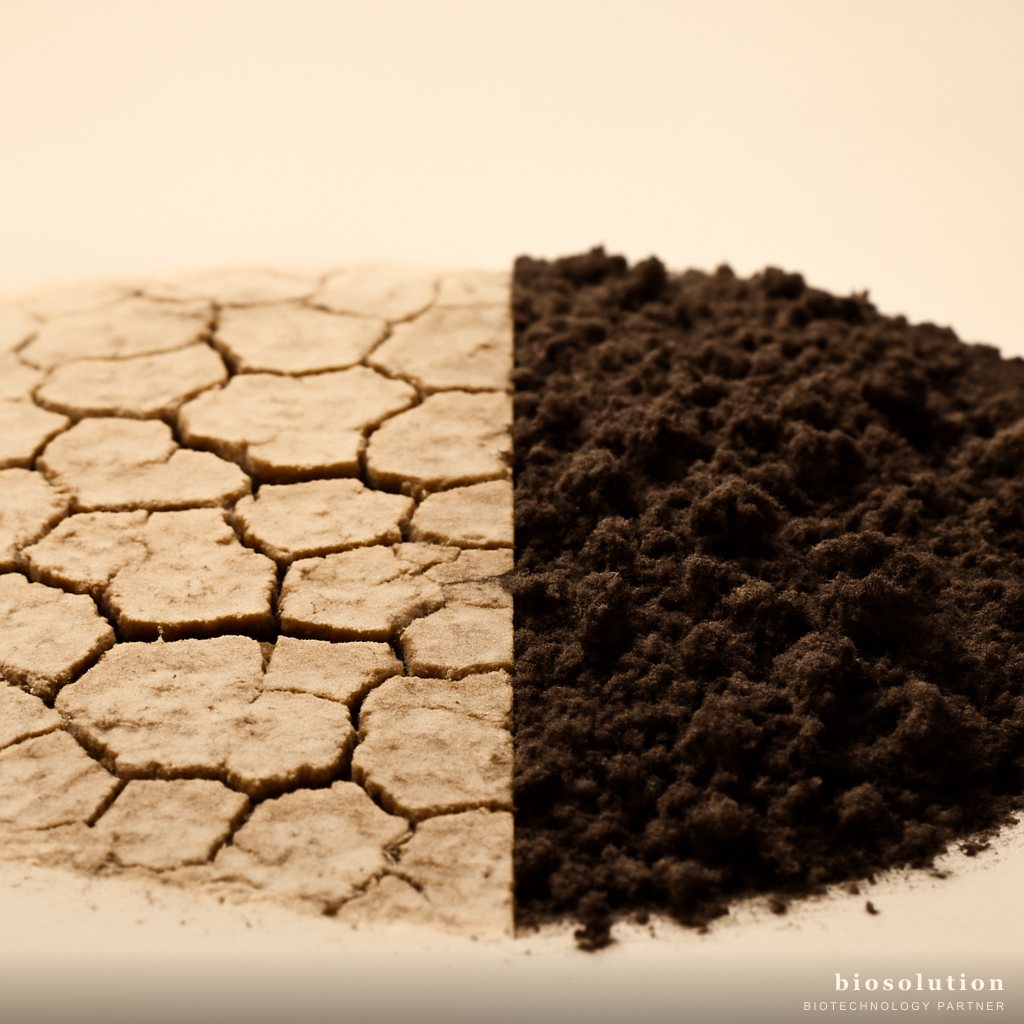
Have you ever found farmland that hardens and cracks during the dry season, or struggles to absorb water even after rain? This condition is often referred to as hard and dry soil, which can be caused by salt accumulation from excessive chemical fertilization. For farmers looking to transition to organic farming, fixing hard and dry soil is a crucial first step. This article will explore how to fix hard and dry soil after chemical fertilizer overdose using a regenerative agriculture approach, leveraging soil microbes as natural repair agents.
Why Does Soil Become Hard and Dry After Chemical Fertilizer Overdose?
Synthetic chemical fertilizers provide instant nutrients to plants, but excessive use without organic matter can damage soil structure. The damage mechanisms include:
Salt Accumulation
Chemical fertilizers such as urea, SP-36, and KCl leave salt residues (cations and anions) in the soil. When salt concentration is high, the soil becomes saline, soil particles repel each other, and soil aggregates collapse. As a result, the soil becomes compact and hard.
Decline in Organic Matter
Chemical fertilizers accelerate the decomposition of soil organic matter because soil microbes become hyperactive. Once organic matter is depleted, the soil loses natural binders like humic acid and glomalin that maintain porosity.
Disruption of Soil Microbiome
Chemical fertilizer overdose kills beneficial microbes such as Azotobacter sp. and Bacillus megaterium. Without these microbes, nutrient cycles are disrupted, and the soil loses its ability to form stable aggregates.
Impact of Hard and Dry Soil on Agricultural Productivity
Hard and dry soil has several negative impacts:
- Low water infiltration: Rain or irrigation water pools on the surface, causing erosion and water waste.
- Root penetration difficulty: Plants suffer from oxygen and nutrient deficiency, stunting growth.
- Nutrient loss: Nutrients leach away or become unavailable due to extreme pH.
- Reduced crop yields: Productivity can drop by 30-50% on marginal land.
Principles of Regenerative Agriculture for Soil Repair
Regenerative agriculture focuses on restoring soil health through the following principles:
- Minimize mechanical disturbance: Use minimal tillage to preserve structure.
- Cover the soil surface: Use organic mulch to reduce evaporation.
- Diversify crops: Rotate crops and use cover crops.
- Integrate livestock: If possible, manure enriches organic matter.
- Utilize soil microbes: Inoculate superior microbes to accelerate repair.
The Role of Microbes in Improving Soil Structure
Soil microbes play a vital role in fixing hard and dry soil. Here are their mechanisms:
Production of Exopolysaccharides (EPS)
Bacteria like Azotobacter sp. produce EPS that act like glue, binding soil particles into macro-aggregates. These aggregates create pores for aeration and water infiltration.
Phosphate and Potassium Solubilization
Bacillus megaterium solubilizes bound phosphate and potassium, making nutrients available to plants. Healthy roots indirectly improve soil structure.
Nitrogen Fixation
Azotobacter sp. and Azospirillum sp. fix nitrogen from the air, reducing the need for chemical fertilizers and lowering salinity.
Soil Structure Improvement Formula: Microbial Solution for Hard and Dry Soil
One of the flagship products for fixing hard and dry soil is Soil Structure Improvement Formula from Biosolution. This product contains three superior microbial strains:
- Azotobacter sp.: Nitrogen fixer and EPS producer that improves soil aggregation.
- Azospirillum sp.: Nitrogen fixer and root growth stimulant.
- Bacillus megaterium: Phosphate and potassium solubilizer, increasing nutrient availability.
Application Method
- Method: Drench or spray onto soil during tillage.
- Dosage: 10 ml per liter of water.
- Frequency: Every 30 days, 3 times per season.
- Timing: Early rainy season or after tillage.
Benefits
- Improves soil structure and porosity.
- Increases water holding capacity.
- Enhances CEC and nutrient availability.
- Boosts productivity of marginal land.
Practical Steps to Fix Hard and Dry Soil
Here is a step-by-step guide:
- Stop excessive chemical fertilizer application: Reduce dosage or switch to organic fertilizers.
- Add organic matter: Compost, manure, or biochar. Dosage 5-10 tons/ha.
- Apply microbes: Use Soil Structure Improvement Formula as directed.
- Use mulch: Straw or silver-black plastic to reduce evaporation.
- Plant cover crops: Examples: Mucuna, Crotalaria, or legumes.
- Practice crop rotation: Avoid continuous monoculture.
- Smart irrigation: Use drip or furrow irrigation to avoid waterlogging.
Case Study: Restoring Marginal Land with Microbes
In several regions of Indonesia, farmers have successfully restored hard and dry soil using a combination of organic matter and microbes. For example, in dry land in Lombok, application of Azotobacter and Bacillus increased soil porosity by 20% and corn yield by 35% in one season.
Conclusion
Fixing hard and dry soil after chemical fertilizer overdose requires a holistic approach: stopping the cause, adding organic matter, and inoculating beneficial microbes. Soil Structure Improvement Formula from Biosolution offers an effective microbiology-based solution to restore soil structure, increase water holding capacity, and return land productivity. Feel free to consult our team via WhatsApp for specific recommendations based on your land conditions.
FAQ
What is the main cause of hard and dry soil?
Hard and dry soil is generally caused by salt accumulation from excessive chemical fertilizers, decline in organic matter, and loss of soil microbes that maintain aggregation. Intensive farming practices without rotation and cover crops worsen this condition.
How long does it take to fix hard soil?
Gradual improvement can be seen within 1-2 growing seasons if done consistently. Regular application of microbes and organic matter will speed up the process, but full recovery may take 1-3 years depending on the severity of damage.
Are the microbes in Soil Structure Improvement Formula safe for plants?
Yes, the strains Azotobacter sp., Azospirillum sp., and Bacillus megaterium are safe and scientifically tested. They are natural soil microbes that actually support plant growth and are not pathogenic.
Can this product be combined with chemical fertilizers?
It is best to reduce chemical fertilizer dosage when using microbes. Combination with organic fertilizers is more recommended. If necessary, allow a 7-10 day gap between microbial and chemical fertilizer applications to avoid toxic effects.
Is this product available throughout Indonesia?
Biosolution products are distributed in various regions of Indonesia. Contact our team via WhatsApp or visit the official website for availability information in your area.