Stable Biofloc Maintenance: 8 Steps for Biofloc Maintenance to Prevent System Crashes
The biofloc system offers high efficiency in fish or shrimp farming, but requires stable biofloc maintenance consistently. Without proper maintenance, flocs can clump excessively, ammonia can spike, or oxygen can drop drastically—leading to system crashes. This article will guide you through critical parameters that must be monitored daily, and how probiotics like Bacillus subtilis, Nitrosomonas sp., and Nitrobacter sp. can maintain microbial balance. By following these 8 steps, you can sustain high stocking densities without risk of failure.
Why Stable Biofloc Maintenance Is Crucial
The biofloc system relies on a community of heterotrophic and autotrophic microbes that process nitrogen waste. If balance is disrupted, flocs can collapse within hours. Stable biofloc maintenance is not just a routine; it is the foundation of productivity. Without daily monitoring, fluctuations in ammonia, pH, dissolved oxygen (DO), and salinity can stress cultured organisms and reduce feed conversion ratio (FCR). Data shows that well-maintained biofloc systems can achieve an FCR of 1.2–1.5, far better than conventional systems. Therefore, understanding water parameters is essential.
Key Parameters to Monitor Daily
Ammonia (NH3/NH4+)
Ammonia is the primary toxin for fish and shrimp. In biofloc, heterotrophic bacteria like Bacillus subtilis assimilate ammonia directly, while nitrifying bacteria (Nitrosomonas and Nitrobacter) oxidize it into nitrate. Ideal total ammonia nitrogen (TAN) is below 1 mg/L, with NH3 (toxic form) below 0.05 mg/L. Daily monitoring using test kits or spectrophotometers is highly recommended. If ammonia rises, immediately add organic carbon (e.g., molasses) and probiotics to accelerate assimilation.
pH
pH affects ammonia toxicity and bacterial activity. The optimal range for biofloc is 7.0–8.5. pH below 6.5 inhibits nitrification, while above 9 increases toxic NH3. Normal daily pH fluctuation is about 0.3–0.5 units. If pH drops drastically, application of dolomite lime or baking soda can help. Probiotics like Bacillus subtilis also help stabilize pH by producing enzymes that break down organic matter without generating excess acid.
Dissolved Oxygen (DO)
Biofloc requires a minimum DO of 4 mg/L, ideally 5–6 mg/L. Aerobic bacteria are highly dependent on oxygen; if DO drops below 3 mg/L, nitrification stops and ammonia accumulates. Ensure adequate aeration, especially at night when phytoplankton do not photosynthesize. Real-time DO monitoring with sensors is better, but test kits are also adequate for periodic checks.
Salinity
Salinity affects osmoregulation of organisms and microbial composition. For vaname shrimp, optimal salinity is 15–25 ppt, while tilapia can tolerate 0–10 ppt. Sudden salinity changes can trigger mass molting or stress. Daily monitoring with a refractometer is important, especially during rainy seasons or freshwater additions.
Role of Probiotics in Biofloc Maintenance
Probiotics are key to stable biofloc maintenance. Products like Biofloc System Maintenance Formula from Biosolution contain three superior bacterial strains:
- Bacillus subtilis: A heterotrophic bacterium that produces protease, amylase, and lipase enzymes to degrade feed residue and feces. This keeps flocs active and prevents excessive clumping.
- Nitrosomonas sp.: A nitrifying bacterium that oxidizes ammonia into nitrite. Its presence ensures rapid ammonia conversion, preventing toxicity.
- Nitrobacter sp.: Oxidizes nitrite into relatively non-toxic nitrate. The synergy of these two nitrifying bacteria keeps the nitrogen cycle running.
Application dosage of 2 L per 1000 m³ every 7 days in the morning is sufficient to maintain bacterial populations. By regularly adding probiotics, you not only prevent crashes but also enhance floc stability, allowing high stocking densities to be maintained.
8 Practical Steps for Stable Biofloc Maintenance
1. Monitor Water Parameters Every Morning and Evening
Record ammonia, pH, DO, temperature, and salinity. Use a logbook or app. If any parameter is outside the optimal range, take corrective action immediately.
2. Maintain Proper C/N Ratio
Ideal carbon-to-nitrogen (C/N) ratio is 10–15:1. If ammonia is high, add molasses or tapioca flour as a carbon source for heterotrophic bacteria. Probiotic products also contain complementary carbon.
3. Apply Probiotics Regularly
Use Biofloc System Maintenance Formula every 7 days. Sprinkle directly into the pond after aeration is turned on. Do not mix with disinfectants or antibiotics.
4. Ensure Optimal Aeration
Keep diffusers or paddlewheels running 24 hours. If DO < 4 mg/L, add aeration units or temporarily reduce stocking density.
5. Manage Feeding Wisely
Feed according to appetite; do not overfeed. Feed residue is the main source of ammonia. Use high-quality protein feed to reduce nitrogen waste.
6. Perform Regular Sludge Siphoning
Accumulated organic sludge can become a source of ammonia and pathogens. Siphon every 2–4 weeks, depending on accumulation rate.
7. Monitor Floc Quality
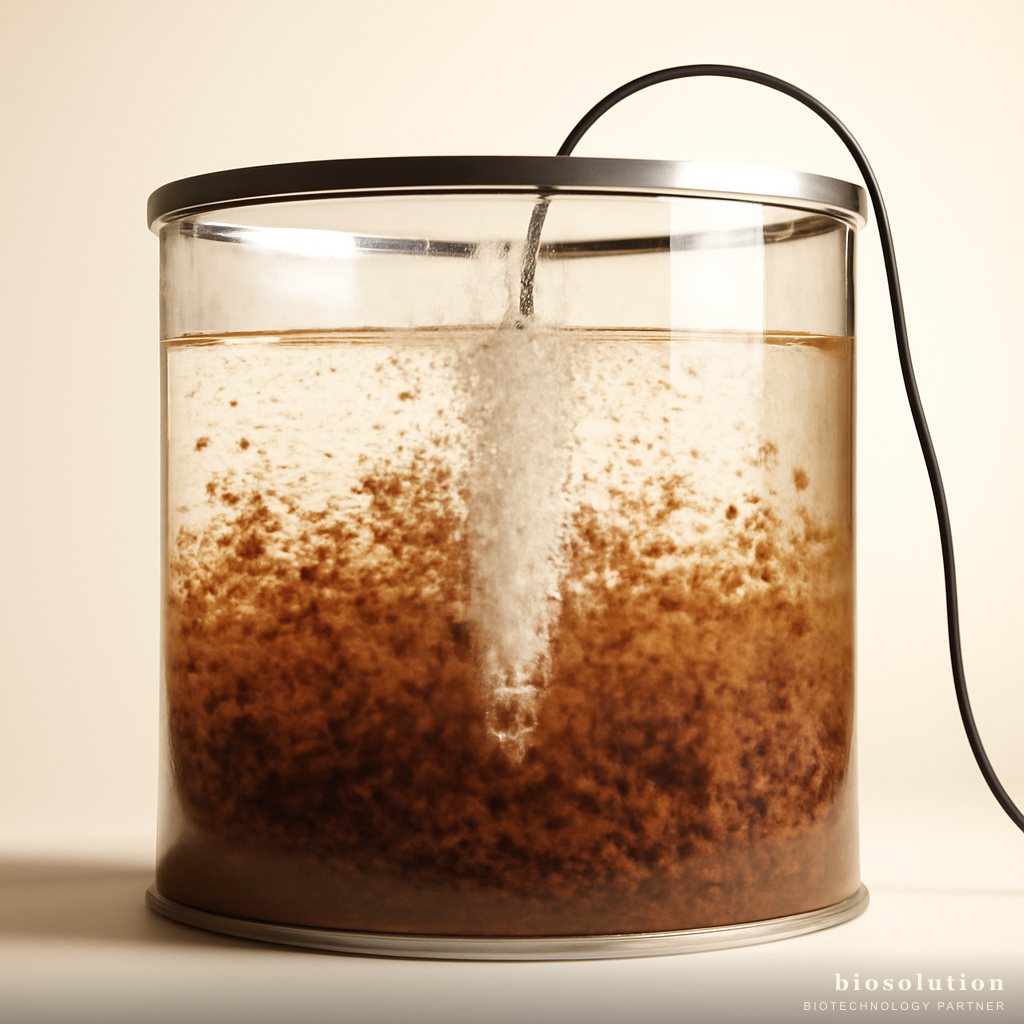
Healthy flocs are brownish-green, 0.5–2 mm in size, and settle easily. If flocs are too fine or clump excessively, check C/N ratio and bacterial activity.
8. Prepare Emergency Measures
If ammonia spikes or pH becomes extreme, have clean freshwater and additional probiotics ready. Gradual salinity reduction can also help.
Case Study: Successful Stable Biofloc Maintenance
A vaname shrimp farmer in Lampung implemented daily monitoring and weekly probiotic application. As a result, the biofloc system lasted until harvest without crashes, with an FCR of 1.3 and survival rate of 85%. A stocking density of 300 shrimp/m³ was maintained thanks to stable ammonia and DO levels. This proves that stable biofloc maintenance is not just theory, but a measurable practice.
Conclusion
Stable biofloc maintenance is an ongoing process that requires attention to water parameters and the role of probiotics. By monitoring ammonia, pH, DO, and salinity daily, and applying Bacillus subtilis, Nitrosomonas, and Nitrobacter regularly, you can prevent system crashes and maintain high productivity. Start with simple steps: record parameters, adjust C/N, and use quality probiotics. For further consultation, contact the Biosolution technical team via WhatsApp.
FAQ
1. What causes a biofloc system to crash?
Crashes are usually triggered by a drastic drop in DO, ammonia spike due to overfeeding, or extreme pH changes. Lack of daily monitoring and unbalanced bacterial populations are also major causes.
2. How often should probiotics be applied for stable biofloc maintenance?
It is recommended every 7 days at a dose of 2 L per 1000 m³. This frequency maintains optimal bacterial populations without overloading. If parameters are disturbed, application can be increased to every 5 days.
3. Can probiotics be replaced with natural ingredients like molasses?
Molasses is only a carbon source, not a probiotic. To maintain nitrifying and heterotrophic bacteria, you still need bacterial inoculants like Bacillus subtilis, Nitrosomonas, and Nitrobacter. A combination of molasses and probiotics is actually more effective.
4. How to measure ammonia accurately?
Use commercial test kits or a spectrophotometer. For high accuracy, measure at recorded temperature and pH, as ammonia toxicity depends on both factors. Calibrate equipment regularly.
5. Should salinity be the same every day?
Ideally, daily salinity fluctuation should not exceed 2 ppt. Sudden changes can cause osmotic stress. Monitor salinity every morning and evening, especially during rainy seasons or water changes.