Stable Biofloc Maintenance with Aquaculture Probiotics
The biofloc system has become a favorite in aquaculture due to its feed efficiency and waste management. However, the biggest challenge for farmers is maintaining stable biofloc maintenance to prevent crashes. A biofloc crash is characterized by decreased dissolved oxygen, ammonia accumulation, and mass mortality. The solution? The right aquaculture probiotics. Strains such as Bacillus subtilis, Nitrosomonas sp., and Nitrobacter sp. work synergistically to maintain floc, support nitrification, and prevent fluctuations in water parameters. This article thoroughly discusses strategies for maintaining stable and productive biofloc.
Why Is the Biofloc System Prone to Crashing?
The biofloc system relies on a community of heterotrophic and autotrophic microbes that form flocs. These flocs process feed residues and feces into microbial protein that can be consumed by fish/shrimp. However, this balance is fragile. Some causes of crashes include:
- Overfeeding: Excess feed increases organic load, triggering excessive growth of heterotrophic bacteria, depleting oxygen, and raising ammonia.
- Nitrification failure: Nitrifying bacteria like Nitrosomonas and Nitrobacter are sensitive to changes in pH, temperature, and oxygen. If their population declines, ammonia and nitrite spike.
- Floc settling: Uneven aeration causes floc to settle, creating dead zones that produce toxic gases.
- Protozoan predation: Protozoa can overconsume floc if the bacterial population is unbalanced.
Impact of a crash: stressed fish, reduced appetite, stunted growth, and even mass mortality. Therefore, stable biofloc maintenance is key to successful aquaculture.
The Role of Aquaculture Probiotics in Stable Biofloc Maintenance
Aquaculture probiotics are not just supplements but tools for managing the biofloc system. By regularly inoculating superior bacteria, we steer microbial succession in the desired direction. Here are the specific roles of each strain in the Biofloc System Maintenance Formula:
Bacillus subtilis: Floc Maintainer and Organic Matter Decomposer
Bacillus subtilis is a Gram-positive bacterium that produces extracellular enzymes such as protease, amylase, and lipase. These enzymes break down feed residues and feces into simple molecules easily assimilated by other bacteria. Thus, B. subtilis prevents the accumulation of organic sludge that can trigger pathogenic bacterial growth. Additionally, B. subtilis produces biosurfactants that help keep floc suspended and prevent clumping.
Nitrosomonas sp.: Ammonia Oxidizer
Nitrosomonas is a chemoautotrophic bacterium that oxidizes ammonia (NH₃) into nitrite (NO₂⁻). Ammonia is highly toxic to fish and shrimp, even at low concentrations. By regularly adding Nitrosomonas, the first stage of nitrification runs optimally, keeping ammonia levels below toxic thresholds.
Nitrobacter sp.: Nitrite-to-Nitrate Converter
Nitrobacter continues nitrification by oxidizing nitrite into nitrate (NO₃⁻). Nitrate is far less toxic and can be utilized by plants or phytoplankton if present. Thus, the combination of Nitrosomonas and Nitrobacter completes the nitrogen cycle, maintaining excellent water quality.
These three strains work synergistically: B. subtilis provides substrate for nitrification, while nitrifiers keep ammonia and nitrite low. The result is stable floc, maintained water quality, and the ability to sustain high stocking densities.
Probiotic Application Strategy for Stable Biofloc Maintenance
For probiotics to be effective, application must be at the correct dosage and regular. Based on product data from Biofloc System Maintenance Formula, here is the application guide:
Dosage and Application Timing
- Dosage: 2 liters per 1000 m³ of pond water.
- Frequency: Every 7 days.
- Time: Morning (around 7-9 AM), when water temperature begins to rise and dissolved oxygen is still high.
Application Method
- Ensure optimal aeration during and after application to distribute probiotics evenly.
- Dilute probiotics with pond water (1:10) before spreading for more homogeneous distribution.
- Spread evenly over the pond surface, especially in areas with good circulation.
- Avoid simultaneous application with disinfectants or antibiotics, as they can kill probiotic bacteria.
Success Indicators
After regular application, monitor the following parameters:
- Ammonia (NH₃): < 0.1 mg/L (ideally 0).
- Nitrite (NO₂⁻): < 0.5 mg/L.
- Nitrate (NO₃⁻): < 50 mg/L.
- pH: 7.0–8.5.
- Floc volume: 15–30 mL/L (Imhoff cone).
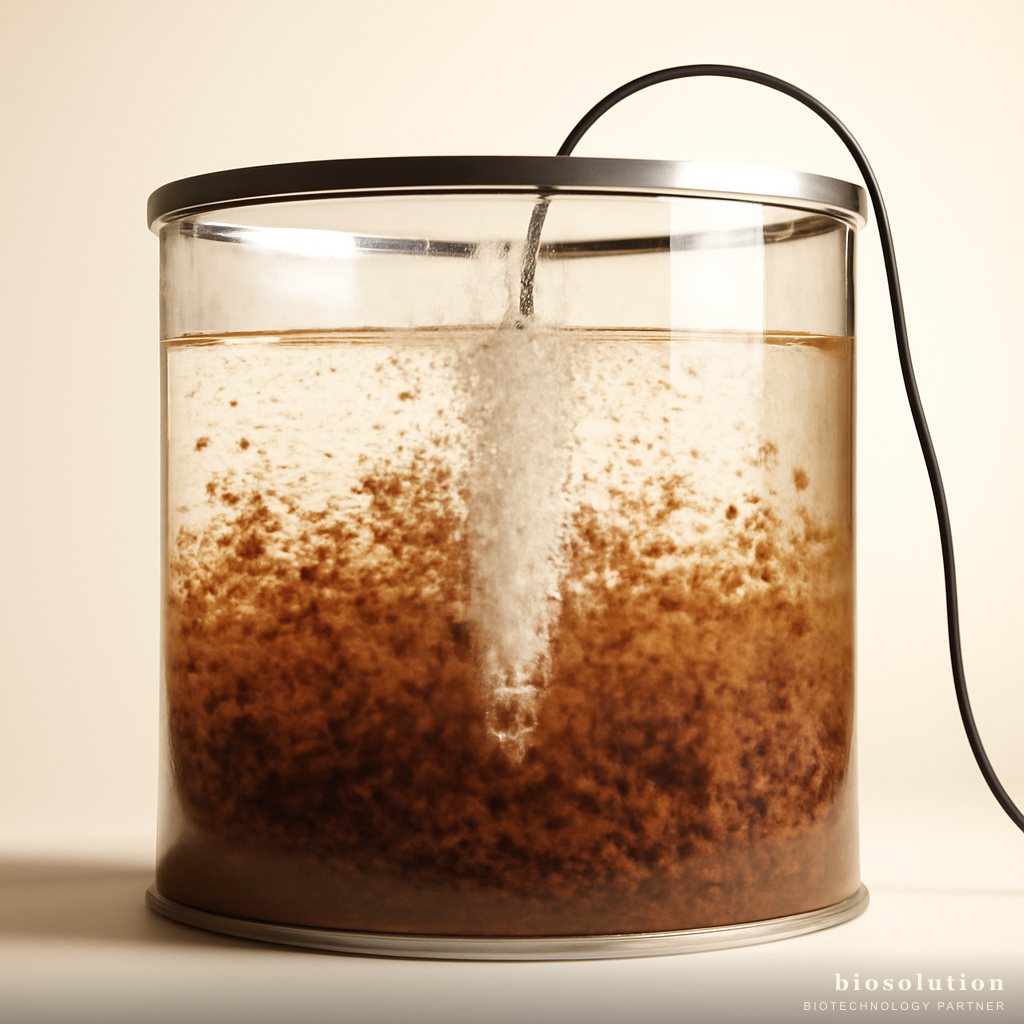
- Floc color: Brownish-green (not black or white).
If floc is black, it indicates anaerobic conditions; if white, it may be dominated by photosynthetic bacteria or protozoa. Both require correction through aeration adjustment and probiotic addition.
Other Supporting Factors to Prevent Biofloc System Crashes
Besides probiotics, several management factors also determine biofloc stability:
Feed Management
Feed according to requirements (feeding rate) and avoid overfeeding. Use feed with moderate protein content (28–32%) to reduce nitrogen load. Multiple feedings help maintain a constant organic load.
Adequate Aeration
The biofloc system requires high oxygen for bacterial respiration and nitrification. Ensure aerators can supply at least 6 mg/L of oxygen. Diffusers or paddlewheels should be arranged to avoid dead zones. Total aeration is recommended at 1 HP per 500–1000 m³ depending on stocking density.
Stocking Density Regulation
High stocking density is advantageous but increases waste load. Use a density appropriate for system capacity. For vaname shrimp, for example, a density of 100–200 shrimp/m³ requires more intensive biofloc management. With regular probiotics, densities of 300 shrimp/m³ can be achieved.
Regular Monitoring
Check water parameters daily: temperature, pH, DO, ammonia, nitrite, nitrate, and floc volume. Record trends. If ammonia spikes, immediately increase aeration and apply extra probiotics. Monitoring enables early detection and correction before a crash occurs.
FAQ on Stable Biofloc Maintenance
Can probiotics replace water changes?
Probiotics do not completely replace water changes but significantly reduce their frequency. In a stable biofloc system, water changes can be reduced to 5–10% per day or even lower. However, if nitrate accumulates excessively (>100 mg/L), dilution is still necessary.
How long does the effect of probiotics last after application?
The probiotic bacterial population declines over time due to competition with native microbes and predation by protozoa. Therefore, regular application every 7 days is needed to maintain sufficient bacterial numbers. A dosage of 2 L/1000 m³ has been proven effective for maintenance.
Can probiotics be used together with lime or dolomite?
Yes, but allow at least a 2-hour interval. Lime or dolomite can increase pH and alkalinity, which actually supports nitrifying bacteria growth. However, simultaneous application can cause excessive flocculation. It is better to apply probiotics first, then add lime a few hours later if needed.
What are the early signs of an impending biofloc crash?
Early signs include: a drastic drop in floc volume (<10 mL/L), floc clumping and settling, water color turning dark brown or black, foul odor (H₂S), and fish/shrimp gasping at the surface. Immediately measure ammonia and nitrite; if high, apply a double dose of probiotics and increase aeration.
Are probiotics safe for fish/shrimp fry?
Very safe. The strains Bacillus subtilis, Nitrosomonas sp., and Nitrobacter sp. are non-pathogenic and widely used in aquaculture. In fact, probiotics can be administered from the start of fry stocking to establish a healthy microbial community and prevent pathogens.
Conclusion
Stable biofloc maintenance is not just a routine but a long-term investment in aquaculture productivity. With the right aquaculture probiotics—containing Bacillus subtilis, Nitrosomonas sp., and Nitrobacter sp.—farmers can prevent crashes, maintain water quality, and sustain high stocking densities. Regular application of 2 L per 1000 m³ every 7 days has proven effective in maintaining floc and the nitrogen cycle. Supported by good feed management, aeration, and monitoring, your biofloc system will be stable and profitable. Want further consultation? Contact our technical team via WhatsApp for product recommendations and dosages tailored to your pond conditions.