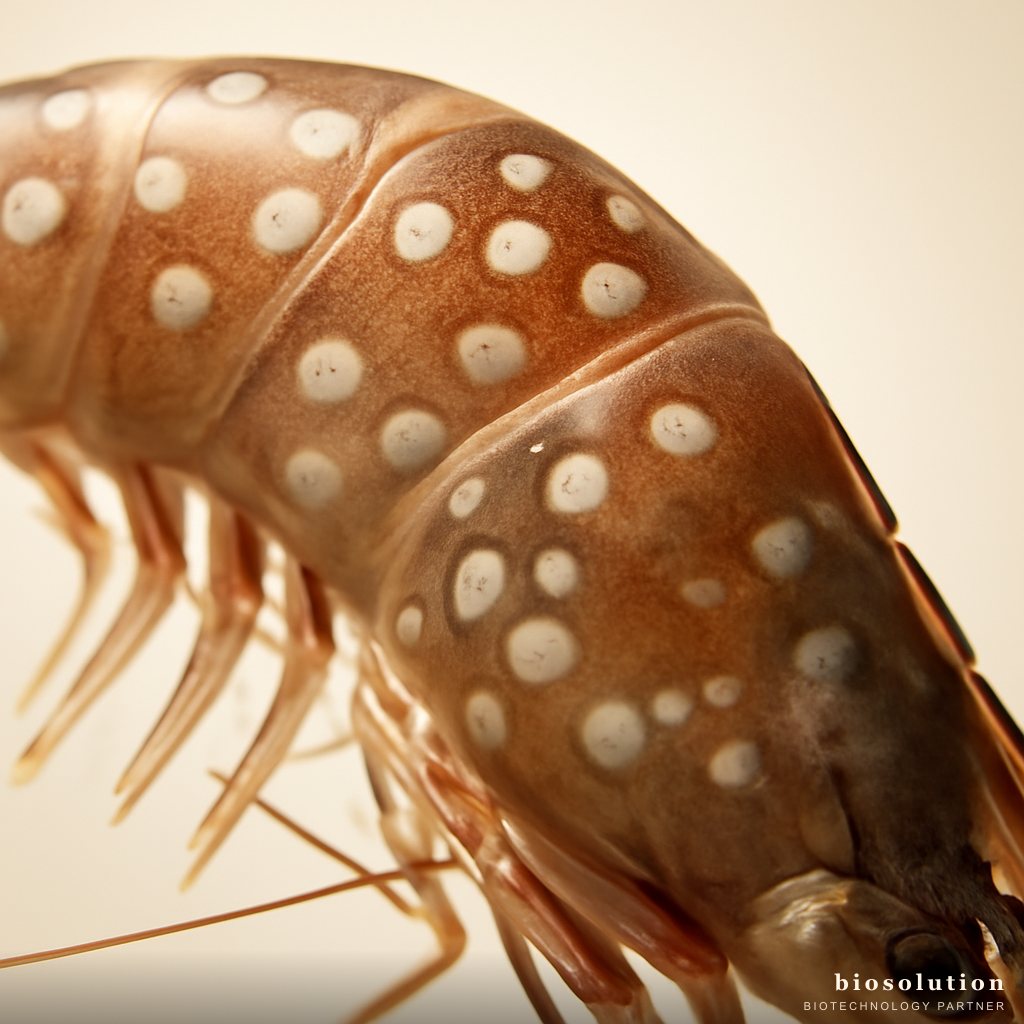
WSSV White Spot Disease in Shrimp: Risk Management with Daily Water Monitoring
WSSV (White Spot Syndrome Virus) is one of the most deadly diseases in vaname shrimp farming, causing massive economic losses worldwide. The virus attacks the nervous system and ectodermal tissues, triggering mass mortality within days. However, the risk of WSSV outbreaks can be significantly reduced through strict water quality management. This article thoroughly explores the role of daily water parameter monitoring—ammonia, pH, dissolved oxygen, and salinity—in preventing and controlling WSSV, and how anti-Vibrio probiotics can serve as an effective emergency solution.
Why Water Monitoring is Key to Preventing WSSV?
WSSV infects shrimp through direct contact with virus particles in the water or via cannibalism. Once inside, the virus replicates rapidly, causing white spots on the carapace, lethargy, reduced appetite, and eventually death. Outbreak risk increases dramatically when water quality deteriorates, as oxidative stress weakens shrimp immunity. Daily monitoring of water parameters enables early detection of unfavorable conditions, allowing corrective actions before the virus becomes explosive.
Ammonia (NH3) and Its Relationship with WSSV
Ammonia is a byproduct of shrimp metabolism and decomposition of leftover feed. At high pH and temperature, ammonia converts to its toxic form (NH3). Ammonia levels >0.1 mg/L can already cause stress in shrimp, suppress immune response, and increase susceptibility to WSSV. Research shows that sublethal ammonia exposure increases WSSV viral load in vaname shrimp. Therefore, daily ammonia monitoring—ideally using test kits or sensors—is crucial. If ammonia is high, immediately perform partial water changes, reduce feeding, and apply organic matter-degrading probiotics.
Water pH: Stability vs. Extreme Fluctuations
Vaname shrimp thrive at pH 7.5–8.5. pH fluctuations >0.5 per day cause osmotic stress and physiological disturbances. Low pH (<7) increases heavy metal solubility and triggers fungal growth, while high pH (>9) increases ammonia toxicity. Both worsen WSSV infection. Monitoring pH twice daily (morning and afternoon) helps detect spikes due to phytoplankton photosynthesis or excessive respiration. Dolomite lime or baking soda can be used to stabilize pH.
Dissolved Oxygen (DO) and Hypoxia Risk
Dissolved oxygen of at least 4 mg/L is required for optimal shrimp metabolism. Low DO (<3 mg/L) triggers hypoxia, reduces appetite, and increases disease susceptibility. Under hypoxic conditions, shrimp immune gene expression is suppressed, while WSSV replication increases. Continuous DO monitoring with a DO meter is highly recommended. Water wheels or additional aerators should be operated especially at night when natural DO drops.
Salinity: Safe Range and Adaptation
Vaname shrimp tolerate salinity of 5–35 ppt, but sudden fluctuations >5 ppt per day cause stress. Low salinity (<10 ppt) is associated with increased WSSV prevalence in some studies. Daily salinity monitoring with a refractometer ensures stability. During the rainy season, incoming freshwater must be anticipated by adding salt or managing drainage.
Role of Anti-Vibrio Probiotics in Reducing WSSV Risk
WSSV often co-infects with Vibrio spp. bacteria, especially Vibrio harveyi and V. parahaemolyticus, which accelerate shrimp mortality. Anti-Vibrio probiotics such as Formula Anti-Vibrio for Vaname Shrimp Ponds (Emergency) contain Bacillus subtilis (10x) and Bacillus licheniformis that work synergistically to suppress Vibrio populations through antibiosis and competition.
Mechanism of Bacillus in Suppressing Vibrio
Bacillus subtilis produces antimicrobial compounds such as subtilosin and surfactin that destroy Vibrio cell walls. Meanwhile, Bacillus licheniformis produces protease and chitinase enzymes that degrade Vibrio biofilm and chitin, reducing its ability to attach to shrimp. Both bacteria also consume the same nutrients as Vibrio, depriving Vibrio of food sources.
Emergency Application When WSSV is Indicated
When water monitoring shows critical parameters (high ammonia, low DO) and shrimp begin to show WSSV symptoms, a shock dose of anti-Vibrio probiotics can be applied. A dose of 10 L per hectare is broadcast directly into the pond in the morning. Bacillus will actively control Vibrio within 24-48 hours, reducing the risk of mass mortality. If no improvement is seen, reapplication can be done after 48 hours. This product is specially designed for emergency conditions with a Bacillus concentration 10 times that of regular maintenance probiotics.
Effective Daily Water Monitoring Steps
To manage WSSV risk, the following monitoring steps are recommended:
- Morning Measurement (06:00-07:00): Record temperature, pH, DO, salinity, and transparency. Morning typically has the lowest pH and DO.
- Afternoon Measurement (14:00-15:00): Repeat measurements to observe fluctuations. pH and DO are usually highest in the afternoon.
- Ammonia and Nitrite: Measure at least once a week, or daily if problems are indicated.
- Alkalinity and Hardness: Measure every 3-4 days to ensure optimal pH buffering.
- Documentation: Record all data in a logbook or digital application for trend analysis.
If deviations are found, take immediate corrective action:
- High ammonia: Reduce feed, increase aeration, apply degrading probiotics.
- Unstable pH: Use dolomite lime if pH is low, or baking soda if pH is high.
- Low DO: Add water wheels, reduce stocking density, or temporarily stop feeding.
- Sharp salinity drop: Add salt or hold freshwater.
Case Study: Success of Monitoring and Probiotics
At a vaname pond in Lampung, daily monitoring showed increased ammonia (0.3 mg/L) and low DO (3.2 mg/L) in the 5th week of cultivation. The farmer immediately reduced feed by 30% and applied Probiotic Formula for Vaname Shrimp Ponds to improve water quality. However, on day 3, some shrimp showed white spots. As an emergency response, the pond owner used Formula Anti-Vibrio for Vaname Shrimp Ponds (Emergency) at a dose of 10 L/ha. Within 48 hours, mortality dropped drastically, and Vibrio populations decreased from 10^4 CFU/mL to <10^2 CFU/mL. The pond was successfully harvested with a survival rate of 78%, higher than neighboring ponds that did not use probiotics.
Conclusion
WSSV white spot disease remains a serious threat, but its risk can be managed through disciplined daily water parameter monitoring and appropriate use of anti-Vibrio probiotics. Ammonia, pH, oxygen, and salinity are key indicators that must be monitored daily to maintain optimal shrimp immunity. When early signs of WSSV appear, high-concentration anti-Vibrio probiotics like Formula Anti-Vibrio for Vaname Shrimp Ponds (Emergency) can be an effective knockdown solution. With a combination of strict monitoring and rapid intervention, farmers can minimize losses due to WSSV.
For further consultation on water management strategies and probiotics, contact the Biosolution technical team via WhatsApp. Get specific recommendations according to your pond conditions.