Anti Aphid Whitefly: 7 Entomopathogen Application Mistakes That Cause Biocontrol Failure
Aphids and whiteflies are major pests on horticultural crops such as chili, tomato, potato, and leafy vegetables. These pests not only directly damage plants by sucking cell sap but also act as vectors for deadly viruses. Biocontrol using entomopathogens such as Verticillium lecani and Cordyceps spp. has been proven effective in controlling pest populations without chemical residues. However, many farmers fail to achieve optimal results due to application errors. This article reviews 7 common mistakes to avoid for successful biocontrol of aphids and whiteflies.
1. Application at the Wrong Time: Avoid Midday Heat
Why Application Time Matters?
Entomopathogens, especially fungi like Verticillium lecani and Cordyceps spp., require high humidity to germinate and infect insects. Fungal spores become active when relative humidity (RH) is above 70%. Application during midday with direct sunlight causes spores to dry out quickly and die before they can infect.
Ideal Time: Afternoon
Application should be done in the afternoon (3:00-5:00 PM) when temperature drops and RH increases. Under these conditions, spores have enough time to germinate on the insect body during the night. If forced to apply in the morning, ensure cloudy weather or high RH.
2. Not Spraying Under Leaves (Under Leaf)
Aphids and Whiteflies Hide Under Leaves
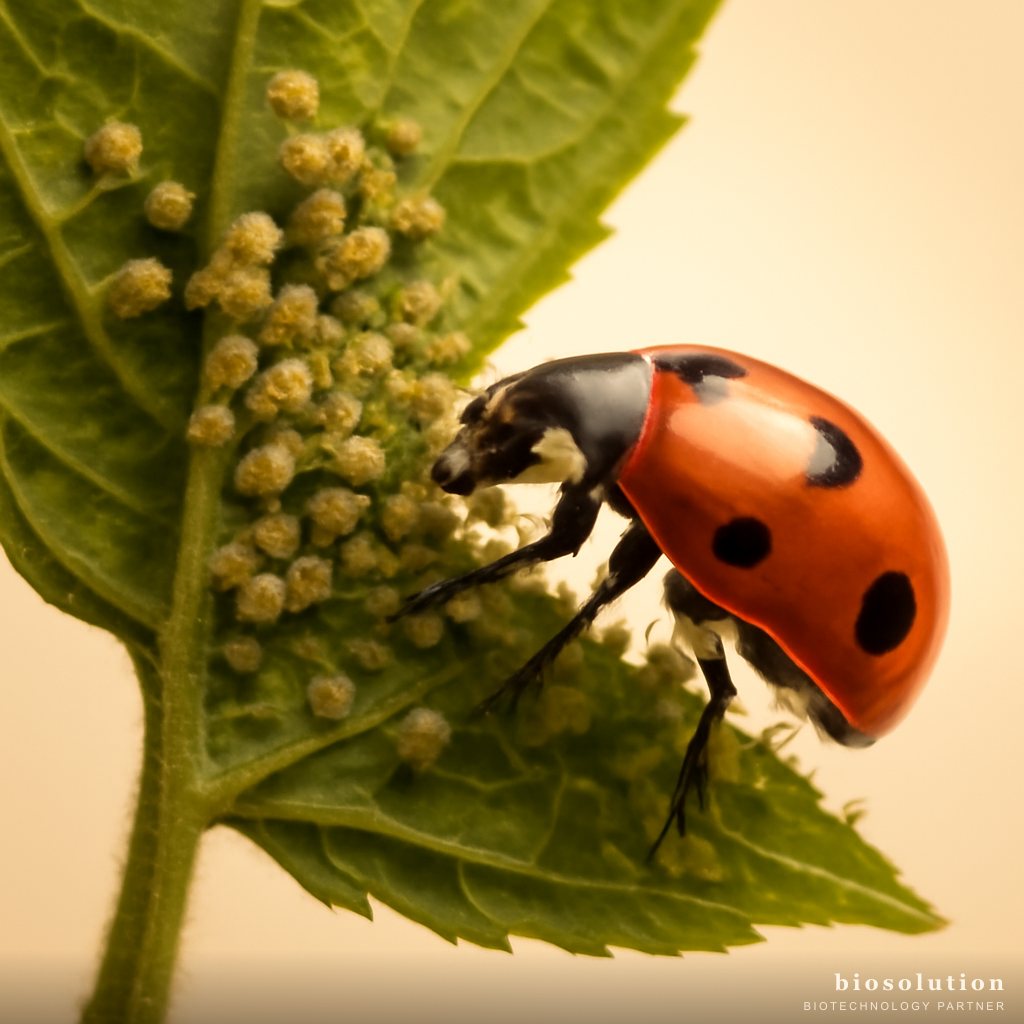
Aphids and whiteflies tend to be on the underside of leaves (abaxial) to avoid sunlight and predators. Spraying only from above the leaves (adaxial) will not hit the pests. Many farmers spray like conventional chemical pesticides, whereas biocontrol requires precise targeting.
Under Leaf Spray Technique
Use a spray nozzle that can be directed to the underside of leaves. Spray the entomopathogen solution evenly on the lower leaf surface, especially on young leaves which are the favorite spots for aphids. Ensure sufficient spray pressure so that droplets reach the inner canopy of the plant.
3. Dosage Too Low or Too High
Correct Dosage of Anti-Aphid & Whitefly Formula
The Anti-Aphid & Whitefly Formula product from Biosolution contains Verticillium lecani and Cordyceps spp. with a recommended dosage of 3 ml per liter of water. Using a lower dosage reduces the number of spores reaching the pests, decreasing effectiveness. Conversely, too high a dosage does not linearly increase efficacy and only wastes product.
Application Frequency
At high populations, application needs to be repeated every 5 days. This is important because of the rapid life cycle of aphids. Whitefly eggs hatch in 5-7 days, so a single application will not control new generations. Consistency of schedule is crucial for success.
4. Not Paying Attention to Water Quality
pH and Chlorine Kill Spores
Water containing high chlorine (tap water) or extreme pH (below 5 or above 8) can kill fungal spores. Use clean water, preferably well water or rainwater, with neutral pH (6-7). If using tap water, let it sit overnight to allow chlorine to evaporate.
Add Sticker (Adjuvant)
Entomopathogens require sufficient contact time with the insect body. Adding a non-ionic sticker (0.1-0.2 ml/liter) can help spores adhere to the pest cuticle, especially on waxy leaves like chili and tomato.
5. Ignoring Plant and Environmental Conditions
Micro-Humidity in Plant Canopy
Entomopathogens require high humidity (RH >70%) for 8-12 hours after application. If plants are too dense so air circulation is poor, humidity is better maintained. However, if too open, spores dry out quickly. Adjust plant spacing and water in the morning to increase environmental humidity.
Optimal Temperature
Verticillium lecani works optimally at 20-28°C. Temperatures above 35°C can inhibit spore germination. Avoid application during heat waves.
6. Not Integrating with Other Controls
Biocontrol as Part of IPM
Relying on a single entomopathogen is not enough. Aphids and whiteflies have natural enemies such as Coccinellidae beetles, syrphid larvae, and parasitoids. Using non-selective chemical pesticides kills these natural enemies. Integrate biocontrol with cultural practices such as sanitation, yellow sticky traps, and silver plastic mulch to reduce initial populations.
Rotation of Biocontrol Agents
To prevent resistance, rotation with other biocontrol agents such as Beauveria bassiana or Metarhizium anisopliae can be done. However, ensure compatibility with the product used.
7. Not Monitoring Population
Economic Threshold and Application Timing
Biocontrol is most effective when applied when pest populations are still low (early infestation). Farmers often wait until pests explode before acting, overwhelming the entomopathogens. Conduct routine monitoring every week by checking young leaves and leaf undersides. The control threshold for whiteflies on chili, for example, is 2-3 nymphs per leaf.
Use Tools
A magnifying glass (loupe) or 10x hand lens helps see small nymphs that are difficult to spot. Record population and fluctuations to determine the right application time.
Conclusion
Biocontrol of aphids and whiteflies with entomopathogens such as Verticillium lecani and Cordyceps spp. is an effective and environmentally friendly solution, but its success depends heavily on correct application techniques. Avoid the seven mistakes above: wrong application time, not under leaf, incorrect dosage, poor water quality, ignoring environment, no IPM integration, and no monitoring. By following this guide, you can maximize the efficacy of Anti-Aphid & Whitefly Formula from Biosolution. For further consultation, contact our expert team via WhatsApp.
FAQ
1. Are entomopathogens safe for plants and humans?
Yes, entomopathogenic fungi such as Verticillium lecani and Cordyceps spp. are specific to insect pests and are not harmful to plants, humans, or pets. These products are registered and safe for organic farming.
2. How long after application do entomopathogens start working?
Spores that attach to the insect body will germinate within 12-24 hours under humid conditions. Infected aphids will die within 3-7 days, depending on temperature and humidity. Maximum effect is seen after 7-10 days.
3. Can entomopathogens be mixed with chemical pesticides?
It is best not to mix directly because chemical pesticides can kill fungal spores. If necessary, apply chemical pesticides at least 3 days before or after biocontrol application. Always test compatibility on a small sample.
4. What should be done if it rains after application?
Heavy rain can wash spores off leaves. If rain falls within 4 hours after application, it is advisable to reapply when the weather is clear. Light rain does not have much effect because spores have already started to adhere.
5. Is this product effective for all types of aphids?
This formula is effective for various species of aphids (Aphididae) and whiteflies (Bemisia tabaci, Trialeurodes vaporariorum). However, for aphids with thick waxy layers, adding a sticker is highly recommended.