Anti Ganoderma Palm BSR: Formula Integration with Natural Enemies for Integrated Pest Management
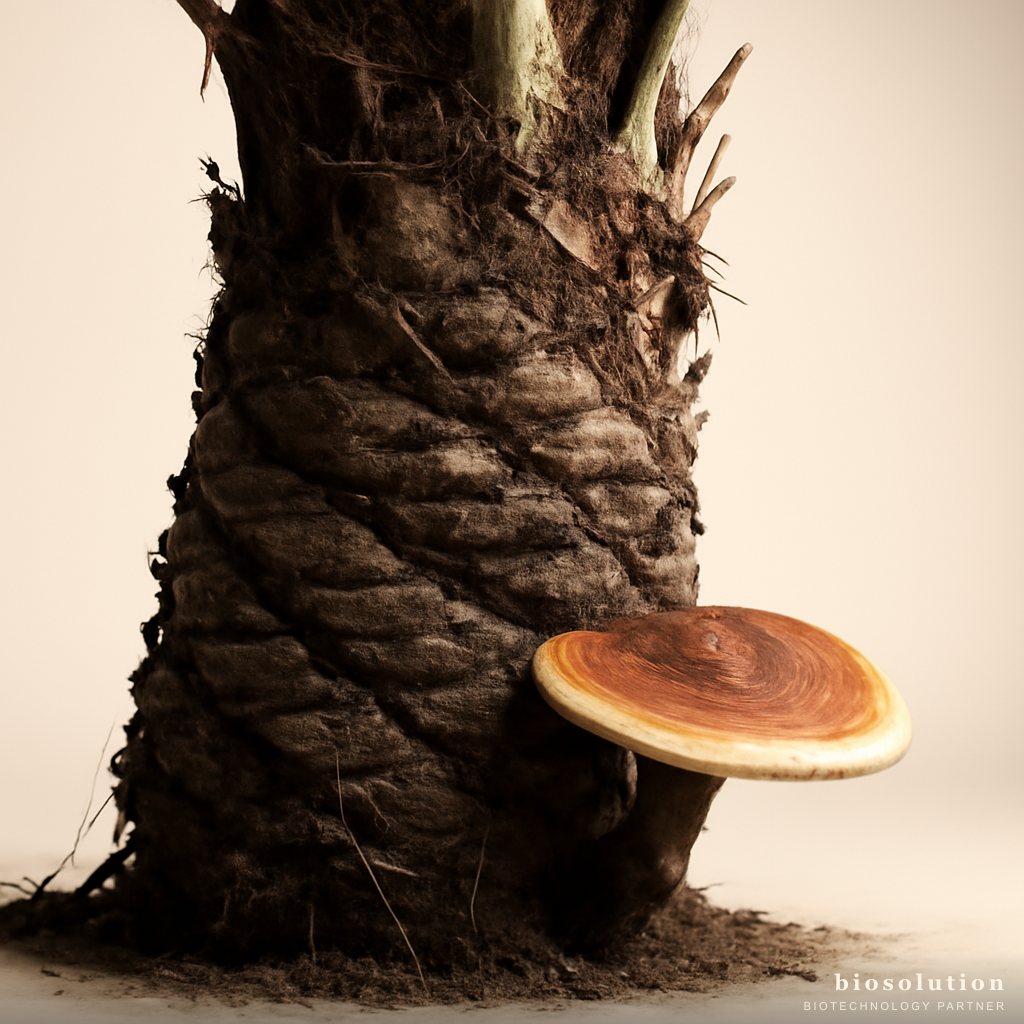
Basal Stem Rot (BSR) caused by the fungus Ganoderma boninense is a serious threat to oil palm productivity in Indonesia. Losses due to BSR include not only reduced production but also tree death, forcing premature replanting. In integrated pest management (IPM), an approach combining biological agents with natural enemies is key to success. This article discusses the integration of Biosolution's Anti-Ganoderma Palm Formula—containing a consortium of Trichoderma harzianum, Gliocladium virens, and Bacillus subtilis—with natural enemies to synergistically suppress BSR progression.
Why is Ganoderma boninense Difficult to Control?
Ganoderma boninense is a soil-borne fungal pathogen that can persist for long periods in soil and root debris. It attacks the vascular tissues of roots and stem bases, disrupting water and nutrient transport, causing wilting, yellowing leaves, and eventually death. Ganoderma's uniqueness lies in its ability to produce resistant survival structures (sclerotia) that withstand extreme environmental conditions. Therefore, chemical control is often ineffective in the long term and disrupts the rhizosphere microflora balance.
Anti-Ganoderma Palm Formula: A Consortium of Three Superior Strains
Biosolution designed the Anti-Ganoderma Palm Formula as a biological solution containing three antagonistic microorganisms with complementary mechanisms:
Trichoderma harzianum: Mycoparasite and Degrader
Trichoderma harzianum acts as a mycoparasite, directly infecting Ganoderma hyphae. The chitinase and glucanase enzymes it produces degrade the pathogen's cell wall. Additionally, Trichoderma competes for space and nutrients in the rhizosphere.
Gliocladium virens: Antibiosis and Competition
Gliocladium virens produces antibiotic compounds such as gliotoxin that inhibit Ganoderma growth. This fungus also aggressively colonizes root surfaces, creating an exclusion zone for the pathogen.
Bacillus subtilis: Induced Systemic Resistance (ISR)
Bacillus subtilis triggers plant defense responses via the ISR pathway. This bacterium also produces antifungal lipopeptides and promotes plant growth through phytohormone production.
These three strains are formulated in practical application doses: 50 ml per tree for drenching and 20 ml per tree for trunk injection, repeated every 3 months. Test results show a 40–60% suppression of BSR progression and an extension of the economic lifespan of oil palm trees by 5–8 years.
Integration with Natural Enemies: Synergy in IPM
Natural enemies such as mycorrhizal fungi, rhizobacteria, and soil microarthropod predators play a vital role in naturally suppressing pathogen populations. Integrating the Anti-Ganoderma Formula with natural enemies creates a more stable and competitive rhizosphere ecosystem. Here are the integration strategies:
1. Co-application with Mycorrhizae
Arbuscular mycorrhizal fungi (AMF) form mutualistic symbiosis with oil palm roots, enhancing nutrient uptake and resistance to biotic stress. Trichoderma and Bacillus in the formula work synergistically with AMF without hindering colonization. In fact, some Trichoderma strains can stimulate mycorrhizal hyphal growth.
2. Conservation of Soil Natural Enemies
Avoid using broad-spectrum chemical fungicides that can kill natural enemies such as earthworms, predatory nematodes, and antagonistic microbes. Applying biological formulas actually enriches soil biodiversity, increasing natural enemy populations.
3. Rotation with Other Rhizobacteria
Besides Bacillus subtilis, rhizobacteria such as Pseudomonas fluorescens and Streptomyces spp. can be rotated to broaden the antagonism spectrum. This prevents pathogen resistance and maintains long-term effectiveness.
4. Organic Matter Management
Adding compost or organic mulch provides substrate for antagonistic microbes and natural enemies. Trichoderma and Gliocladium are highly responsive to organic matter, increasing their populations and optimizing activity.
IPM Mechanism: From Rhizosphere to Canopy
BSR IPM focuses not only on roots but also on canopy health. Application of the Anti-Ganoderma Formula via drenching and trunk injection ensures biological agents reach the target directly. Here's how it works:
- Drenching: Saturates the root zone with a microbial consortium that immediately colonizes the rhizosphere. Trichoderma and Gliocladium form a protective layer on the root surface.
- Trunk injection: Injects Bacillus subtilis directly into vascular tissues, inducing systemic ISR. This method is effective for trees with early infection.
Integration with natural enemies strengthens these effects. For example, predatory nematodes (e.g., Mononchus spp.) prey on nematodes carrying Ganoderma spores, while other antagonistic microbes help suppress the pathogen.
Performance Data of Anti-Ganoderma Palm Formula
Field trials show significant results:
- BSR progression suppression: −40–60% in lightly to moderately infected trees.
- Economic lifespan extension: +5–8 years compared to untreated.
- Specific consortium: 3 complementary strains.
- Plantation grade: Designed for B2B plantation scale needs.
With routine application every 3 months, Ganoderma populations in soil can be suppressed below economic thresholds.
Implementation Challenges and Solutions
Although effective, this integration requires good management:
- Application time: Morning before 10 AM to avoid UV damage to microbes.
- Soil moisture: Ensure moist soil for microbial activity. During dry season, light irrigation before application is recommended.
- Compatibility: Do not mix with chemical fungicides or chlorine-containing fertilizers. Conduct compatibility tests first.
- Monitoring: Periodically evaluate Ganoderma and natural enemy populations using PCR or selective media isolation.
Conclusion
Integrating the Anti-Ganoderma Palm Formula with natural enemies is an effective and sustainable IPM strategy for controlling BSR. The consortium of Trichoderma harzianum, Gliocladium virens, and Bacillus subtilis works synergistically with mycorrhizae, rhizobacteria, and soil predators to suppress disease progression by up to 60% and extend the economic lifespan of oil palm. This approach reduces reliance on chemical fungicides, maintains ecosystem health, and enhances long-term productivity. For further consultation on application in your plantation, contact the Biosolution technical team via WhatsApp.
FAQ
1. What is the Anti-Ganoderma Palm Formula?
The Anti-Ganoderma Palm Formula is a biocontrol product from Biosolution containing three antagonistic microbial strains: Trichoderma harzianum, Gliocladium virens, and Bacillus subtilis. It is specifically formulated to suppress basal stem rot (BSR) caused by Ganoderma boninense in oil palm. Application is done by drenching (50 ml/tree) or trunk injection (20 ml/tree) every 3 months.
2. How does the three-strain consortium work in this formula?
Trichoderma harzianum acts as a mycoparasite, infecting and degrading Ganoderma hyphae. Gliocladium virens produces antibiotics that inhibit pathogen growth and competes for root space. Bacillus subtilis triggers induced systemic resistance (ISR) and produces antifungal compounds. Together, they synergistically suppress BSR progression by up to 60%.
3. Is this product safe for natural enemies and the environment?
Yes, the Anti-Ganoderma Formula is very safe for natural enemies such as mycorrhizal fungi, rhizobacteria, earthworms, and soil microarthropods. Unlike chemical fungicides, it does not kill non-target organisms and actually enriches rhizosphere biodiversity. Its use supports environmentally friendly integrated pest management (IPM) principles.
4. When is the best time to apply this formula?
The best time is in the morning before 10 AM, when temperatures are low and humidity is high. Avoid application during heavy rain or direct sunlight. Soil should be moist to optimize microbial activity. Repeat application every 3 months to maintain high biological agent populations.
5. Can this formula be used together with other fertilizers or pesticides?
It is best not to mix with chemical fungicides, chlorine-containing fertilizers, or broad-spectrum pesticides. If you wish to use other products, conduct a compatibility test first. Organic fertilizers and compost are recommended as they support the growth of antagonistic microbes.