Anti Oryctes Palm Weevil Borer: 7 Fatal Mistakes When Applying Entomopathogen
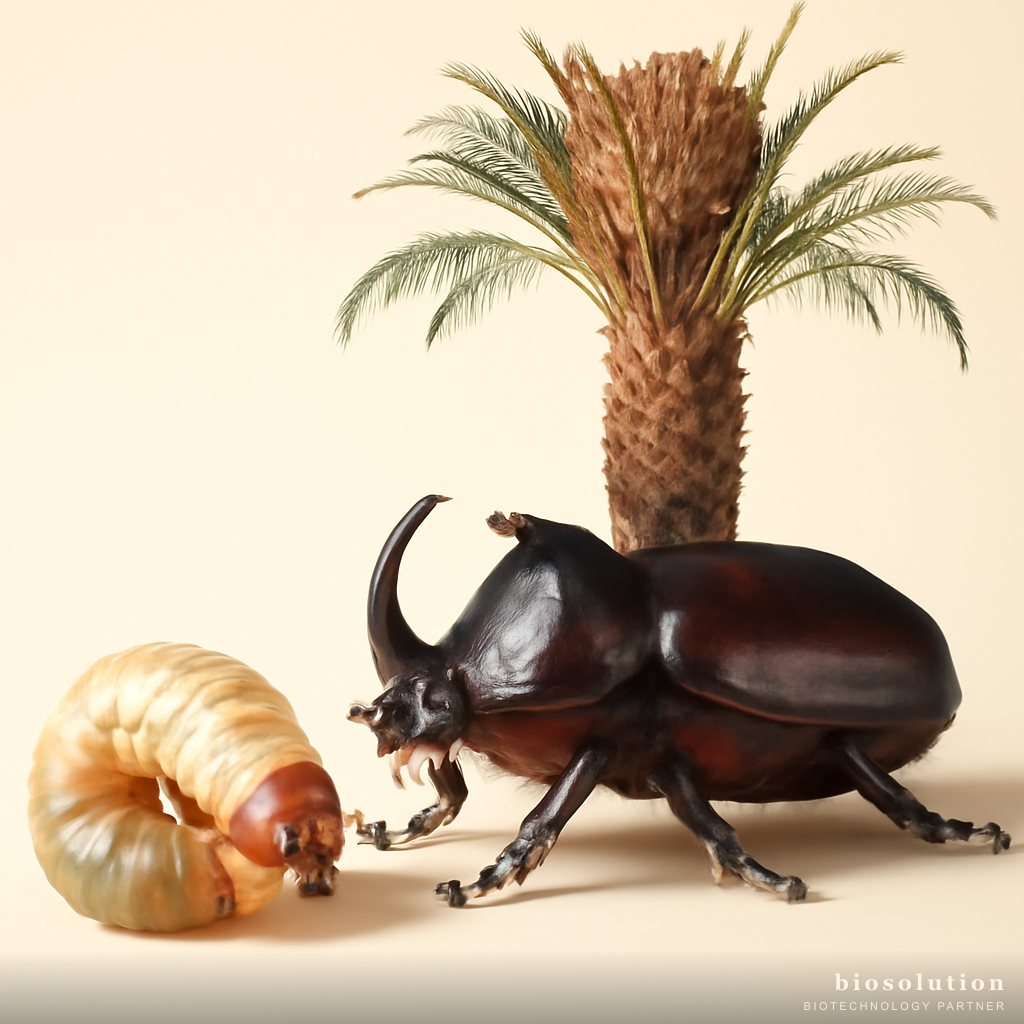
The palm weevil borer (Oryctes rhinoceros) is a major pest that attacks oil palm plants, especially in the nursery and young plant stages. Its attack damages the growing point, inhibits growth, and can even kill the plant. The use of entomopathogens such as Metarhizium anisopliae has been proven effective as a biocontrol for Oryctes rhinoceros, with the ability to suppress populations by 70–80%. However, many growers still fail to optimize this potential due to application errors. This article reviews 7 common mistakes and how to fix them so that the anti-palm weevil borer formula works optimally.
1. Incorrect Application Timing
One of the most common mistakes is applying the entomopathogen during the day when temperatures are high and UV rays are strong. Metarhizium anisopliae is a microorganism sensitive to ultraviolet radiation and drought. If applied under the scorching sun, fungal spores can die before infecting larvae or adult beetles.
Solution: Application should be done in the afternoon (after 3:00 PM) when temperatures begin to drop and humidity increases. This aligns with the recommendation of the Anti-Palm Weevil Borer Formula product, which emphasizes afternoon application to maximize spore viability.
2. Insufficient or Excessive Dosage
Many farmers think that the more dosage, the more effective, or conversely use too low a dosage due to cost reasons. In fact, improper dosage actually reduces efficacy.
Ideal dosage: 200 grams per cubic meter of waste pile (empty fruit bunches, livestock manure, harvest residues). This dosage has been tested to produce sufficient spore concentration to infect larvae and beetles. Reducing the dosage means the target population is not exposed to adequate inoculum, while excessive dosage does not significantly increase mortality and only wastes the product.
3. Wrong Application Method
Metarhizium anisopliae works by contact and ingestion. That is, spores must come into direct contact with the body of larvae or beetles. If only sprinkled on the surface without mixing into the medium, many spores do not reach the target.
Correct method: Sprinkle the formula evenly onto the waste pile, then stir until thoroughly mixed with the medium. Ensure all parts of the pile are exposed to spores. Do not just sprinkle on the surface because Oryctes larvae live inside the medium.
4. Not Paying Attention to Media Conditions
Entomopathogens require sufficient moisture to germinate and infect. Media that is too dry will inhibit fungal growth, while media that is too wet can cause spores to suffocate or grow contaminant fungi.
Optimal conditions: Media moisture around 60-70% (not waterlogged, not dry). If the media is too dry, moisten it first before application. Avoid standing water that can wash away spores.
5. Application Only When Infestation Is Already Severe
Many growers only use biocontrol after beetle populations are high and damage is visible. At this stage, the entomopathogen takes time to infect and kill the pest, so further damage cannot be avoided.
Preventive approach: Application should begin early in the rainy season or when populations start to increase. Conduct routine monitoring with pheromone traps or direct inspection. If 1-2 beetles per trap are found, immediately apply the Anti-Palm Weevil Borer Formula periodically every 30 days.
6. Not Considering Rotation and Integration
Relying on a single control method continuously can lead to resistance or pest adaptation. Although Metarhizium anisopliae rarely causes resistance, its effectiveness can decline if environmental conditions are not supportive.
Integrated strategy: Combine biocontrol with cultural practices such as plantation sanitation (cleaning waste piles, destroying breeding sites), use of pheromone traps, and if necessary, selective insecticides. This integration aligns with sustainable plantation programs recommended on the bio solutions page.
7. Improper Product Storage and Handling
Metarhizium anisopliae is a living organism. If stored in a hot place, exposed to direct sunlight, or for too long, spores will die. Many farmers store the product in open warehouses or in hot vehicles.
Proper storage: Store in a cool, dry place (temperature 4-8°C if possible, or maximum 25°C). Avoid direct sunlight exposure. Use the product within 6 months of production. Always check the expiration date and physical condition (if using, do not use if it smells bad or is clumpy).
Conclusion
Biocontrol of Oryctes rhinoceros using Metarhizium anisopliae is an effective and environmentally friendly solution to overcome the palm weevil borer. However, its success depends heavily on correct application techniques. Avoid the 7 mistakes above: wrong application timing, improper dosage, incorrect method, unsuitable media, late application, lack of integration, and poor storage. By applying the correct methods, you can suppress beetle populations by 70-80% and protect young oil palm plants. For further consultation on using the anti-palm weevil borer formula, contact the Biosolution technical team via WhatsApp.
FAQ
1. Is Metarhizium anisopliae safe for oil palm plants and the environment?
Yes, Metarhizium anisopliae is specific to target insects (Oryctes rhinoceros) and is not pathogenic to plants, humans, or animals. The fungus decomposes naturally in the environment and leaves no harmful residues. Its use aligns with sustainable agriculture principles.
2. How long after application does the entomopathogen start to show results?
Infection begins 3-7 days after contact with spores. Infected larvae will stop eating, turn dark brown, and die within 7-14 days. In adult beetles, the effect may be slower due to larger body size. The population will decrease significantly after 2-3 routine applications.
3. Can Metarhizium anisopliae be combined with chemical pesticides?
It is best to avoid mixing directly with chemical fungicides or insecticides as they can kill spores. If chemical application is necessary, allow a gap of at least 3-5 days. For optimal results, use biocontrol as a gradual replacement for chemical pesticides in an integrated pest management program.
4. Can the anti-palm weevil borer formula be used for other types of beetles?
Metarhizium anisopliae has a broad host spectrum against insects of the order Coleoptera (beetles) and some other orders. However, the highest effectiveness is against Oryctes rhinoceros. For other beetle pests, dosage and application methods may need adjustment. Consult an expert for specific recommendations.
5. How do I know that the entomopathogen application was successful?
Success indicators: finding dead larvae or beetles covered with white or green mycelium (spores) in the waste pile. Additionally, a decrease in adult beetle populations is evident from drastically reduced trap catches. New damage to palm shoots also decreases. Conduct routine monitoring every week to track effectiveness.