Bactrocera Fruit Fly Control: Population Monitoring in Mango and Guava
Fruit flies Bactrocera spp. are major pests of mango and guava in Indonesia. Their attacks can reduce fruit quality and cause crop failure. To control fruit flies effectively and efficiently, farmers need to conduct routine population monitoring. This article discusses three monitoring methods: traps, visual scouting, and action thresholds. By understanding these techniques, farmers can determine the right time for control applications, including the use of biological agents such as Metarhizium anisopliae in Anti-Fruit Fly Formula.
Why is Fruit Fly Population Monitoring Important?
Monitoring Bactrocera fruit fly populations is the first step in integrated pest management (IPM). Without monitoring, farmers tend to use insecticides routinely without knowing whether the pest population has reached damaging levels. This increases production costs, raises pesticide residues, and disrupts natural enemies. With monitoring, farmers can:
- Understand population fluctuations over time.
- Detect attacks early before they spread.
- Determine the right timing for control applications (targeted).
- Evaluate the effectiveness of control measures.
- Reduce chemical insecticide use and switch to environmentally friendly methods.
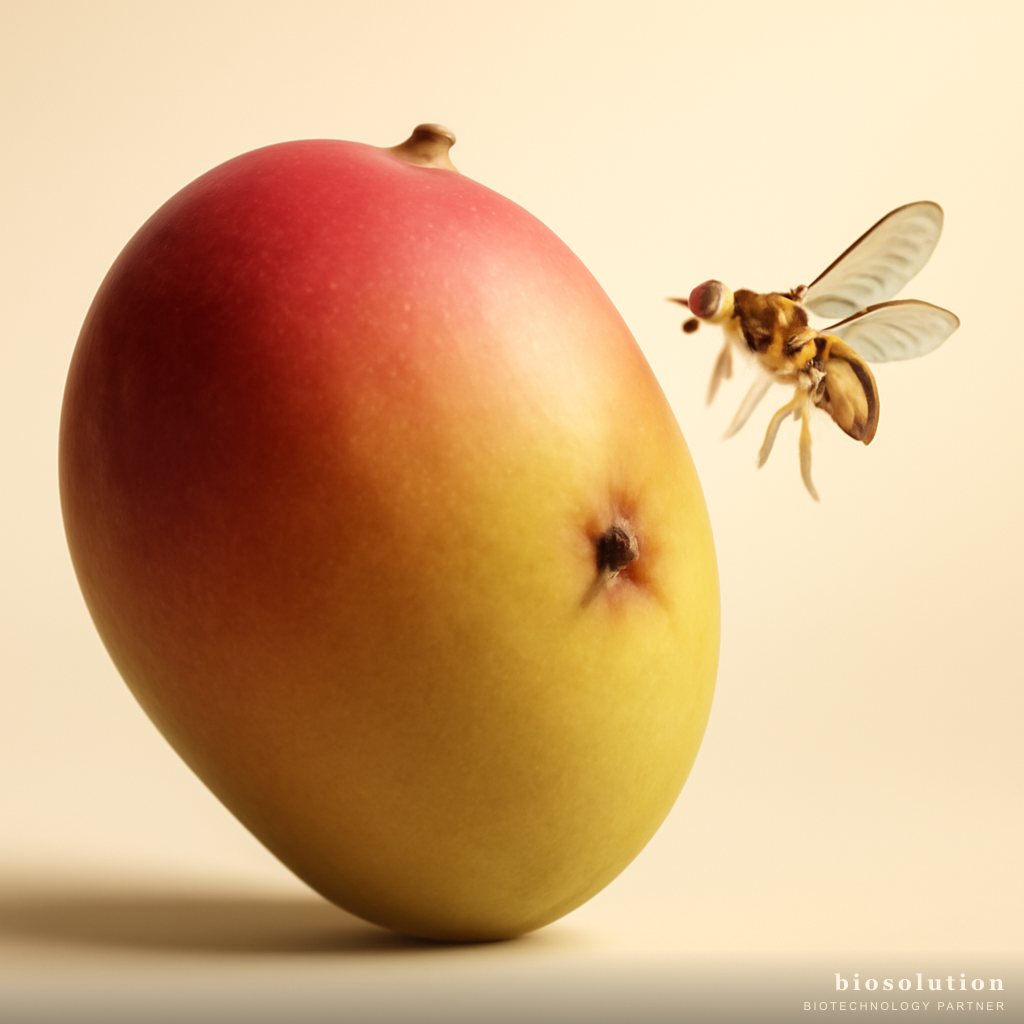
In mango and guava, common Bactrocera species include B. dorsalis, B. carambolae, and B. papayae. They attack ripening fruit, causing rot and drop. Therefore, monitoring should be conducted from fruit set to harvest.
Trapping Methods for Fruit Fly Monitoring
Fruit fly traps are devices used to capture adult flies, both male and female. Several types of traps are commonly used:
Methyl Eugenol Attractant Traps
Methyl eugenol is a specific attractant for male fruit flies. These traps are effective for monitoring male populations, which correlate with female populations. Preparation: Place 2-3 drops of methyl eugenol on cotton or cloth inside a perforated plastic bottle. Hang the trap in a mango or guava tree at 1.5-2 meters height. Replace the attractant every 2 weeks as it evaporates.
Protein Hydrolysate Traps
These traps use protein hydrolysate to attract female fruit flies that need protein for egg maturation. Protein hydrolysate is mixed with insecticide or adhesive. These traps are more selective for females, providing a more accurate picture of potential infestation.
Yellow Sticky Traps
Fruit flies are attracted to yellow color. Yellow boards or bottles coated with glue can capture adult fruit flies. Although not specific, these traps are easy to make and cheap. However, their effectiveness is lower than attractant traps.
Tips for trap placement:
- Install at least 4-5 traps per hectare for representative data.
- Place traps in parts of the tree exposed to morning sunlight.
- Record the number of fruit flies caught every week.
Visual Scouting in the Field
In addition to traps, direct visual inspection of fruit and plants is important. Scouting involves observing symptoms of fruit fly attack on mango and guava fruit. Early symptoms are sting marks on the fruit surface, which later turn into brown or black spots. Infested fruit will rot and drop.
Scouting steps:
- Select sample trees randomly (e.g., 10 trees per hectare).
- Inspect 10-20 fruits per tree, especially ripening fruit.
- Record the number of fruits showing attack symptoms (stung or rotten).
- Calculate the percentage of infestation.
Scouting should be done weekly, especially when fruit enters the mature green to fully ripe stage. Scouting data is used together with trap data to determine action thresholds.
Determining Action Thresholds
An action threshold is the pest population level at which control measures must be taken to prevent economic loss. For Bactrocera fruit flies on mango and guava, action thresholds can be based on:
- Number of flies caught per trap per day: If the average catch exceeds 5 flies per trap per day, control is needed.
- Percentage of infested fruit: If more than 5% of fruit show attack symptoms, take immediate action.
However, action thresholds may vary depending on variety, season, and fruit market price. Farmers are advised to keep historical data to set their own thresholds.
Control Based on Monitoring Results
Once monitoring shows that fruit fly populations have exceeded the action threshold, control measures must be taken immediately. Environmentally friendly control can use biological agents such as Metarhizium anisopliae contained in Anti-Fruit Fly Formula. M. anisopliae is an entomopathogenic fungus that infects fruit fly pupae in the soil. By applying Anti-Fruit Fly Formula solution to the soil around the tree's root zone, pupae in the soil become infected and die before emerging as adults. This mechanism naturally breaks the fruit fly life cycle.
Application of Anti-Fruit Fly Formula:
- Dosage: 5 ml per liter of water, 1 liter of solution per tree.
- Frequency: every 30 days.
- Time: morning or evening.
- Method: evenly pour onto the soil under the tree canopy (root zone).
Advantages of using M. anisopliae:
- Significantly reduces fruit fly attacks.
- Helps fruit meet export standards (free of chemical residues).
- Reduces dependence on synthetic chemical attractants.
- Safe for organic farming and does not harm natural enemies.
In addition to soil application, farmers can combine with orchard sanitation (collecting and burning rotten fruit) and mass trapping to suppress adult populations.
Case Study: Field Monitoring and Control
In a mango orchard in East Java, farmers conducted monitoring using methyl eugenol traps. In the 4th week after fruit set, the average catch reached 7 flies per trap per day. Scouting showed 8% of fruit had sting marks. Farmers then applied Anti-Fruit Fly Formula at 5 ml/L water, 1 L per tree, every 30 days. After 2 months, trap catches decreased to 2 flies per day, and fruit infestation dropped below 3%. Harvest yield increased by 20%, and fruit passed export selection due to being free of pesticide residues.
Conclusion
Monitoring Bactrocera fruit fly populations using traps, visual scouting, and action thresholds is a key strategy in integrated pest management for mango and guava. With accurate monitoring data, farmers can determine the right timing for control, save costs, and reduce environmental impact. The use of biological agents such as Metarhizium anisopliae in Anti-Fruit Fly Formula is an effective and environmentally friendly solution for controlling fruit fly populations in the pupal stage in the soil. For further consultation, contact the Biosolution team via WhatsApp.
FAQ
What is the action threshold for fruit flies?
The action threshold is the pest population level that requires control measures to prevent economic loss. For Bactrocera fruit flies on mango and guava, the action threshold is typically set when the average trap catch exceeds 5 flies per day or the percentage of infested fruit exceeds 5%.
How to make a simple fruit fly trap?
A simple trap can be made from a used plastic bottle. Make holes on the sides, then insert cotton soaked with methyl eugenol (for males) or protein hydrolysate (for females). Close the bottle and hang it in a tree at 1.5-2 meters height. Replace the attractant every 2 weeks.
Is Anti-Fruit Fly Formula safe for plants and the environment?
Yes, Anti-Fruit Fly Formula contains Metarhizium anisopliae, a natural entomopathogenic fungus. This product is safe for plants, animals, and humans, and leaves no harmful residues. Suitable for organic farming and environmentally friendly.
When is the best time to monitor fruit flies?
Monitoring should start when fruit enters the mature green stage (about 2-3 weeks before harvest). Conduct monitoring weekly until harvest is complete. During the dry season, fruit fly populations tend to increase, so monitoring needs to be more intensive.
Are traps alone sufficient to control fruit flies?
Traps serve for monitoring, not mass control. To effectively suppress populations, traps need to be combined with orchard sanitation, application of biological agents like Metarhizium anisopliae, and environmental management. Integrated control provides the best results.