Biologically Controlling Fall Armyworm in Corn: Life Cycle, Symptoms, and Economic Threshold
The fall armyworm, scientifically known as Spodoptera frugiperda (FAW), has become a scourge for corn farmers in Indonesia since it was first reported in 2019. Its rapid and destructive attacks can significantly reduce yields. However, biologically controlling fall armyworm does not always have to rely on chemical insecticides. A biological approach based on pathogenic microorganisms offers an effective, environmentally friendly, and sustainable solution. This article thoroughly examines the FAW life cycle, attack symptoms, economic threshold, and how biological products like Biosolution's Anti-Fall Armyworm Formula can be a powerful weapon for farmers.
Life Cycle of Fall Armyworm (FAW)
Understanding the pest's life cycle is the first step in control. FAW undergoes complete metamorphosis: egg, larva (caterpillar), pupa, and adult (moth).
Eggs
Female moths lay eggs in clusters (100-300 eggs) on the underside of corn leaves, usually near the base of the plant. Eggs are yellowish-white and hatch in 2-3 days. Egg clusters are covered with fine, cottony hairs that protect them from predators.
Larvae (Caterpillars)
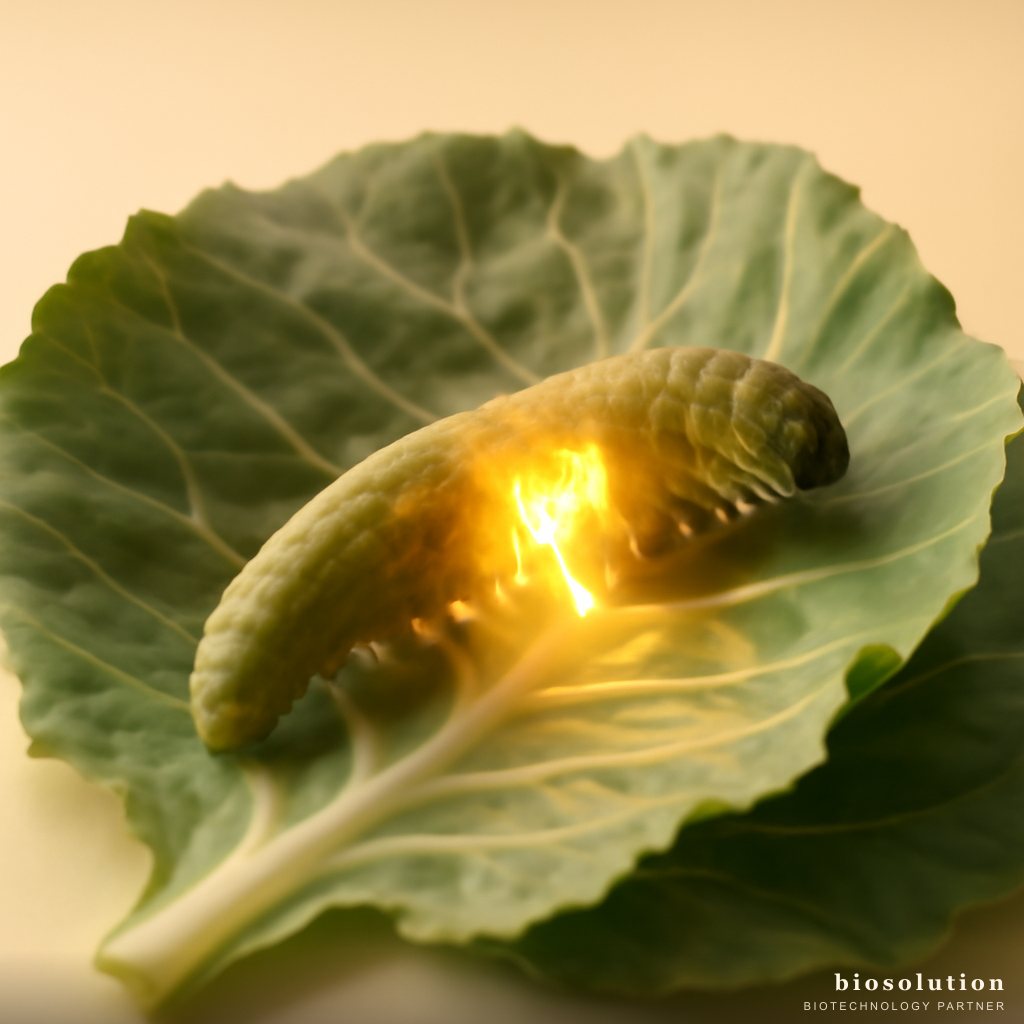
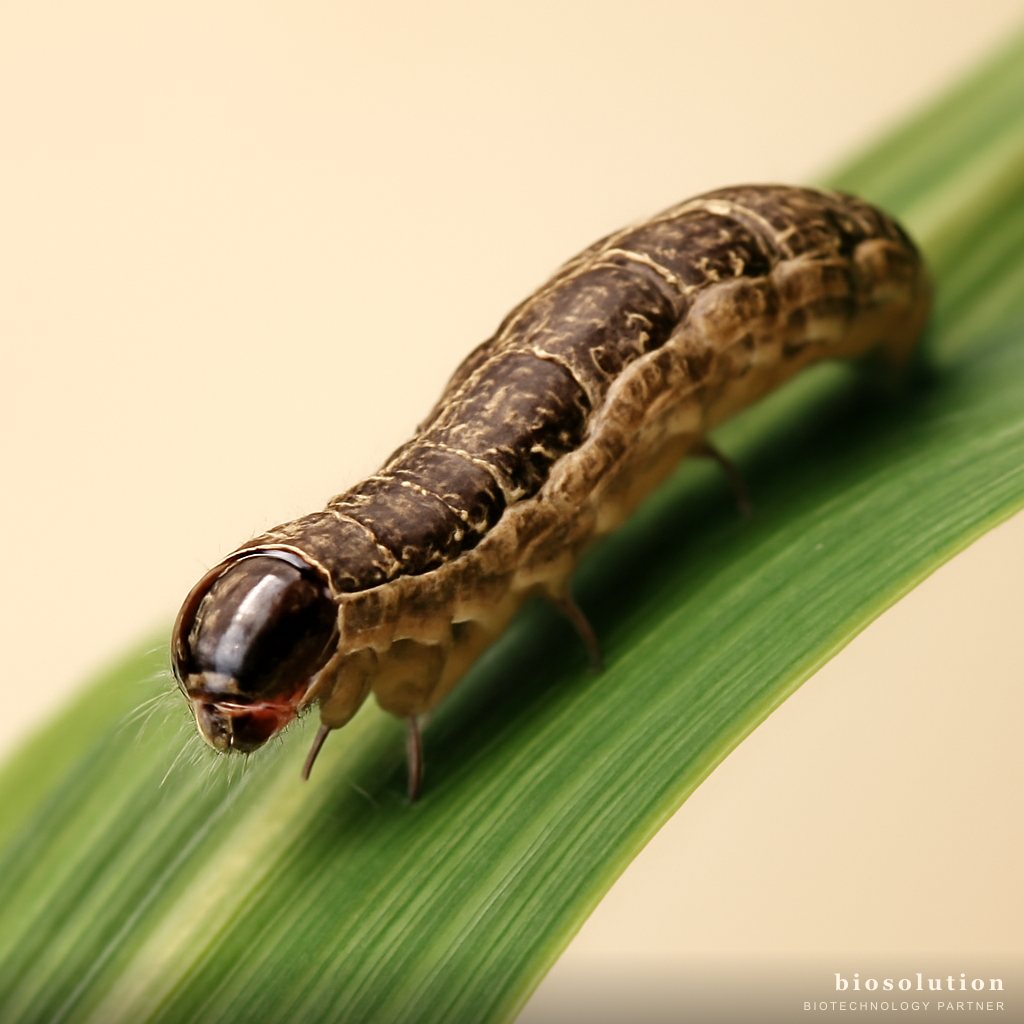
FAW larvae have six instars. Early instars (1-2) are green with a black head, live in groups, and begin feeding on leaf tissue. From instar 3, larvae disperse and become cannibalistic. A distinctive feature of FAW larvae is an inverted "Y" on the head and four black dots forming a square on the last abdominal segment. Instars 5-6 are very voracious, can cut young corn stalks, and enter the ear. The larval stage lasts 14-21 days.
Pupae
Final instar larvae drop to the ground and form pupae in a soil cocoon at a depth of 2-8 cm. Pupae are reddish-brown and last 7-13 days depending on temperature.
Adult Moths
Moths are active at night and can fly long distances (up to 100 km/day) carried by the wind. Adult lifespan is about 10-14 days, and females can lay up to 1000 eggs in their lifetime. The total life cycle is 30-40 days in tropical regions, allowing up to 12 generations per year.
Symptoms of Fall Armyworm Attack on Corn Plants
FAW attack symptoms vary depending on the corn growth stage. Farmers need to be observant in recognizing the signs.
Early Vegetative Stage (0-4 weeks)
- Window-pane leaves: Instars 1-2 feed on the lower leaf epidermis, leaving a thin transparent layer.
- Whorl injury: Instars 3-4 enter the growing point (bud) and feed on young leaves, leaving frass like sawdust.
- Longitudinal leaf tears: When leaves open, holes and long tears result from larval feeding inside the bud.
- Dead growing point: Severe attack on seedlings causes stunting or death.
Generative Stage (4-8 weeks)
- Flag leaf and ear damage: Instars 5-6 attack young ears, cut ear silks, and feed on kernels.
- Stem holes: Larvae can bore into the stem below the ear, causing the ear to break.
- Direct kernel damage: On formed ears, larvae eat kernels from the ear tip.
Differentiation from Common Armyworm
FAW has a characteristic attack pattern: young larvae make webs on leaves (skeletonizing), while older larvae create large holes and frass in the whorl. This differs from the common armyworm (Spodoptera litura), which more often attacks older leaves and pods.
Economic Threshold of Fall Armyworm on Corn
The economic threshold is the pest population level at which control measures must be taken to prevent economic loss. For FAW, several references:
- Vegetative stage (0-4 WAP): The control threshold is 20% of plants showing attack symptoms (holes in leaves or frass in whorl).
- Generative stage (5-8 WAP): A lower threshold of 10% of plants showing attack symptoms on ears.
- Alternative: Use of sex pheromone traps to monitor moths. If catches exceed 7 moths per night, caution is needed.
Decision-making also considers plant age. Corn younger than 4 weeks is very vulnerable; after 8 weeks, leaf damage does not significantly affect yield. However, ear attack remains critical.
Biological Control: Biosolution's Anti-Fall Armyworm Formula
One way to biologically control fall armyworm effectively and environmentally friendly is by using biological products. Biosolution presents Anti-Fall Armyworm Formula for Rice & Corn containing two insect-pathogenic microorganisms:
- Bacillus thuringiensis: A bacterium that produces δ-endotoxin specific to Lepidoptera larvae. This toxin binds to the larval gut receptors, causing paralysis and death within 24-48 hours.
- Beauveria bassiana: An entomopathogenic fungus that infects larvae and pupae through the cuticle. Mycelium grows inside the body, producing toxins that kill larvae within 3-7 days.
The combination of these two biological agents provides a synergistic effect: B. thuringiensis works quickly, while B. bassiana controls residual populations and the pupal stage. This product is designed to suppress resistance and is safe for natural enemies.
Proper Application Method
- Dosage: 3 ml per liter of water.
- Timing: Spray in the late afternoon (temperature < 30°C, high humidity) to avoid UV degradation and enhance B. bassiana effectiveness.
- Frequency: Every 5-7 days, especially when eggs or instars 1-2 are visible.
- Method: Spray evenly onto the growing point (whorl) and egg clusters on the underside of leaves.
Product Advantages
- Effective: Controls FAW and common armyworm (S. litura).
- Reduces chemical insecticides: Suitable for integrated pest management (IPM) programs.
- Safe: Non-toxic to humans, animals, and beneficial insects like bees.
- No cross-resistance: Different mode of action from chemical insecticides.
Biosolution also provides Caterpillar & Borer Control Formula (Bt) as an alternative for other Lepidoptera pests.
Integrated Pest Management (IPM) Strategy for FAW
Using the Anti-Fall Armyworm Formula is most optimal when combined with IPM practices:
- Regular monitoring: Check plants weekly, calculate the percentage of attacked plants.
- Cultural practices: Plant corn simultaneously, avoid intercropping with alternative hosts (e.g., grasses).
- Conservation of natural enemies: Ants, spiders, and egg parasitoids (e.g., Trichogramma) can help suppress populations.
- Mechanism rotation: If chemical insecticides are necessary, choose a different class and only when the economic threshold is exceeded.
Conclusion
Fall armyworm (FAW) is a serious pest that requires smart control strategies. By understanding the life cycle, symptoms, and economic threshold, farmers can make timely decisions. Biologically controlling fall armyworm using products like Biosolution's Anti-Fall Armyworm Formula containing Bacillus thuringiensis and Beauveria bassiana is an effective, safe, and sustainable solution. Proper application at a dosage of 3 ml/L every 5-7 days can suppress FAW populations without damaging the ecosystem.
For further consultation on FAW control or other biological products, contact the Biosolution team via WhatsApp. Together, we can achieve healthy and productive corn farming.