Industrial Wastewater Bioremediation: Integration with Existing WWTP
Food and textile industries produce wastewater with high organic loads that often exceed quality standards. Industrial wastewater bioremediation emerges as a biological solution that can be integrated into existing Wastewater Treatment Plants (WWTP). By utilizing a consortium of decomposing bacteria and the mold Aspergillus niger, this approach not only significantly reduces Biochemical Oxygen Demand (BOD) and Chemical Oxygen Demand (COD) but also reduces dependence on expensive chemicals. This article technically explores how integrating bioremediation into existing WWTP can be a smart strategy for industrial environmental managers.
Why Bioremediation is Suitable for Existing Industrial WWTP?
Compatibility with Existing Infrastructure
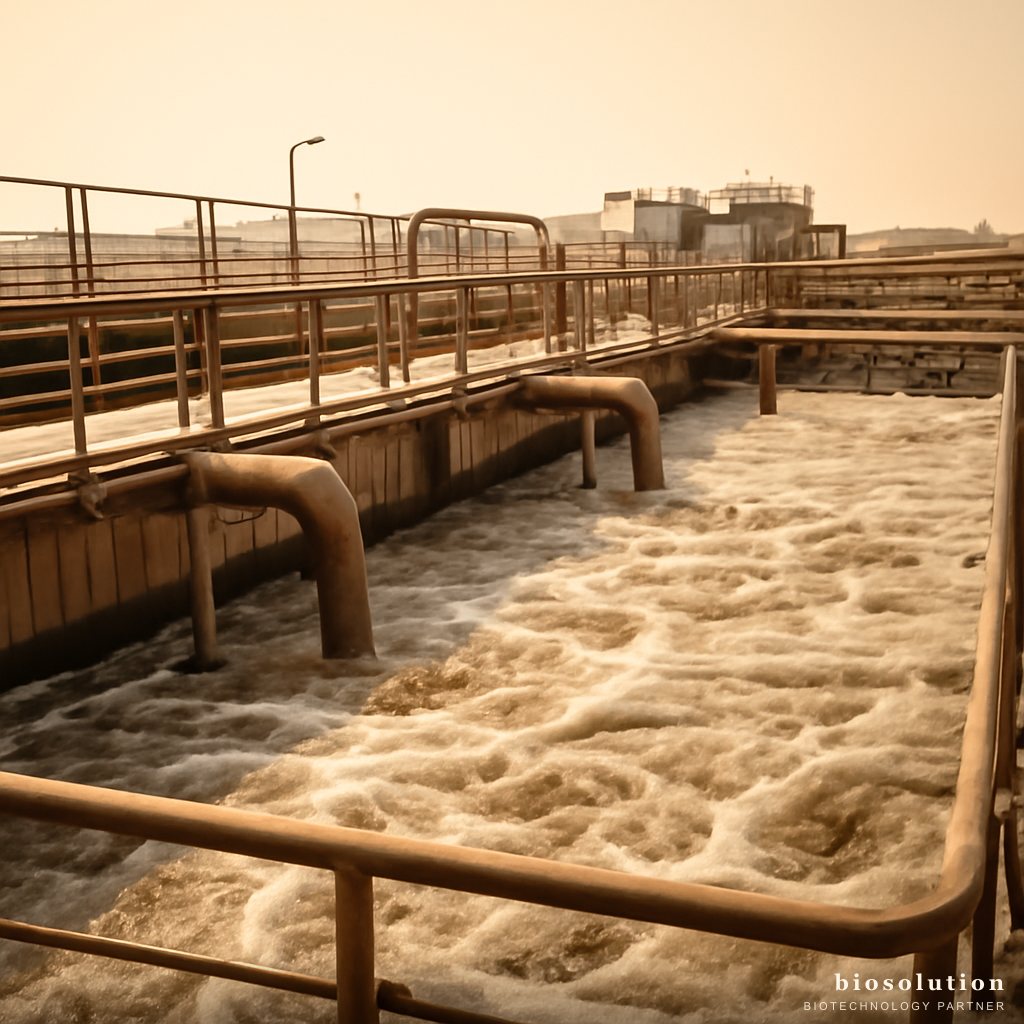
Conventional WWTP systems generally consist of sedimentation tanks, aeration tanks, and clarifiers. Bioremediation does not require major modifications because products like Industrial Wastewater Bioremediation Formula are applied directly to WWTP ponds through simple dosing. Operators simply add the bacterial consortium and Aspergillus niger according to the recommended dosage, i.e., 100–500 ml per m³ of wastewater at the start of treatment. This process does not disrupt the existing WWTP workflow.
Improved Degradation Efficiency
The bacterial consortium in this formula works synergistically to break down complex organic compounds into simpler ones. Meanwhile, Aspergillus niger produces extracellular enzymes such as amylase, protease, and cellulase that accelerate the hydrolysis of organic polymers. As a result, the organic pollutant load decreases faster compared to relying solely on natural WWTP microbes. This integration allows existing WWTP to achieve BOD/COD reduction efficiency of up to 80-90% within 2-4 weeks.
Reduced Operational Costs
With reduced need for coagulants, flocculants, and other chemicals, wastewater treatment costs can be lowered. Additionally, bioremediation reduces the volume of chemical sludge that must be disposed of, thus saving solid waste management costs. Fast ROI is a strong reason for industries to adopt this method.
Working Mechanism of Bioremediation Formula in WWTP
Microbial Colonization and Adaptation
After dosing, the microbes in the formula colonize the surface of media and suspended particles. The adaptation phase lasts 1-3 days, depending on wastewater characteristics. During this period, the produced enzymes begin to break down organic substrates. Routine weekly application for maintenance keeps the microbial population optimal.
Aerobic and Anaerobic Degradation
In the aeration tank, aerobic bacteria oxidize organic compounds into CO₂ and water. Meanwhile, in anaerobic zones, anaerobic bacteria (also contained in the consortium) break down organic matter into methane and other simple compounds. Aspergillus niger works in both conditions, producing enzymes active over a wide pH and temperature range. This combination ensures effective degradation even with fluctuating waste loads.
Reduction of BOD/COD and Other Parameters
Data from several field applications show BOD reduction of up to 85% and COD reduction of up to 80% within the first 2 weeks. Additionally, ammonia and phosphate content also decrease significantly as microbes utilize them as nutrients. The final result is that the wastewater leaving the WWTP meets the quality standards set by the Ministry of Environment and Forestry (KLHK).
Steps for Integrating Bioremediation into Existing WWTP
1. Evaluate Current WWTP System
Before starting, conduct an audit of WWTP capacity, retention time, and wastewater characteristics (pH, temperature, BOD, COD, TSS). This data is crucial for determining initial dosage and application frequency. Consult with our technical team for appropriate recommendations.
2. Adjust Dosage and Application Method
Initial dosage is generally 100–500 ml per m³, depending on pollution level. For wastewater with COD >5000 ppm, the initial dosage can be increased to 1 liter per m³. Application is done by pouring directly at the inlet point or in the aeration area for even mixing. After that, perform weekly maintenance with a dosage of 50-200 ml per m³.
3. Monitoring and Optimization
Monitor key parameters such as BOD, COD, pH, and DO daily during the first week, then periodically. If reduction is not optimal, adjust dosage or frequency. The presence of Aspergillus niger also helps suppress the growth of disruptive wild fungi.
4. Documentation and Reporting
Record all monitoring data for reporting purposes to authorities. With bioremediation, environmental documents will show compliance with quality standards, thus reducing the risk of fines and sanctions.
Economic and Environmental Benefits of Bioremediation
Reduced Treatment Costs
The use of chemicals such as PAC, lime, and polymers can be reduced by up to 50% after 2-3 months of application. Chemical sludge produced also decreases, saving transportation and disposal costs. With lower operational costs, investment in Industrial Wastewater Bioremediation Formula provides ROI within 3-6 months.
Regulatory Compliance
Minister of Environment and Forestry Regulation No. 5 of 2014 concerning Wastewater Quality Standards sets strict limits for organic parameters. Bioremediation helps industries consistently meet these standards, thus avoiding administrative fines up to revocation of environmental permits.
Improved Corporate Image
Adopting green technologies like bioremediation enhances the company's reputation in the eyes of consumers, investors, and regulators. This is an added value in the era of sustainable industry.
Case Studies: Food and Textile Industries
Food Industry
A tofu processing plant in East Java with a flow rate of 200 m³/day and COD of 6,000 ppm applied bioremediation. After 4 weeks, COD dropped to 800 ppm (below the quality standard of 1,000 ppm). Chemical costs decreased by 60%, and the sludge produced was only half of the previous amount.
Textile Industry
A textile factory in Bandung with wastewater containing azo dyes and COD of 3,500 ppm. Bioremediation with a bacterial consortium and Aspergillus niger successfully reduced COD to 400 ppm within 3 weeks. The color of the wastewater also faded significantly due to ligninolytic enzymes produced.
Conclusion
Integration of industrial wastewater bioremediation into existing WWTP systems is an effective strategy to improve wastewater treatment performance without major infrastructure investment. By utilizing bacterial consortia and Aspergillus niger, industries can significantly reduce BOD/COD, lower operational costs, and meet environmental quality standards. Easy initial steps, ready technical support, and fast ROI make bioremediation a smart choice for food, textile, and other sectors. For more information or a free consultation, contact our team via WhatsApp. Together, we create a cleaner and more sustainable industry.
FAQ
What is industrial wastewater bioremediation?
Industrial wastewater bioremediation is the process of using microorganisms (bacteria and fungi) to degrade organic pollutants in wastewater. In the context of WWTP, a consortium of bacteria and Aspergillus niger works to break down complex organic compounds into harmless simple compounds, thereby naturally reducing BOD and COD.
How to integrate bioremediation into an existing WWTP?
Integration is very easy: simply dose directly into the WWTP pond according to the recommended dosage (100-500 ml per m³ initially). No infrastructure modification is needed. After that, perform weekly maintenance with a maintenance dosage. Periodic parameter monitoring ensures effectiveness.
How long does it take to see results?
BOD/COD reduction is usually noticeable within 3-7 days after application. Optimal results (reduction of up to 80-90%) can be achieved within 2-4 weeks, depending on wastewater characteristics and proper dosage.
Is bioremediation safe for the environment?
Yes, the microbes used are non-pathogenic and have been isolated from nature. This product does not contain hazardous chemicals. The treated wastewater is safe for the environment and does not cause negative side effects.
How much does it cost to switch to bioremediation?
The initial cost for purchasing the formula and technical consultation is relatively affordable. In the long term, savings from reduced chemical use and sludge management result in ROI within 3-6 months. For specific cost estimates, please contact our team.