Root-Knot Nematode Biocontrol: Understanding and Controlling Meloidogyne in Tomato and Vegetable Crops
Root-knot nematodes, particularly from the genus Meloidogyne, are among the most damaging soil-borne pathogens for horticultural crops such as tomatoes, chili peppers, and other vegetables. These nematode attacks not only drastically reduce yields but also cause significant economic losses for farmers. In Indonesia, yield losses due to root-knot nematodes in tomatoes can reach 30–60% if not properly managed. Fortunately, advances in agricultural biotechnology have introduced effective and environmentally friendly biocontrol solutions for root-knot nematodes. This article thoroughly covers the life cycle of Meloidogyne, symptoms of attack, economic thresholds, and how biocontrol with Biosolution's Root-Knot Nematode Control Formula can be a powerful weapon for farmers.
Life Cycle of Meloidogyne Nematodes: From Egg to Parasite
To understand how to control nematodes, we must know their life cycle. Meloidogyne are obligate endoparasitic nematodes, meaning they must enter root tissue to reproduce. Their life cycle consists of several stages:
Egg Stage
Adult female nematodes produce eggs in a gelatinous mass called an ovisac, which attaches to the root surface or within root tissue. One female can produce 500–1000 eggs. These eggs are highly resistant to unfavorable environmental conditions, such as drought or extreme temperatures, and can survive in the soil for years.
Juvenile Stage
After hatching, the second-stage juvenile (J2) emerges, which is infective. J2 juveniles are highly active, moving through soil pores toward plant roots, guided by chemical compounds released by roots (root exudates). J2 juveniles are about 400–500 micrometers long, small enough to penetrate young root tips.
Penetration and Migration
Once they find a root, J2 juveniles puncture root cell walls using a stylet (mouth needle) and enter the root tissue. They then migrate intercellularly toward the vascular cylinder (stele) to find cells that will serve as feeding sites.
Giant Cell Formation
Inside the stele, J2 juveniles stimulate several root cells to transform into giant cells through the secretion of enzymes and hormones. These giant cells are multinucleate, have high metabolic activity, and become the primary nutrient source for the nematode. This process causes root swelling or galls.
Adult Development and Reproduction
After giant cell formation, J2 juveniles undergo three molts to become J3, J4, and finally adults. Adult female nematodes are pear-shaped (saccate) and remain inside the root, continuously feeding and producing eggs. Adult male nematodes are worm-shaped and exit the root to fertilize females. However, some Meloidogyne species can reproduce parthenogenetically (without males).
Egg Release
Once mature, females deposit egg masses on the root surface or within root tissue. These eggs then hatch into J2 juveniles ready to infect new roots. The complete life cycle of Meloidogyne at optimal temperatures (25–30°C) ranges from 25–30 days, allowing multiple generations within a single growing season.
Symptoms of Nematode Attack on Plant Roots
Symptoms of Meloidogyne nematode attack can be recognized through two types: root symptoms (primary symptoms) and shoot symptoms (secondary symptoms).
Root Symptoms
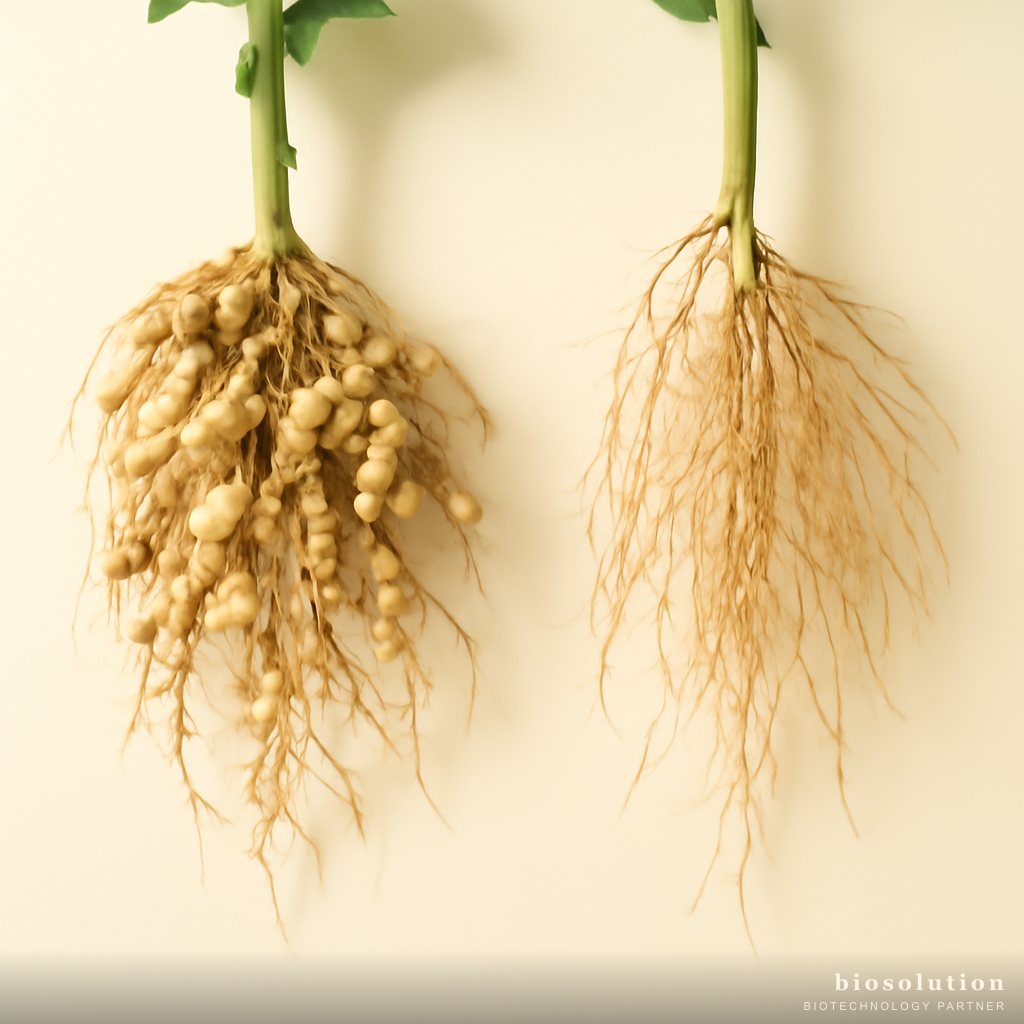
The characteristic symptom of Meloidogyne attack is the formation of galls on roots. These galls are local swellings caused by hypertrophy and hyperplasia of root cells around the nematode. Gall size varies from small, pinhead-sized to marble-sized, depending on nematode numbers and plant species. In severe attacks, the entire root system becomes covered with galls, making roots appear knobby and non-functional. Infected roots also easily rot due to secondary infection by pathogenic fungi or bacteria.
Shoot Symptoms
Root damage disrupts water and nutrient uptake, causing plants to show symptoms such as stunting, yellowing leaves (chlorosis), wilting during the day, and reduced yield. In tomato plants, fruits become small, few in number, and of poor quality. These symptoms often resemble nutrient deficiency or drought, leading to misdiagnosis by farmers. Therefore, root observation is crucial for confirmation.
Economic Threshold of Nematode Attack
The economic threshold is the nematode population level in the soil that causes economic losses, requiring control measures. For Meloidogyne in tomato plants, the economic threshold varies depending on soil type and plant variety. Generally, if 1–2 J2 juveniles per gram of soil or 10–20 galls per plant are found in the early growth stage, the risk of loss is significant. Under such conditions, control must be implemented immediately to prevent further losses.
Principles of Root-Knot Nematode Biocontrol
Root-knot nematode biocontrol uses biological agents that naturally parasitize or inhibit nematodes. This approach is more sustainable than chemical nematicides, which are toxic and damage the soil ecosystem. Two biological agents proven effective are Paecilomyces lilacinus and Bacillus firmus, which are key components in Biosolution's Root-Knot Nematode Control Formula.
Paecilomyces lilacinus: Parasite of Nematode Eggs and Juveniles
Paecilomyces lilacinus is an entomopathogenic fungus that is also nematophagous (nematode-eating). This fungus infects nematode eggs and juveniles by penetrating their body walls with hyphae. Inside eggs, the fungus grows and destroys the embryo, preventing hatching. In juveniles, the fungus infects and kills them within 24–48 hours. Studies show that application of P. lilacinus can suppress Meloidogyne populations by up to 70% in tomato plants.
Bacillus firmus: Producer of Anti-Nematode Toxins
Bacillus firmus is a rhizosphere bacterium that produces bioactive compounds such as lipopeptides and enzymes with nematicidal properties. This bacterium also produces plant growth hormones and solubilizes phosphate, thus not only controlling nematodes but also improving plant health. B. firmus works by attaching to the nematode cuticle and producing toxins that damage cell membranes, causing death. Additionally, this bacterium colonizes the root surface and creates a protective zone (rhizosphere competence).
Synergistic Mechanism of Both Biological Agents
The combination of P. lilacinus and B. firmus in the Root-Knot Nematode Control Formula provides a synergistic effect. P. lilacinus attacks eggs and juveniles in the soil, while B. firmus protects roots from juvenile penetration and stimulates plant growth. As a result, nematode populations are suppressed by 70–80%, gall formation is reduced, and plants grow more vigorously.
Application of Root-Knot Nematode Control Formula on Tomato and Vegetable Crops
For optimal results, the Root-Knot Nematode Control Formula must be applied correctly according to dosage and timing.
Application Method: Root Drench
This product is applied by drenching the root zone. The recommended dosage is 5 ml per liter of water. The solution volume is adjusted according to plant age: for seedlings, 50–100 ml per plant; for mature plants, 200–300 ml per plant. Ensure the solution reaches the active root zone.
Frequency and Timing of Application
Applications are made every 14 days, at least 4 times per growing season. The best times are at planting (to prevent initial infection) and after pruning, as root wounds can be entry points for nematodes. Regular applications maintain high populations of biological agents in the rhizosphere.
Benefits of Using Biocontrol
- Environmentally safe: Leaves no toxic residues, safe for natural enemies and non-target organisms.
- Improves soil health: Beneficial microbes enhance soil biological activity.
- No resistance development: Unlike chemical nematicides, biological agents have multiple mechanisms, making it difficult for nematodes to develop resistance.
- Compatible with other agricultural practices: Can be combined with organic fertilizers, mulch, and drip irrigation.
Conclusion
The parasitic nematode Meloidogyne is a serious threat to tomato and vegetable cultivation. Understanding its life cycle, symptoms, and economic threshold is the first step toward effective control. Root-knot nematode biocontrol using biological agents such as Paecilomyces lilacinus and Bacillus firmus offers a safe, effective, and sustainable solution. Biosolution's Root-Knot Nematode Control Formula, with its combination of these two microbes, can suppress nematode populations by up to 70–80%, reduce root galls, and enhance plant growth. With proper application (root drench at 5 ml/L, every 14 days), farmers can protect their crops from nematode losses without harming the ecosystem. For further consultation, contact the Biosolution team via WhatsApp or visit the product page Root-Knot Nematode Control Formula.