Wastewater BOD COD Reduced to Quality Standards: A Bioremediation Case Study for Industrial Wastewater
Every industry that produces wastewater faces pressure to meet environmental quality standards. The parameters BOD (Biochemical Oxygen Demand) and COD (Chemical Oxygen Demand) are key indicators strictly monitored by the Ministry of Environment and Forestry. Failure to meet standards not only results in administrative fines but can also halt factory operations. A textile factory in West Java successfully reduced wastewater BOD COD to quality standards in just 6 weeks using a bioremediation formula based on a consortium of decomposer bacteria and Aspergillus niger. This article thoroughly examines the case study, scientific mechanisms, and implementation steps.
Why BOD and COD Are Critical Parameters in Wastewater Quality Standards
BOD measures the amount of oxygen required by microorganisms to decompose organic matter in water. The higher the BOD, the more organic pollutants contaminate the receiving water body. COD, on the other hand, measures the total oxygen required to chemically oxidize all chemicals, both organic and inorganic. Wastewater quality standards for the textile sector in Indonesia generally set a maximum BOD of 60 mg/L and a maximum COD of 150 mg/L (Minister of Environment and Forestry Regulation No. 16/2019).
Industries often struggle to achieve these figures due to the complex characteristics of wastewater, such as the content of dyes, surfactants, and other chemicals. Chemical treatment methods using coagulants and flocculants are effective in reducing COD, but they often leave hazardous residues and increase operational costs. Bioremediation offers a more natural and sustainable alternative.
Case Study: Textile Factory with BOD 350 mg/L and COD 700 mg/L
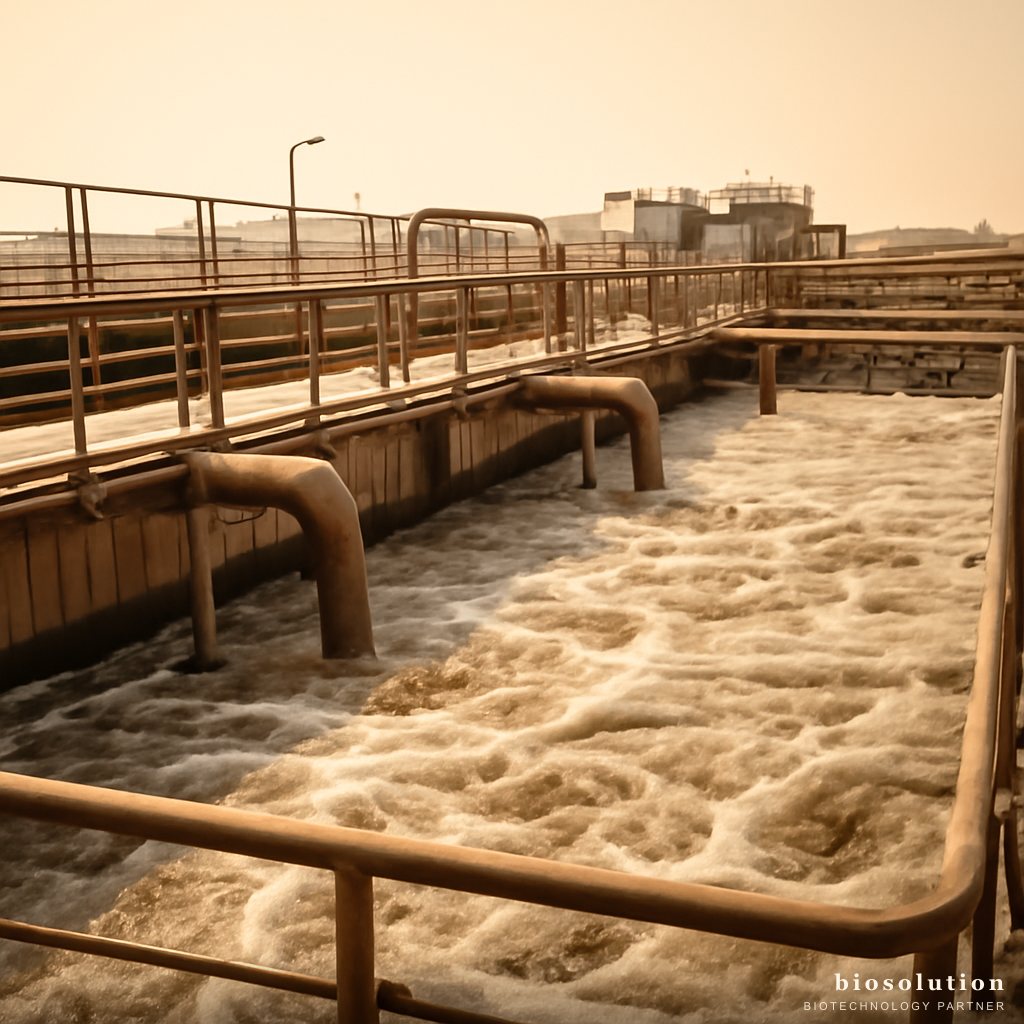
A textile factory in the Majalaya industrial area, West Java, faced a serious problem. Their existing WWTP could only reduce BOD to 200–250 mg/L and COD to 450–500 mg/L, still far from the quality standards. The environmental management team decided to integrate a bioremediation formula as bioaugmentation into the WWTP system.
Initial WWTP conditions:
- Aeration pond volume: 500 m³
- Wastewater flow rate: 100 m³/day
- Inlet BOD: 350 mg/L
- Inlet COD: 700 mg/L
- TSS: 200 mg/L
- pH: 7.2
Interventions performed:
- Initial dose: 300 ml/m³ of bioremediation formula (containing a consortium of decomposer bacteria and Aspergillus niger)
- Maintenance dose: 150 ml/m³ every week
- Aeration adjustment: DO maintained at 2–4 mg/L
- Daily monitoring of BOD, COD, TSS, and pH
Results after 6 weeks:
- BOD: 45 mg/L (87% reduction)
- COD: 120 mg/L (83% reduction)
- TSS: 30 mg/L
- pH stable at 6.8–7.5
This success not only met quality standards but also reduced chemical treatment costs by 40% because the coagulant dose could be significantly reduced.
Scientific Mechanism: Role of Decomposer Bacteria Consortium and Aspergillus niger
The bioremediation formula used contains a consortium of decomposer bacteria consisting of various aerobic and facultative anaerobic species. These bacteria produce extracellular enzymes such as amylase, protease, and lipase that break down starch, proteins, and fats into simple compounds. Subsequently, heterotrophic bacteria oxidize these organic compounds into CO₂ and H₂O, thereby drastically reducing BOD.
Aspergillus niger acts as a producer of cellulase and hemicellulase enzymes capable of degrading cellulose fibers from textile waste. This fungus also produces organic acids that help lower pH if the wastewater is too alkaline. The combination of bacteria and fungi creates a synergy that accelerates the degradation of organic pollutants.
Steps for Implementing Bioremediation in Industrial WWTP
To achieve optimal results like the case study above, the following steps need to be taken:
1. Wastewater Characterization and Dose Design
Conduct initial analysis of BOD, COD, TSS, pH, as well as heavy metal and toxic compound content. This is important to determine the appropriate formula dose. As a guide, the initial dose ranges from 100–500 ml per m³ of aeration pond volume, depending on the pollution level.
2. Microbial Acclimatization
Before full application, perform acclimatization by giving a small dose (e.g., 100 ml/m³) for 3–5 days. Monitor daily BOD/COD changes. If a significant decrease occurs, proceed to the maintenance dose.
3. Routine Application and Monitoring
The maintenance dose is given every week at half the initial dose. Ensure the aeration system functions well to provide oxygen for aerobic bacteria. Key parameters are monitored at least once a week.
4. Evaluation and Adjustment
If the target is not achieved within 4–6 weeks, recheck WWTP conditions such as DO, pH, or the presence of inhibitory compounds. Dose adjustments or nutrient addition (such as molasses) may be necessary.
Advantages of Bioremediation Over Chemical Methods
| Parameter | Chemical Method | Bioremediation |
|---|---|---|
| Operational cost | High (coagulants, flocculants) | Low (only microbes) |
| BOD/COD effectiveness | Moderate (COD decreases, BOD may increase) | High (both decrease) |
| Environmental impact | Metal residues, chemical sludge | Environmentally friendly |
| Sustainability | No | Yes, microbes reproduce |
Bioremediation also reduces the volume of sludge generated, thereby lowering sludge management costs. In the long term, the ROI (Return on Investment) is very attractive due to savings in chemical costs and environmental fines.
Conclusion
Reducing wastewater BOD COD to quality standards is not impossible with the right bioremediation approach. The case study of a textile factory in Majalaya proves that in 6 weeks, BOD dropped from 350 mg/L to 45 mg/L and COD from 700 mg/L to 120 mg/L using a consortium of decomposer bacteria and Aspergillus niger. This success inspires other industries to switch to more natural and economical solutions.
If you face similar challenges, the Biosolution technical team is ready to help design a bioremediation program tailored to your wastewater characteristics. Free consultation via WhatsApp or see the Wastewater Bioremediation Formula product for more details.