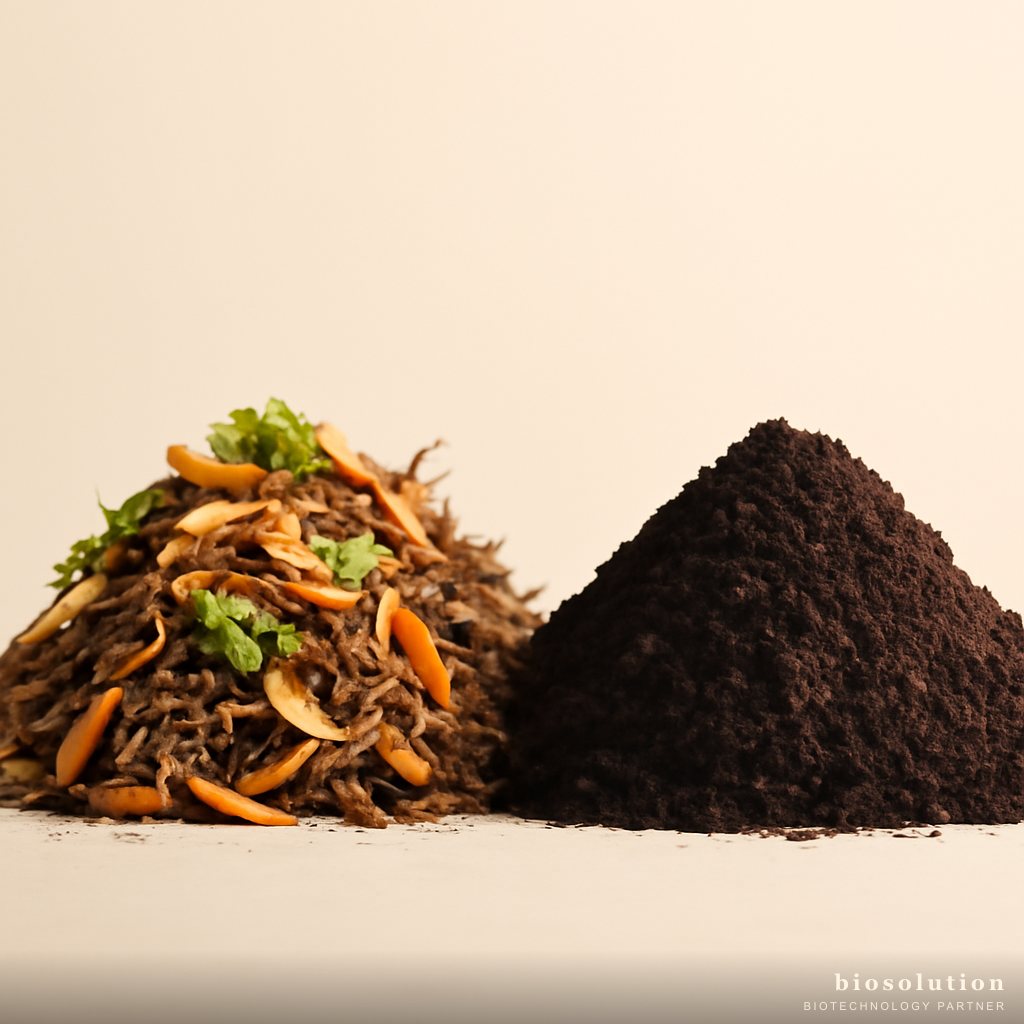
14-Day Fast Compost with Microbial Decomposer: Application Schedule for Straw & Organic Waste Decomposer Formula
Making compost in a short time, specifically 14-day fast compost, is no longer a dream for organic farmers. By using superior microbial decomposers, the composting process that usually takes 30–45 days can be cut in half. This article will discuss technically and applicatively how the Straw & Organic Waste Decomposer Formula Biosolution works, as well as the appropriate application schedule per growth phase for maximum results. Suitable for those who want to manage agricultural waste efficiently and environmentally friendly.
Mechanism of Microbial Decomposer in Accelerating Composting
Composting speed depends heavily on the activity of microorganisms in degrading organic matter. The Straw & Organic Waste Decomposer Formula contains three key microbial strains that work synergistically:
- Aspergillus niger: Producer of cellulase enzymes and organic acids. Cellulase enzymes break down cellulose into simple sugars easily consumed by other microbes, while organic acids help soften lignocellulose fibers.
- Trichoderma viride: Fast lignocellulose decomposer. This fungus is known to be aggressive in degrading lignin, a complex polymer that is usually the main obstacle in straw composting.
- Thiobacillus sp.: Sulfur oxidizer, plays a role in lowering compost pH. The sulfur oxidation process produces sulfuric acid that helps break lignin bonds and suppresses pathogen growth.
When these three microbes are applied together, a synergistic effect occurs: Aspergillus niger initiates initial degradation, Trichoderma viride continues lignin breakdown, and Thiobacillus sp. conditions the pH. As a result, the composting process that originally took 30–45 days can be completed in 14–21 days with a final C/N ratio below 20, meeting mature compost standards.
Growth Phases and Application Schedule of Decomposer Formula
Decomposer application is not only during composting but can also be integrated into the growth phase to maximize benefits. Here is the application schedule per phase:
Land Preparation Phase (2–3 weeks before planting)
In this phase, previous crop residues (straw, stover) are usually still in the field. Instead of burning, you can compost them in situ by spraying the Straw & Organic Waste Decomposer Formula. Method: pile crop residues 20–30 cm high, spray with decomposer solution at a dose of 1 liter per ton of material, then cover with mulch. Turn the pile every 5–7 days. Within 14 days, the material is degraded and ready to be processed into base fertilizer.
Early Planting Phase (0–30 DAP)
Mature compost from the previous phase can be applied as base fertilizer. Mix compost with soil in beds at a dose of 5–10 tons per hectare. The microbes contained in the compost will continue to be active in improving soil structure and providing nutrients for young plants.
Vegetative Growth Phase (30–60 DAP)
If there are leftover organic waste from fertilization or weeding, collect and make new compost with the decomposer. This process can be done on the edge of the field or in sacks. The resulting compost can be applied as a supplementary fertilizer in the generative phase later.
Generative Phase (60 DAP – harvest)
In this phase, plant nutrient needs increase. Application of compost from the decomposer can be done by drenching or spreading around the root zone. Mature compost (C/N <20) will release nutrients slowly, supporting flower and fruit formation.
Post-Harvest
Immediately after harvest, process straw or crop residues with the decomposer. Do not let them pile up too long as they can become a source of disease. With regular application, the composting cycle can run continuously, creating a sustainable agricultural system.
Case Study: 14-Day Rice Straw Composting
As an illustration, here are the steps to make compost from 1 ton of rice straw in 14 days using the Straw & Organic Waste Decomposer Formula:
- Material preparation: Chop straw into 5–10 cm pieces to increase microbial contact surface.
- Solution preparation: Mix 1 liter of decomposer with 10 liters of water (or according to package instructions). Stir well.
- Piling: Make a pile of straw 1–1.5 meters high, 2 meters wide. Spray the solution evenly while turning the pile.
- Incubation: Cover the pile with a tarp or plastic to maintain moisture and temperature. Ideal temperature 40–60°C.
- Turning: Turn the pile every 5–7 days for aeration. On day 7, the temperature will start to decrease, indicating the decomposition process is running.
- Compost harvest: On day 14, the compost is dark brown, smells like soil, and is not hot. C/N ratio below 20, ready to use.
Laboratory test results show that compost from straw accelerated with decomposer has nutrient content N 1.5–2%, P2O5 0.5–1%, and K2O 1.5–2.5%, depending on raw materials. This is equivalent to mature manure.
Advantages of Straw & Organic Waste Decomposer Formula
Compared to conventional decomposers, this product has several advantages:
- Dosage efficiency: Only 1 liter for 1 ton of raw material, very cost-effective.
- Speed: Accelerates composting time by up to 50% compared to natural.
- Compost quality: Low C/N (<20), odorless, and rich in beneficial microbes.
- Environmentally friendly: Reduces straw burning that causes air pollution.
- Easy to apply: Just spray onto organic waste piles, no special equipment needed.
Efficacy data shows that within 14–21 days, compost is mature and ready to apply. This greatly helps farmers who want to accelerate the planting cycle.
FAQ (Frequently Asked Questions)
Is this formula safe for plants?
Yes, the microbial strains used are non-pathogenic and have been tested. In fact, the presence of Trichoderma viride can suppress soil-borne pathogens such as Fusarium and Rhizoctonia.
Can it be used for waste other than straw?
Certainly. This formula is effective for rice straw, corn stalks, husks, sawdust, animal manure, and household organic waste. Adjust the dosage according to the type of waste.
How long can compost be stored?
Mature compost can be stored for up to 6 months in dry conditions and protected from direct sunlight. Ensure moisture content <30% to maintain quality.
Is additional chemical fertilizer needed?
Not mandatory. Compost from the decomposer already provides complete nutrients. However, on very nutrient-poor soil, you can add organic or inorganic fertilizer as a supplement.
How to get this product?
Contact the Biosolution team via WhatsApp for ordering and free consultation. We are ready to help you succeed in organic farming.
Conclusion
Making 14-day fast compost is not difficult if using the right microbial decomposer. Biosolution's Straw & Organic Waste Decomposer Formula offers a practical, efficient, and environmentally friendly solution for organic farmers. By following the application schedule per growth phase, you not only accelerate compost production but also improve soil fertility sustainably. For more information or ordering, please consult with our team or visit the product page Straw & Organic Waste Decomposer Formula.