Application Guide for 5-in-1 Liquid Biofertilizer Formula as a Substitute for Urea Fertilizer
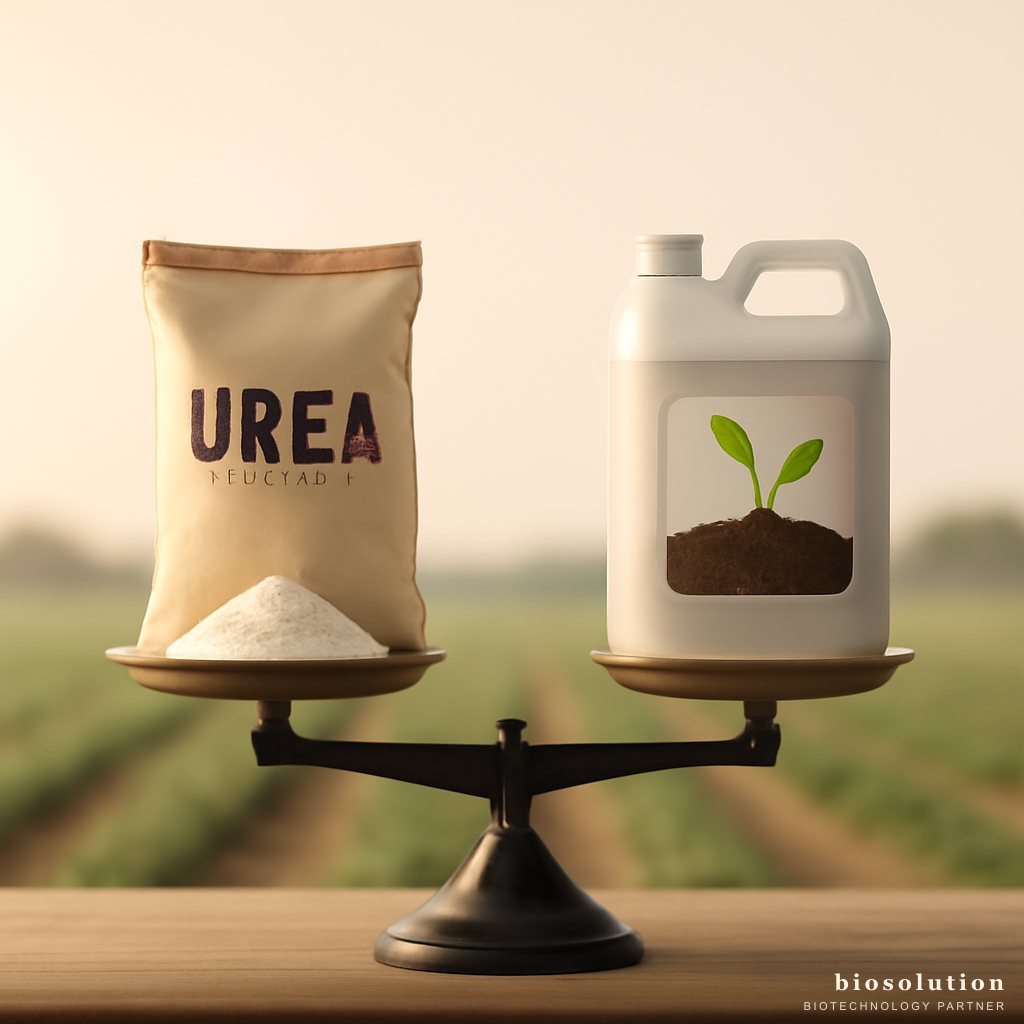
Urea fertilizer is the main source of nitrogen for plants, but its fluctuating price and environmental impact from overuse have driven farmers to seek alternatives. Nitrogen-fixing biofertilizers like the 5-in-1 Liquid Biofertilizer Formula serve as an effective and environmentally friendly substitute for urea fertilizer. This product contains five superior microbial strains that work synergistically to provide nitrogen, phosphorus, and growth hormones, thereby reducing chemical fertilizer dosage by up to 50% without lowering crop yields. This article will guide you on the correct application: dosage, frequency, and best timing.
Why Can Nitrogen-Fixing Biofertilizer Replace Urea Fertilizer?
Urea fertilizer (CO(NH₂)₂) provides nitrogen in the form of ammonium that is readily available, but most is lost through volatilization and leaching. Nitrogen-fixing biofertilizers work naturally by utilizing N₂-fixing bacteria from the air. In the 5-in-1 Liquid Biofertilizer Formula, there are two nitrogen-fixing strains: Rhizobium sp. which symbioses with legumes, and Azospirillum sp. which associates with the roots of gramineae like rice and corn. These bacteria convert atmospheric nitrogen (N₂) into ammonia (NH₃) that plants can absorb. With a population of 10⁸ CFU/ml per strain, this consortium can provide the equivalent of 50–100 kg N/ha per season, depending on soil and crop conditions. Additionally, Bacillus subtilis solubilizes bound phosphate, Pseudomonas fluorescens controls pathogens, and Trichoderma sp. improves soil. This combination makes the biofertilizer not only replace part of the urea fertilizer but also increase overall fertilization efficiency.
Nitrogen Fixation Mechanism by Rhizobium and Azospirillum
Rhizobium sp. forms root nodules on legume plants (soybean, peanut) and fixes N₂ symbiotically. Meanwhile, Azospirillum sp. lives on the root surface and inside root tissues of non-legume plants, producing nitrogen through associative fixation. Both produce the phytohormone IAA which stimulates root growth, making plants more efficient at nutrient uptake. With regular application, these bacterial populations continue to develop in the rhizosphere, providing a continuous nitrogen supply throughout the growing season.
Correct Dosage of 5-in-1 Liquid Biofertilizer Formula as a Substitute for Urea Fertilizer
The recommended dosage is 5–10 ml per liter of water, applied by drenching the root zone or spraying onto the soil. For each application, use 1–2 liters of solution per square meter of land. For rice, for example, a dosage of 10 ml per liter of water (equivalent to 200 ml of product per hectare per application) is sufficient to replace 50% of the urea dosage. For corn or horticultural crops, a dosage of 5–7 ml per liter of water is effective. It is important not to exceed the dosage, as excess microbes can cause competition among strains. The solution should be used immediately after mixing, and avoid mixing with chemical fertilizers or pesticides in the same tank as it can kill the microbes.
Dosage Table for Several Crops
| Crop | Dosage per liter of water | Solution volume per plant | Frequency |
|---|---|---|---|
| Rice | 10 ml | 200 ml per hill | 3–5 times/season |
| Corn | 7 ml | 300 ml per plant | 3–4 times/season |
| Chili | 5 ml | 200 ml per plant | 4–5 times/season |
| Soybean | 5 ml | 150 ml per plant | 2–3 times/season |
Effective Application Frequency
The application frequency for the 5-in-1 Liquid Biofertilizer Formula is every 10–14 days, 3–5 times per growing season. This interval maintains a high microbial population in the rhizosphere. The first application is done at planting or immediately after seedlings are transplanted, then repeated during the active vegetative phase (15–30 DAT) and early generative phase (40–50 DAT). For long-season crops like chili or tomato, an additional application during fruit set can increase yields. Do not apply during heavy rain as the solution will be washed away; choose sunny weather or after the rain subsides.
Example Application Schedule for Rice
- Application I (0–7 DAT): Drench 10 ml/liter of water at planting or immediately after transplanting.
- Application II (15–20 DAT): Drench again with the same dosage to stimulate tillering.
- Application III (35–40 DAT): At the panicle initiation stage, support panicle formation.
- Application IV (50–55 DAT): Optional, if plants appear yellowish.
Best Application Time: Morning or Afternoon?
Microbes in biofertilizers are sensitive to UV light and high temperatures. The best application times are morning before 10 AM or afternoon after 4 PM. During these hours, sunlight intensity is low, so bacteria do not die quickly. Soil temperature is also cooler, supporting microbial growth. Avoid application during the hot midday or when it is windy. If forced to apply at midday, immediately water with clean water afterward to reduce microbial death.
Tips for Successfully Reducing Urea Fertilizer with Biofertilizer
- Combine with organic fertilizer: Manure or compost provides organic matter as food for microbes, increasing nitrogen fixation effectiveness.
- Gradually reduce urea dosage: Start by reducing 25% of the urea dosage in the first season, then 50% in the following season if yields remain good.
- Ensure soil moisture: Microbes need adequate moisture. Good irrigation helps distribute bacteria.
- Use clean water: Well water or rainwater is better than tap water containing chlorine.
- Store product in a cool place: Keep away from direct sunlight to maintain microbial viability at 10⁸ CFU/ml.
Advantages of 5-in-1 Liquid Biofertilizer Formula Compared to Urea Fertilizer
Besides being a substitute for urea fertilizer, this product provides multiple benefits: increasing phosphorus (P) availability through Bacillus subtilis, controlling root diseases with Pseudomonas fluorescens and Trichoderma sp., and improving soil structure. Field trial results show a 20–30% increase in rice and corn yields, and up to 50% savings on fertilizer costs. With a population of 10⁸ CFU/ml per strain, this consortium of 5 microbes works more effectively than single-strain biofertilizers. This product is also safe for humans and the environment, leaving no chemical residues.
Conclusion
Replacing urea fertilizer with a nitrogen-fixing biofertilizer like the 5-in-1 Liquid Biofertilizer Formula is a smart step toward sustainable agriculture. With a dosage of 5–10 ml per liter of water, frequency every 10–14 days for 3–5 times per season, and application in the morning or afternoon, you can reduce urea use by up to 50% without sacrificing yields. This product not only provides nitrogen but also improves soil fertility and plant resilience. For optimal results, consult with the Biosolution expert team via WhatsApp or see product details on the product page. Start the transition to economical and environmentally friendly farming now!
FAQ
Can the 5-in-1 Liquid Biofertilizer Formula completely replace urea fertilizer?
Not entirely. This product can replace up to 50% of the urea dosage, especially in crops responsive to nitrogen fixation like rice and corn. For high nitrogen requirements, a low dose of urea fertilizer is still needed as a supplement. The combination provides optimal results.
How many applications per growing season?
It is recommended to apply 3–5 times per growing season with an interval of 10–14 days. The first application at planting, then during the vegetative and early generative phases. For long-season crops, an additional application during fruit set can increase yields.
Can it be mixed with pesticides?
It is best not to mix directly in the same tank because chemical pesticides can kill the microbes. Apply the biofertilizer first, wait 2–3 days, then spray pesticides if needed. For best results, use compatible organic pesticides.
How to store the product?
Store in a cool, dry place at 15–25°C, away from direct sunlight. Do not freeze. The product remains stable for 12 months from production with a minimum population of 10⁸ CFU/ml per strain.
Is this product suitable for all plants?
Yes, the 5-in-1 Liquid Biofertilizer Formula is formulated for all plants, especially rice, corn, soybean, and horticultural crops. For legume plants, Rhizobium sp. will form root nodules, while Azospirillum sp. works on gramineae. Other plants also benefit from phosphate solubilization and growth hormones.