Beginner Biofloc System Starter: 3 Proven Key Bacterial Formulas to Accelerate Stable Floc Formation
Starting fish farming with a biofloc system is often a challenge for beginners. One of the most critical success factors is the beginner biofloc system starter for fish farming. Without proper bacterial inoculation, floc formation can be slow, water quality unstable, and ultimately ruin the harvest. In this article, we will technically discuss how a starter formula based on three superior bacterial strains from Biosolution can accelerate floc formation, based on real field case studies.
Why is a Biofloc Starter Important for Beginners?
The biofloc system relies on a microbial community to process nitrogen waste (ammonia, nitrite) into single-cell protein that fish can eat. This process does not happen instantly. In new ponds, populations of nitrifying and heterotrophic bacteria are very low. As a result, ammonia can spike and kill the fry. This is where the biofloc system starter plays a role. By adding a proven bacterial consortium, beginners can shorten the incubation period from 2-3 weeks to just 5-7 days. A case study in Mr. Slamet's pond in East Java showed that without a starter, floc formed completely only on day 18, while with the Biosolution formula, floc was stable by day 6.
3 Key Formulas in the Biosolution Biofloc Starter
The Biofloc System Starter Formula product from Biosolution contains three bacterial strains that work synergistically to build and stabilize floc. Here are the details of each:
Bacillus subtilis: Floc Biofilm Former
Bacillus subtilis is a Gram-positive bacterium that produces extracellular protease and amylase enzymes. These enzymes break down leftover feed and feces into simple molecules that are then used as substrates for floc formation. More importantly, B. subtilis produces biosurfactant compounds that help aggregate organic particles into compact floc. In the starter application, this bacterium ensures floc forms quickly and has a structure that is not easily destroyed by aeration.
Bacillus megaterium: Floc Microbiota Stabilizer
Bacillus megaterium is a large bacterium capable of fermenting various complex carbohydrates. Its role in the starter is to maintain the balance of microbial populations within the floc. This bacterium produces natural antimicrobial compounds that suppress the growth of pathogenic bacteria such as Vibrio spp. In biofloc ponds, the presence of B. megaterium has been shown to reduce fry mortality by up to 30% (Biosolution internal trial data).
Nitrosomonas sp.: Nitrification Engine of the Biofloc System
Nitrosomonas sp. is a chemoautotrophic bacterium that oxidizes ammonia (NH₃) into nitrite (NO₂⁻). This is the first step in the nitrogen cycle. Without Nitrosomonas, ammonia will accumulate and become toxic to fish. In the starter formula, Nitrosomonas sp. is present at high concentrations so that nitrification can proceed from the first day of application. As a result, ammonia levels remain below 0.5 mg/L during the critical first week.
Case Study: Beginner Catfish Biofloc Pond in Lampung
To provide a real picture, we take a case study of a catfish pond owned by Mr. Agus (a beginner) in Lampung. The pond is 500 m³ with a stocking density of 200 fish/m³. He used the Biofloc System Starter Formula according to instructions: 5 L per 1000 m³, applied in the morning before stocking fry. Carbon source in the form of molasses was given at a C:N ratio of 15:1. Results:
- Day 3: Floc began to appear as small spheres (0.5-1 mm diameter).
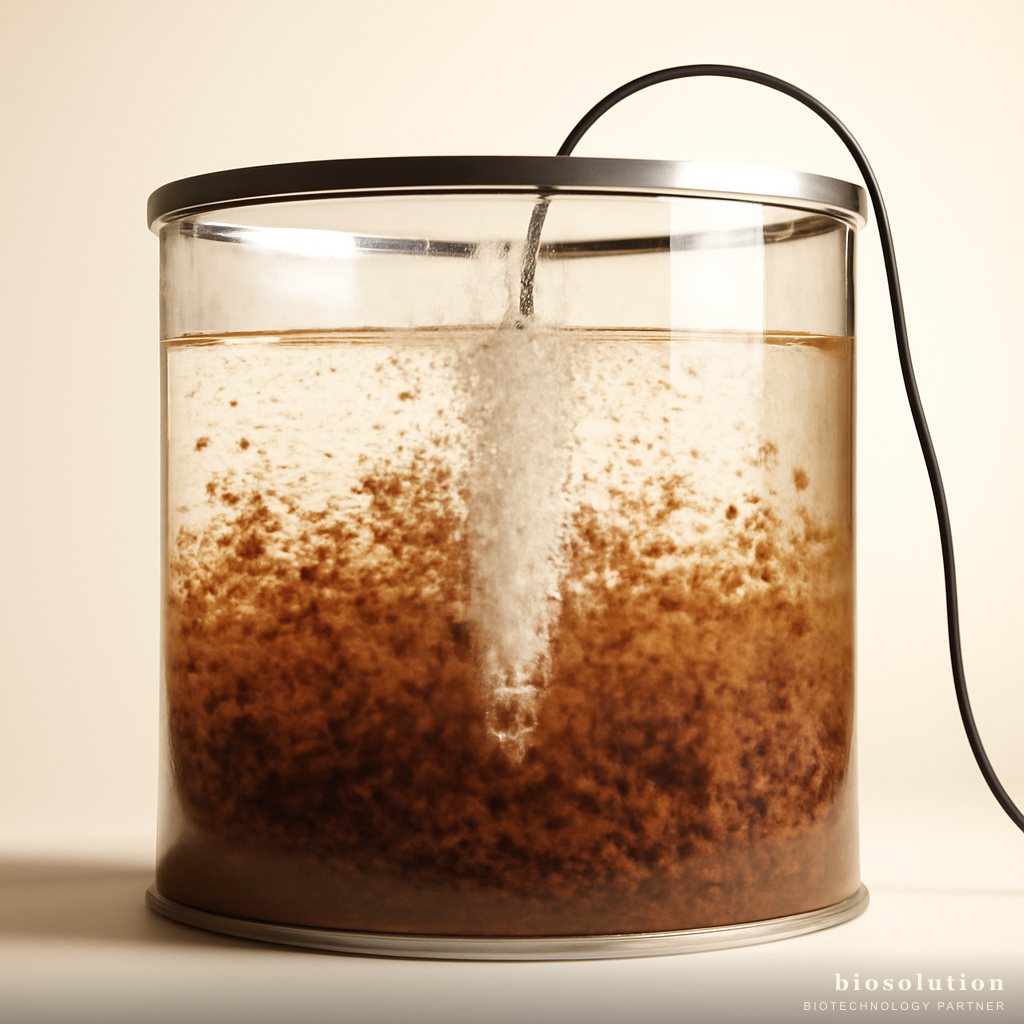
- Day 7: Floc reached 3-5 mm diameter, water turned brownish-green (sign of rich microbes).
- Day 14: Stocking density increased to 300 fish/m³ without water quality issues.
- Harvest day 60: FCR 0.9 (conventional average 1.2-1.5), survival rate 92%.
Mr. Agus saved up to 25% on feed costs compared to his previous method. According to him, the key to success is the right starter and discipline in maintaining the C:N ratio.
How to Apply the Biofloc Starter Formula for Beginners
Here is a step-by-step guide to applying the Biofloc System Starter Formula:
- Pond Preparation: Fill the pond with fresh water, adjust pH to 7-8, temperature 28-30°C. Ensure aeration runs 24 hours before starter.
- Calculate Dosage: Use 5 L of formula per 1000 m³ of water. For a 500 m³ pond, 2.5 L is sufficient.
- Application: Dilute the formula with pond water (1:10), then spread evenly on the surface. Do this in the morning, 1-2 hours before stocking fry.
- Carbon Source: Add molasses or tapioca flour at a C:N ratio of 15-20. For every 1 kg of feed given, add 0.5 kg of molasses (assuming 40% carbon content).
- Monitoring: Measure ammonia, nitrite, and floc volume every 2 days. Ideal floc volume is 10-15 mL/L after 1 week.
Note: If floc has not formed by day 5, check aeration and C:N ratio. Do not hesitate to boost with half the initial dose.
Advantages of Biosolution Starter Formula Compared to Other Products
Many biofloc starter products are on the market, but the Biosolution formula has several technical advantages:
- Three-Bacterial Consortium: Not only Bacillus, but also Nitrosomonas which is rarely found in other products. This ensures rapid nitrification.
- High Concentration: Each mL contains at least 10⁸ CFU of live bacteria, making the dosage more efficient.
- Shelf Stability: The formula is packaged in airtight bottles with stabilizers, lasting up to 12 months at room temperature.
- Environmentally Friendly: Contains no synthetic chemicals, safe for fish and workers.
FAQ: Common Questions from Biofloc Beginners
1. Does the biofloc starter need to be reapplied every cycle? Yes, at the start of each new cycle the pond must be restarted because bacterial populations drop drastically after harvest. However, if you use a recirculation system with a biofloc filter, the starter dose can be reduced.
2. How long does it take for floc to start forming after starter application? With the Biosolution formula, floc usually becomes visible within 3-5 days. Influencing factors: water temperature, carbon availability, and aeration. At temperatures below 25°C, the process is slightly slower.
3. Can I mix the starter with other probiotics? It is best not to. The starter formula is already formulated with a balanced consortium. Mixing other probiotics could disrupt the population ratio. If you want to add probiotics, do so after floc is stable (at least 2 weeks).
4. What should I do if there is too much floc (volume >20 mL/L)? Reduce feeding and increase aeration. Excess floc can cause high oxygen consumption at night. You can also harvest some floc to use as additional feed.
5. Can the starter be used for all types of fish? Yes, this formula is suitable for freshwater fish such as catfish, tilapia, pangasius, and gourami. However, for brackish or marine fish, consult first with the Biosolution technical team because salinity affects bacterial performance.
Conclusion
A biofloc system starter for beginner fish farming is not just an additional product, but an initial investment that determines the success of the cultivation cycle. With a formula containing Bacillus subtilis, Bacillus megaterium, and Nitrosomonas sp., Biosolution provides a starter solution proven to accelerate floc formation, reduce fry mortality risk, and improve feed efficiency. The case study in Lampung proves that even beginners can achieve FCR below 1.0 and survival rates above 90% as long as they follow the application SOP diligently. If you are interested in starting biofloc farming, do not hesitate to consult with the Biosolution expert team via WhatsApp or see the product directly Biofloc Starter Formula for optimal results.