Beginner Biofloc System Starter: Correct Application Method & Dosage
Starting fish farming with a biofloc system can feel complicated for beginners. However, with the right beginner biofloc system starter, you can accelerate floc formation and maintain water quality. This article will guide you step by step in applying the Biosolution Biofloc System Starter Formula, including dosage per hectare, frequency, and optimal application time.
What Is a Biofloc System Starter and Why Is It Important?
The biofloc system is a farming technology that relies on microbial communities to process organic waste into natural protein feed. A biofloc system starter is a bacterial inoculant that accelerates the formation of flocs (microbial aggregates) in the pond. Without a starter, nitrification and biofilm formation can take weeks, increasing the risk of fry mortality due to high ammonia.
The Biosolution Biofloc System Starter Formula contains three superior bacteria:
- Bacillus subtilis: a biofilm-forming bacterium that serves as the floc framework.
- Bacillus megaterium: stabilizes the floc microbiota and helps decompose organic matter.
- Nitrosomonas sp.: a nitrifying bacterium that oxidizes ammonia to nitrite, then nitrate.
This combination ensures rapid floc formation, high stocking density, and a healthy farming environment.
Biofloc System Starter Dosage: 5 L per 1000 m³
The recommended dosage for the Biofloc System Starter Formula is 5 liters per 1000 cubic meters of water. This is equivalent to 5 mL per cubic meter. For a pond with a volume of 200 m³, you only need 1 liter of product. This dosage has been tested to produce optimal floc density within 7-14 days.
How to Calculate Requirements
- Measure pond volume: length x width x water depth (in meters).
- Example: pond 10 m x 5 m x 2 m = 100 m³.
- Starter requirement: (100 m³ / 1000 m³) x 5 L = 0.5 L or 500 mL.
Make sure to use clean measuring tools to avoid contamination.
Application Time: Morning Before Stocking Fry
The best time to apply the starter is in the morning, before fry are stocked. Lower water temperature in the morning (25-30°C) supports bacterial activity without thermal stress. Additionally, morning application gives bacteria time to adapt and start forming flocs before fry enter.
Application Steps
- Pond preparation: Fill the pond with clean water, ensure pH 6.5-8.0 and salinity suitable for the fish species.
- Aeration: Turn on aerators for 24 hours before starter to increase dissolved oxygen.
- Carbon addition: Add a carbon source (e.g., molasses or tapioca flour) at a C:N ratio of 15-20. Example: for 100 m³, add 2-3 kg of molasses.
- Starter application: Mix 5 L of starter per 1000 m³ with pond water, then spread evenly over the surface.
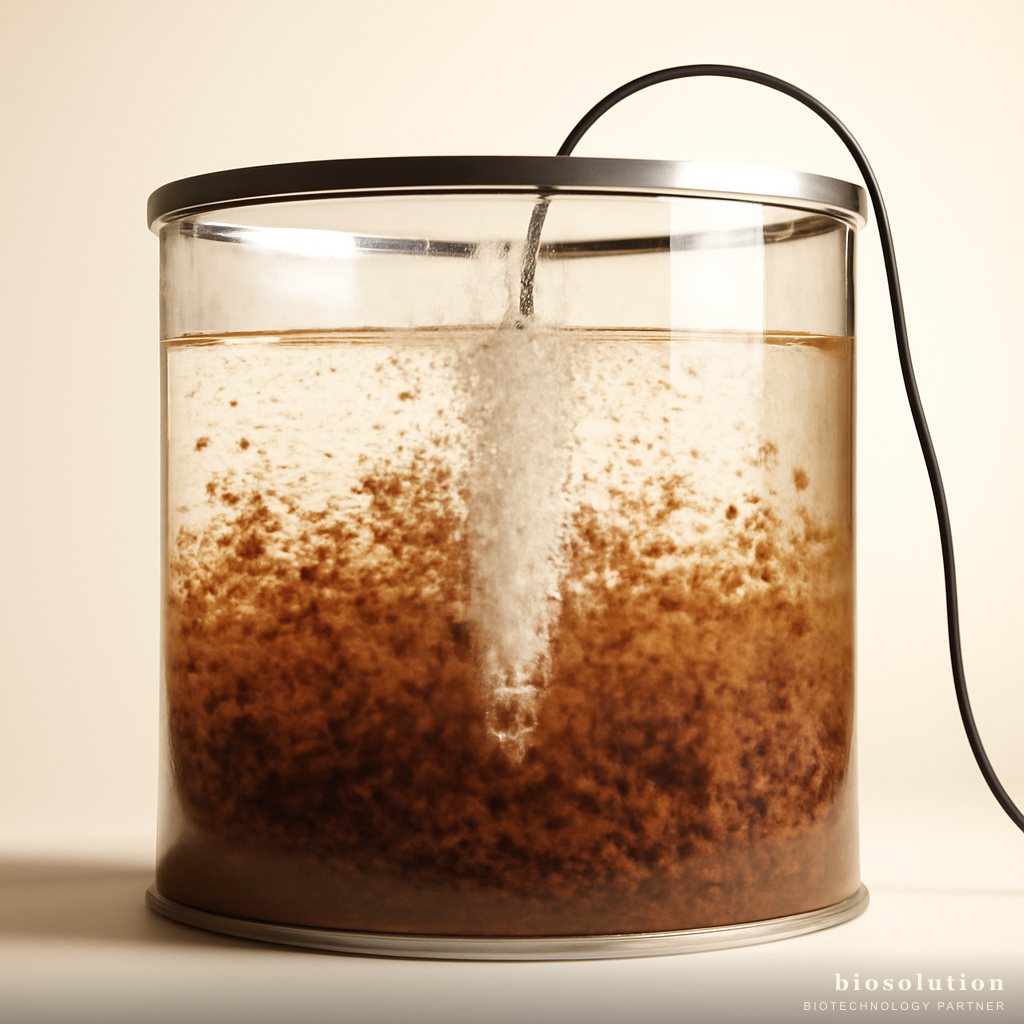
- Wait 3-7 days: Let the flocs develop. Monitor water parameters (ammonia, nitrite, pH). Once flocs form (water turns brownish-green), fry are ready to be stocked.
Frequency: One-Time Starter, Then Maintenance
For beginners, one starter application at the beginning of the cycle is sufficient. After flocs form, you only need to perform regular maintenance by adding carbon daily (as needed) and additional probiotics if necessary. However, if flocs decline or water quality changes drastically, you can repeat the starter at half the initial dosage.
Maintenance Tips
- Monitor floc volume: ideally 10-20% of water volume.
- Maintain C:N ratio by adding carbon every time feed is given.
- Periodically siphon bottom sludge to prevent accumulation.
Benefits of Using a Biofloc Starter for Beginners
By following the guide above, you will experience several advantages:
- Stable flocs from the start: Reduces the risk of floc formation failure.
- High stocking density: With maintained water quality, you can stock more fry.
- Water and feed savings: Flocs become natural feed, reducing water change frequency and feed costs.
- Environmentally friendly: Organic waste is processed directly in the pond, not polluting the environment.
Conclusion
The biofloc system starter is the key to successful fish farming with biofloc technology, especially for beginners. With a dosage of 5 L per 1000 m³, application in the morning before stocking fry, and one-time starter frequency, you can achieve stable flocs in a short time. Make sure to follow the SOP for carbon addition with a C:N ratio of 15-20 for optimal results.
If you want to start biofloc farming, see the Biofloc Starter Formula product to get a quality starter. For further consultation, contact the Biosolution team via WhatsApp.
FAQ
1. Is the biofloc starter safe for fish fry?
Yes, the biofloc starter contains non-pathogenic bacteria that are safe for fish. Bacillus subtilis, Bacillus megaterium, and Nitrosomonas sp. are microbes commonly used in aquaculture. Make sure to follow the recommended dosage and do not stock fry before flocs form (usually 3-7 days after application).
2. What if my pond is larger than 1000 m³?
The dosage remains proportional: 5 L per 1000 m³. For example, a 5000 m³ pond requires 25 L of starter. You can buy larger packaging or several 5 L packages. Ensure even mixing by diluting the starter in pond water before spreading.
3. Do I need to add carbon after the starter?
Yes, it is very important. Bacteria need carbon as an energy source to form flocs. Add a carbon source (molasses, sugar, or flour) at a C:N ratio of 15-20. After the starter, you need to maintain carbon daily according to the feed given.
4. How long until flocs become visible?
Flocs usually become visible within 3-7 days after starter application. Signs: water turns brownish-green, small aggregates appear, and ammonia smell decreases. If flocs have not formed within 10 days, check water parameters (pH, oxygen, temperature) and repeat the starter.
5. Can the starter be used for all types of fish?
The biofloc starter is suitable for fish tolerant of turbidity and low oxygen, such as tilapia, catfish, and pangasius. For more sensitive fish, consult an expert. Also ensure salinity and pH match the requirements of your fish species.