Common Mistakes in Using Pond Bottom Sludge Decomposers Without Draining
Accumulated pond bottom sludge is a nightmare for intensive farmers. The buildup of leftover feed, feces, and dead plankton creates an organic layer that hinders productivity. Many turn to pond bottom sludge decomposers without draining as a solution, but many fail due to application errors. This article discusses seven common mistakes and how probiotics with Bacillus subtilis and Bacillus licheniformis can be the right answer.
1. Choosing a Product Without Understanding the Microbial Composition
The first mistake is choosing a pond bottom sludge decomposer product without looking at the microbial strains inside. Not all decomposer bacteria work effectively in aquaculture environments. Products containing only fermentation bacteria will not be able to decompose complex organic sludge.
Why Bacillus Dominates?
Bacillus subtilis and Bacillus licheniformis are gram-positive bacteria that produce extracellular enzymes such as protease, amylase, and lipase. These enzymes break down proteins, carbohydrates, and fats in sludge into simple, non-toxic compounds. Without these bacteria, the decomposition process is slow and incomplete.
2. Incorrect Dosage and Application Frequency
The second mistake is haphazard dosing. Many farmers think "the more the better" or apply too little, making it ineffective. In fact, each product has an optimal dosage based on pond area and sludge accumulation level.
Correct Dosage of Pond Bottom Sludge Decomposer Formula
Biosolution's Pond Bottom Sludge Decomposer Formula is recommended at a dose of 1 tablet per 50 m² of pond bottom, applied every 14 days in the morning. Tablets are scattered at points on the pond bottom so bacteria directly contact the sludge. This dosage has been tested to maintain pond ecosystem balance without overfeeding bacteria.
3. Application at the Wrong Time
Application time greatly affects bacterial effectiveness. Bacillus bacteria are aerobic, requiring sufficient dissolved oxygen to thrive. Application at night or when oxygen is low causes bacteria to become inactive.
Morning is the Best Time
Morning after the first feeding is ideal because dissolved oxygen is still high and water temperature begins to rise. Avoid application during cloudy weather or after rain, as oxygen tends to be low.
4. Not Checking Water Quality Before Application
The fourth mistake is directly spreading probiotics without checking water parameters such as pH, temperature, and salinity. Bacillus bacteria require neutral to slightly alkaline pH (6.5–8.5) and temperatures of 25–35°C. Water that is too acidic or too cold will inhibit bacterial growth.
Preparation Steps
Before application, measure pH and water temperature. If pH is below 6.5, apply lime first. Ensure water temperature is above 25°C. Under optimal conditions, bacteria will work maximally to decompose sludge.
5. Ignoring Aeration and Water Circulation
Although probiotics work on the pond bottom, aeration remains important. Bacillus bacteria need oxygen for respiration and enzyme production. Without sufficient aeration, bacteria will die or switch to anaerobic metabolism, producing toxic gases.
Manage Aeration
Ensure aerators function well for 24 hours. Place paddlewheels or blowers so that circulation reaches the pond bottom. With optimal aeration, sludge decomposition is faster and ammonia remains controlled.
6. Inconsistent Application
The sixth mistake is applying only once or not regularly. Organic sludge forms every day, so bacteria must be supplied periodically to maintain sufficient populations. Many farmers stop after sludge decomposes, but accumulation will recur.
Regular Schedule
Follow a frequency of every 14 days. If sludge is very thick, apply every 7 days for the first 2–3 applications, then return to 14 days. Consistency is key to success without draining.
7. Assuming All Probiotics Are the Same
The last mistake is assuming all pond probiotics have the same function. In fact, there are probiotics for improving water quality, for feed, and specifically for sludge decomposition. Using regular water probiotics to decompose sludge will not be effective because the microbial composition is different.
Product Specifications
The Pond Bottom Sludge Decomposer Formula is specifically designed with Bacillus subtilis as an organic decomposer and Bacillus licheniformis as an extracellular enzyme producer. This combination accelerates sludge decomposition without disturbing pond biota. This product also contains extracellular enzymes that directly break down organic matter.
Conclusion
Using a pond bottom sludge decomposer without draining is a smart step for operational efficiency. However, avoid the seven mistakes above for optimal results. Choose a product with a composition of Bacillus subtilis and Bacillus licheniformis like Pond Bottom Sludge Decomposer Formula from Biosolution. With the right dosage, morning application time, and consistency, pond bottom sludge will decompose, ammonia drops significantly, and the pond remains healthy without needing draining. For further consultation, contact our technical team via WhatsApp.
FAQ
1. Is the Pond Bottom Sludge Decomposer Formula safe for fish/shrimp?
Yes, this product is safe because it uses non-pathogenic bacteria that have been tested. Bacillus subtilis and Bacillus licheniformis are probiotic bacteria commonly used in aquaculture. They do not infect fish or shrimp; instead, they help improve water quality, reducing stress on biota.
2. How long does it take for pond bottom sludge to decompose after application?
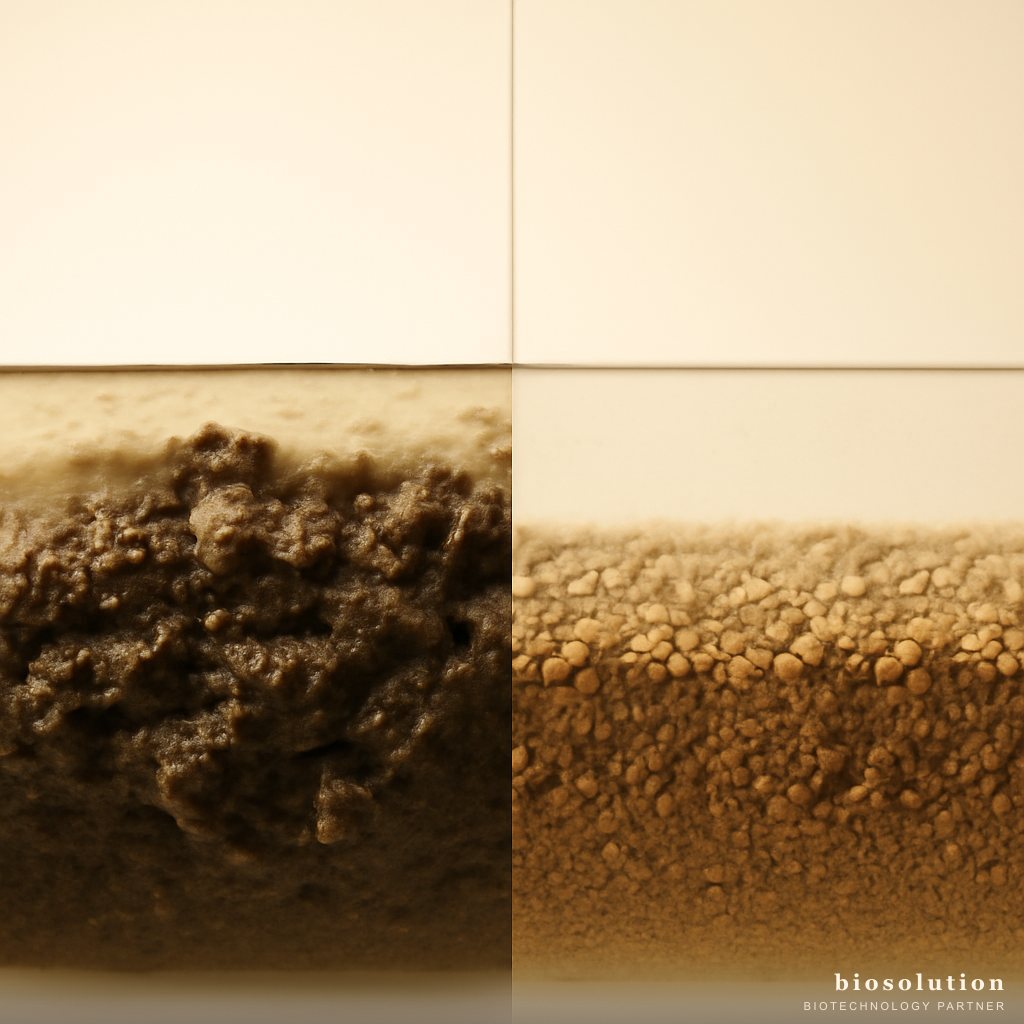
Results begin to appear within 7–14 days after regular application. Sludge volume decreases and its color changes from jet black to grayish brown. Ammonia reduction is usually detected within 3–5 days. Complete decomposition requires 2–3 application cycles (28–42 days).
3. Do I need to reduce feeding when using probiotics?
No. Probiotics work to decompose leftover feed and feces, so feeding remains normal. However, ensure feed is not excessive to reduce organic load. Monitor feed conversion ratio (FCR) for efficiency.
4. Can it be used together with other water probiotics?
Yes, as long as those water probiotics do not contain chemicals that kill bacteria. It is best to leave a 2–3 hour gap between applying water probiotics and sludge decomposer. Consult with a technician for the right product combination.
5. How should probiotic tablets be stored?
Store in a cool, dry place at room temperature (25–30°C), away from direct sunlight. Tablets do not need refrigeration. Ensure the package is tightly sealed after use to maintain bacterial viability.