Granular Biofertilizer for Large-Scale Plantations: Latest Formula Field Trial Results for B2B Plantations
Large-scale plantations face unique fertilization challenges: application efficiency, labor costs, and long-term effectiveness. Granular biofertilizer for large-scale plantations emerges as a solution combining mechanical application ease with soil microbiology benefits. This article presents field trial results of the Granular Biofertilizer Formula for Large-Scale Plantations from Biosolution, specially formulated for B2B plantations. With five superior microbial strains, this product offers gradual nutrient release, increases soil organic carbon, and reduces nutrient leaching. How does it perform in the field? Check out the data and analysis below.
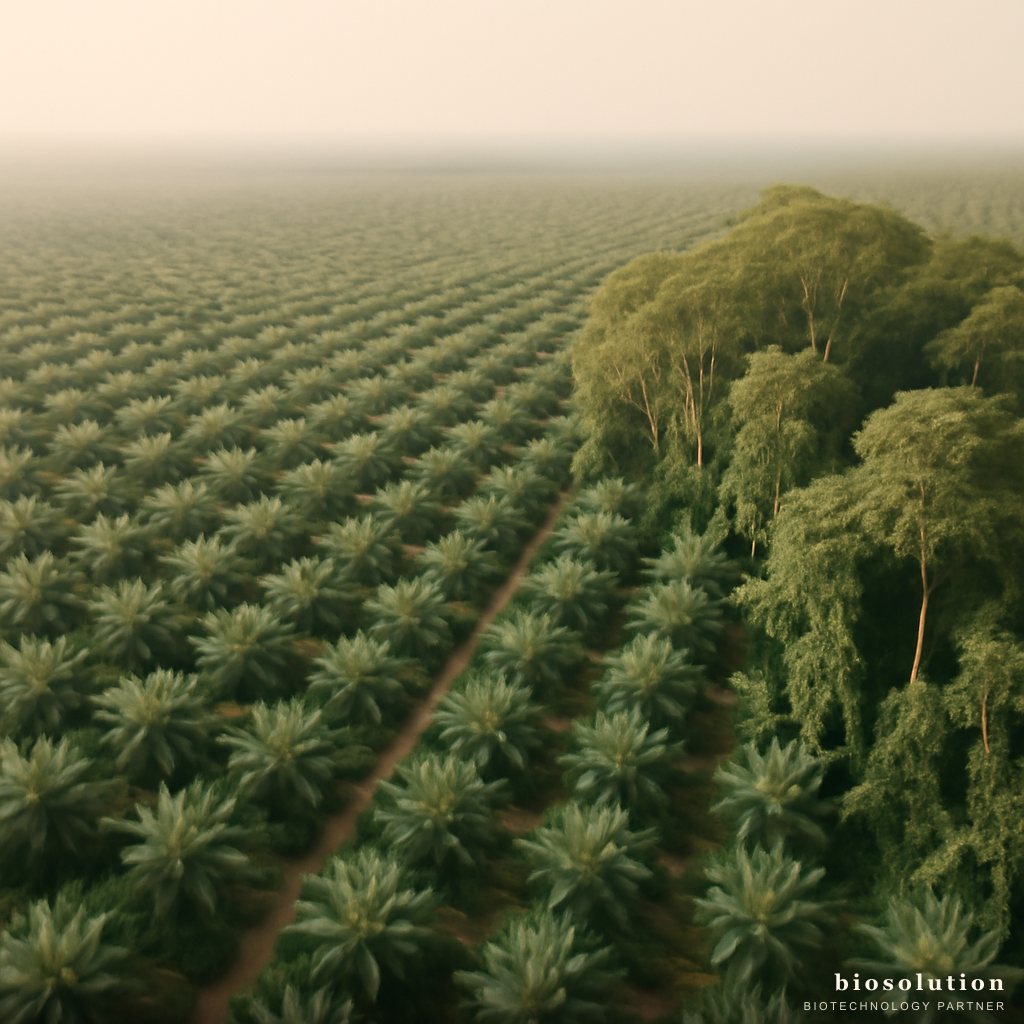
Field Trial of Granular Biofertilizer Formula on Oil Palm Plantations
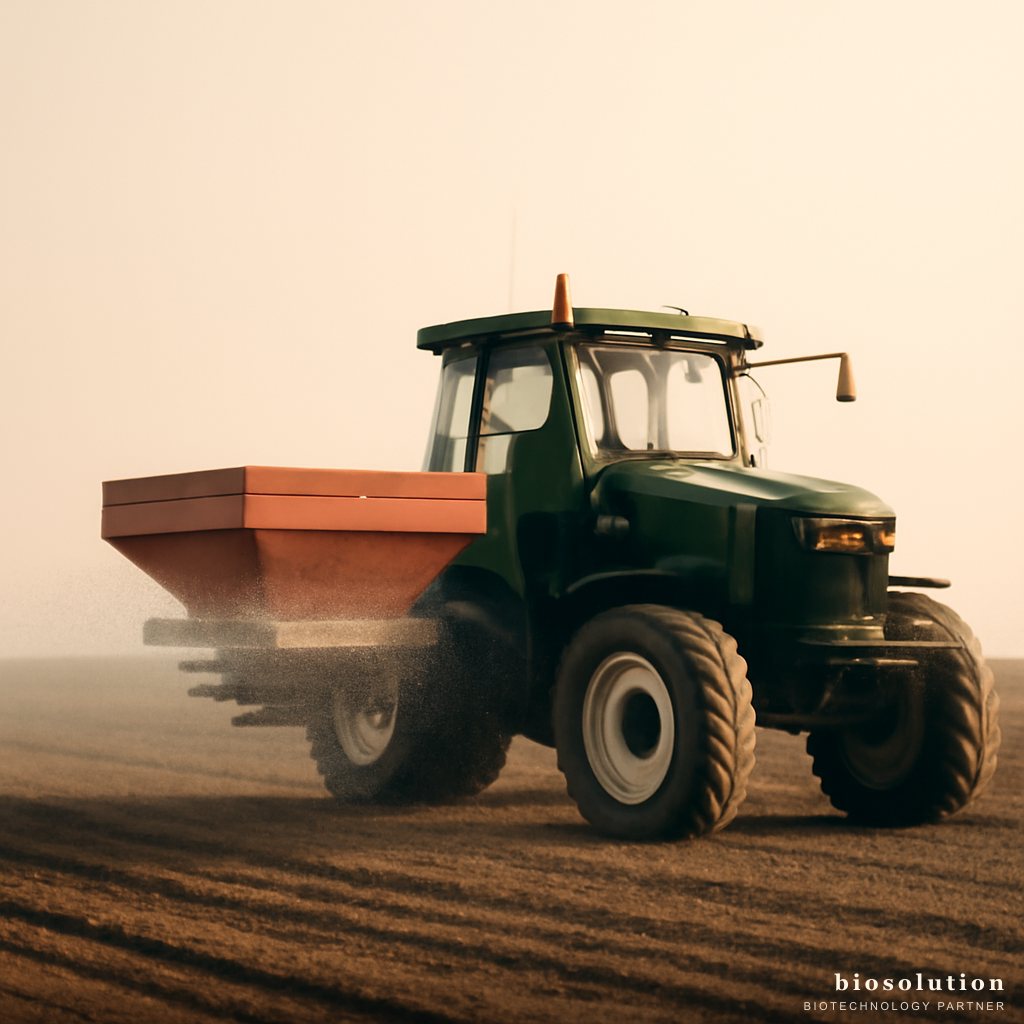
The first field trial was conducted on a 50-hectare oil palm plantation in Riau. The treatment used the Granular Biofertilizer Formula for Large-Scale Plantations at a dose of 200 kg/ha, applied once at the start of the rainy season using a centrifugal spreader. Parameters measured included plant height, stem diameter, number of fronds, and fresh fruit bunch (FFB) production over two harvest seasons.
Application Method and Dosage
Application was done by spreading granules evenly around the root zone, within a radius of 1-2 meters from the base of the stem. The 2-4 mm granule size ensures uniform distribution without clogging the spreader nozzle. A dose of 200 kg/ha is equivalent to 2 kg per tree (population of 100 trees/ha). Application was carried out in the morning when soil moisture is high to optimize microbial activation.
Observation Results
After 12 months, treated plants showed:
- Average plant height increase of 12% compared to control
- Stem diameter 8% larger
- Number of productive fronds increased by 15%
- FFB production increased by 18% in the first season and 22% in the second season
Rhizobium sp. in the formula plays a role in fixing nitrogen from the air, while Bacillus subtilis solubilizes bound phosphate and suppresses pathogens such as Ganoderma boninense. This combination creates synergy that supports vegetative and generative growth of oil palm.
Field Trial on Dryland Sugarcane Plantations
The second field trial was conducted on a 30-hectare dryland sugarcane plantation in East Java. The sugarcane variety used was PS 881. The treatment used the Granular Biofertilizer Formula for Large-Scale Plantations at a dose of 150 kg/ha, applied during land preparation together with basal NPK fertilization.
Microbial Mechanism of Action on Sugarcane
Azospirillum sp. in the formula is an associative nitrogen-fixing bacterium that lives in the sugarcane rhizosphere and continuously provides nitrogen. Pseudomonas fluorescens produces siderophores that bind iron, inhibit pathogen growth, and solubilize phosphate. Trichoderma sp. acts as a biocontrol agent for soil fungi such as Fusarium and Rhizoctonia.
Harvest Data
Parameters observed included plant height, stem diameter, stem weight per clump, and sugar yield. Results showed:
- Average plant height of 2.8 meters (control 2.5 meters)
- Stem diameter of 3.2 cm (control 2.9 cm)
- Stem weight per clump increased by 20%
- Sugar yield increased by 1.2 absolute points (from 8.5% to 9.7%)
This increase in sugar yield is economically significant because every 1-point increase in yield is equivalent to millions of rupiah in additional income per hectare.
Advantages of Granule Formula for Mechanical Application
One obstacle of liquid biofertilizers is the need for repeated applications and specialized equipment. The granule formula overcomes this with several advantages:
- Ideal Granule Size: 2-4 mm, suitable for all types of spreaders (centrifugal spreader, boom spreader, drone spreader).
- Long Shelf Life: 24 months at room temperature, without significant viability decline.
- High Density: 10⁹ CFU/g granule, ensuring sufficient microbial population even at low doses.
- Gradual Release: The granule matrix protects microbes from drought and UV light, releasing them slowly.
- Labor Efficiency: One spreader operator can apply to 10-15 hectares per day, compared to 2-3 hectares with manual application.
Comparison with Liquid Biofertilizer
| Parameter | Granule | Liquid |
|---|---|---|
| Application frequency | 1-2 times/season | 3-4 times/season |
| Water requirement | Not needed | Requires dissolution |
| Shelf life | 24 months | 6-12 months |
| Ease of application | Very easy (machine) | Moderate (spray) |
| Labor cost | Low | Medium-high |
Impact on Long-Term Soil Health
In addition to crop yield, the field trial also measured changes in soil properties after two seasons of application. Soil samples were taken at a depth of 0-20 cm before and after treatment.
Increase in Soil Organic Carbon
Soil organic carbon content increased by an average of 0.3% (from 1.2% to 1.5%). The granule matrix containing organic matter contributes directly, while microbial activity enhances decomposition of plant residues. This increase in organic carbon is important for water retention, cation exchange capacity, and soil biological activity.
Rhizosphere Microbial Population
The population of phosphate-solubilizing bacteria increased 2-3 fold, while the population of pathogenic fungi decreased drastically. This indicates that the Granular Biofertilizer Formula for Large-Scale Plantations not only provides exogenous microbes but also stimulates indigenous microbes.
Economic Analysis: Fertilization Cost Efficiency
A cost-benefit analysis was conducted on an oil palm plantation assuming an FFB price of IDR 2,500/kg and application costs of IDR 500,000/ha for granules (including machine rental and operator) versus IDR 1,200,000/ha for liquid biofertilizer (4 applications).
Additional Revenue Calculation
- Control FFB production: 25 tons/ha/year
- Treatment FFB production: 30 tons/ha/year (20% increase)
- Additional revenue: 5 tons x IDR 2,500,000 = IDR 12,500,000/ha
- Additional biofertilizer cost: IDR 2,500,000/ha (product price + application)
- Net profit: IDR 10,000,000/ha/year
Thus, investment in granular biofertilizer provides a return on investment (ROI) of over 400% in one season.
Conclusion
Field trial results prove that the Granular Biofertilizer Formula for Large-Scale Plantations effectively increases productivity of B2B plantations, both oil palm and sugarcane. With ease of application using spreaders, a dose of 100-250 kg/ha, and a content of 10⁹ CFU/g, this product is an economical sustainable fertilization solution. For further consultation on specific doses for your crop, contact the Biosolution technical team via WhatsApp.
FAQ
1. What is the appropriate dose for rubber plants? The recommended dose for rubber is 150-200 kg/ha, applied at the start of the rainy season. For immature plants (TBM), a dose of 100 kg/ha is sufficient. It is advisable to conduct a soil test first to determine specific needs.
2. Can it be mixed with chemical fertilizers? Yes, the Granular Biofertilizer Formula can be mixed with NPK or urea fertilizers during application. However, avoid mixing with fertilizers containing chlorine or lime as they can reduce microbial viability. Simultaneous application is recommended during land preparation.
3. How should it be stored properly? Store in a cool, dry place at temperatures below 30°C, away from direct sunlight. Do not store near volatile chemicals such as pesticides or herbicides. Shelf life is 24 months in tightly sealed packaging.
4. Is this product certified organic? This product is registered with the Ministry of Agriculture and meets biofertilizer standards. For certified organic farming, consultation with an organic auditor is recommended as some institutions require specific organic raw materials.
5. How long does it take to see effects after application? The first effects are usually visible after 2-4 weeks, such as increased leaf greenness and root growth. Significant harvest results are only seen in the following harvest season because microbes need time to build up populations in the rhizosphere.