Green Water Transparency in Fish Ponds: Chemicals vs Probiotics
Deep green pond water with low transparency is often a nightmare for intensive tilapia farmers. The causes are excessive phytoplankton dominance, accumulation of organic matter, and microbial imbalance. Many immediately use chemicals such as alum, chlorine, or lime to clarify the water. However, did you know that a microbial approach with probiotics is actually more effective and economical? This article thoroughly examines the cost and effectiveness comparison between chemical and microbial management of green water transparency in fish ponds, specifically for tilapia cultivation.
Why is Green Water Transparency in Fish Ponds Important?
Water transparency is a key indicator of pond quality. In intensive tilapia ponds, ideal transparency ranges from 25-40 cm. If it is too low (<20 cm), sunlight is blocked, phytoplankton productivity is disrupted, and oxygen fluctuates. The green color is caused by phytoplankton blooms triggered by excess nutrients such as nitrogen and phosphorus. If not managed, this condition can lead to mass mortality due to oxygen deficiency at night or ammonia toxicity.
Negative Impacts of Dense Green Water
- Extreme oxygen fluctuations: Phytoplankton produces oxygen during the day but consumes it at night. Severe blooms cause drastic oxygen drops.
- High ammonia: Decomposition of organic matter and fish excretion increase ammonia, which is toxic at high pH.
- Stress on fish: Tilapia are susceptible to diseases when water quality is poor.
- Stunted growth: Fish energy is used for adaptation, not growth.
Chemical Method: Fast but Expensive and Risky
Many farmers rely on chemicals to clarify water. Here are some common ones:
Alum (Al₂(SO₄)₃)
- Mechanism: Binds suspended particles and phytoplankton, causing them to settle.
- Dosage: 5-10 ppm (5-10 g/m³).
- Cost: Around Rp 5,000-10,000 per kg. For a 1000 m³ pond, one application costs Rp 50,000-100,000. However, the effect is temporary (3-5 days), and the settled sludge actually increases the organic load at the bottom.
- Risks: Drastic pH drop, aluminum toxicity to fish, and triggering more severe blooms after the effect wears off.
Chlorine (Ca(OCl)₂)
- Mechanism: Kills phytoplankton and bacteria.
- Dosage: 2-5 ppm.
- Cost: Rp 15,000-25,000 per kg. One application costs Rp 30,000-125,000. Chlorine also kills beneficial microbes, damaging the pond ecosystem.
- Risks: Toxic chlorine residues, death of natural plankton, and pond instability.
Lime (CaCO₃ or Ca(OH)₂)
- Mechanism: Increases alkalinity and pH, aiding sedimentation.
- Dosage: 50-200 ppm.
- Cost: Agricultural lime Rp 1,000-2,000 per kg, quicklime Rp 3,000-5,000. Cost per application is quite cheap, but lime does not directly clarify water; it only improves pH.
Total chemical cost per month (assuming alum 2x/week + chlorine 1x/week): Rp 400,000-800,000 for a 1000 m³ pond. Not including labor and risk of crop failure.
Microbial Method: Sustainable Solution with Probiotics
Pond probiotics use beneficial bacteria to decompose organic matter, control phytoplankton, and maintain nitrogen balance. Biosolution has a Tilapia Pond Probiotic Formula containing Nitrosomonas sp., Nitrobacter sp., and Bacillus subtilis.
Mechanism of Action
- Nitrosomonas sp.: Oxidizes ammonia to nitrite.
- Nitrobacter sp.: Oxidizes nitrite to safer nitrate.
- Bacillus subtilis: Decomposes leftover feed, fish waste, and dead phytoplankton, reducing turbidity and preventing blooms.
Application Method
- Dosage: 2 L per 1000 m³ water.
- Frequency: Every 7 days.
- Time: Morning, directly broadcast into the pond.
Probiotic Cost
- Probiotic price around Rp 50,000-100,000 per liter (depending on packaging). For a 1000 m³ pond, one application costs Rp 100,000-200,000. Per month (4 times) = Rp 400,000-800,000. Same as chemical cost! However, probiotic effects are cumulative; the longer they are used, the more stable the pond becomes, so dosage can be reduced.
Long-Term Advantages
- Stable water quality: No extreme fluctuations.
- Reduced mortality: Healthier fish, lower death rates.
- Higher stocking density: With maintained water quality, you can increase density.
- Consistent growth: Better FCR, faster harvest.
Effectiveness and Total Cost Comparison
| Aspect | Chemicals | Probiotics |
|---|---|---|
| Monthly cost (1000 m³) | Rp 400,000-800,000 | Rp 400,000-800,000 |
| Duration of effect | 3-5 days | 7 days (cumulative) |
| Risk of fish death | High (toxicity, pH drop) | Low |
| Ecosystem impact | Destroys beneficial microbes | Improves balance |
| Application frequency | 3-4x/week | 1x/week |
| Labor | More frequent | Less frequent |
| Harvest outcome | Potential failure | More guaranteed |
Conclusion: Monthly operational costs are relatively similar, but probiotics provide added value in terms of stability, safety, and potential for better harvest results. In the long run, probiotics are cheaper because they reduce the risk of crop failure and increase productivity.
Case Study: Real Field Comparison
A tilapia farmer in West Java managed two identical ponds (1000 m³) with a stocking density of 10,000 fish. Pond A used alum + chlorine (3x/week), pond B used probiotics (1x/week). After 3 months:
- Pond A: Transparency fluctuated (15-30 cm), 2 mass mortality events (10% total), harvest 8,000 fish (survival 80%), average weight 300 grams.
- Pond B: Transparency stable at 25-35 cm, no mass mortality, harvest 9,500 fish (survival 95%), average weight 350 grams.
Cost Analysis:
- Chemical cost pond A: Rp 600,000/month x 3 = Rp 1,800,000.
- Probiotic cost pond B: Rp 600,000/month x 3 = Rp 1,800,000.
- However, pond A lost 2,000 fish (value Rp 6,000,000 assuming Rp 3,000/fish), while pond B only lost 500 fish (Rp 1,500,000). The profit difference from larger weight is also significant.
Practical Steps to Manage Transparency with Probiotics
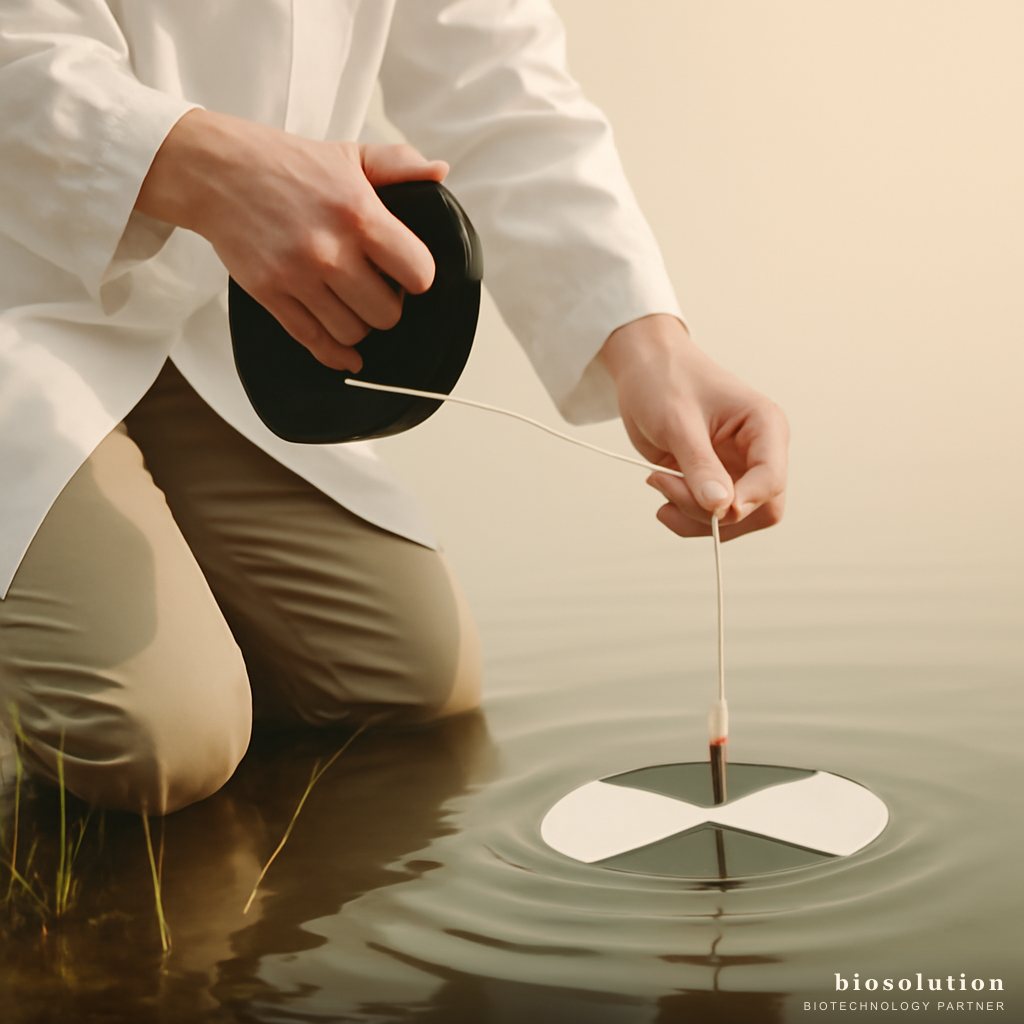
- Measure transparency regularly using a secchi disk. Target 25-40 cm.
- Apply probiotics according to dosage. For ponds that are already dark green, you can add an initial double dose (4 L/1000 m³) for the first 2 weeks.
- Reduce feeding temporarily if transparency <20 cm.
- Ensure adequate aeration to help oxygenation and probiotic distribution.
- Monitor ammonia and nitrite periodically. Probiotics will lower toxic levels.
Conclusion
Managing green water transparency in tilapia ponds does not have to be expensive and risky. The chemical approach may provide quick results, but the hidden costs of fish mortality and instability are actually greater. Probiotics like the Tilapia Pond Probiotic Formula from Biosolution offer a solution that is equally cost-efficient, yet safer and more sustainable. With probiotics, you not only clarify the water but also build a healthy pond ecosystem for optimal tilapia growth.
Want to try? Consult your pond conditions with the Biosolution team via WhatsApp for appropriate dosage recommendations.