How to Fix Hard and Dry Soil After Chemical Fertilizer Overdose
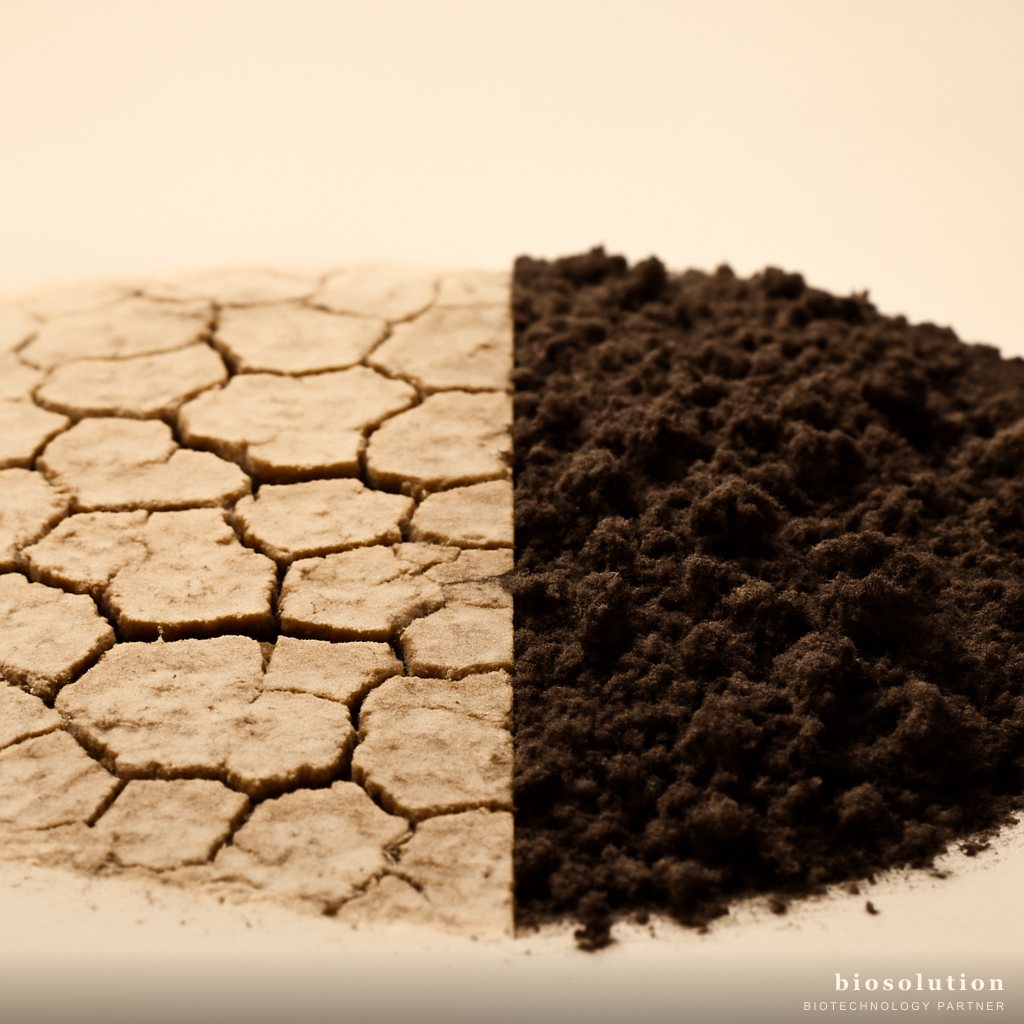
Chemical fertilizer overdose often leaves a detrimental impact: hard, dry, and infertile soil. Accumulated salts from fertilizers damage soil aggregates, clog soil pores, and reduce microbial activity. As a result, the soil struggles to absorb water, plant roots find it difficult to develop, and land productivity declines. For farmers transitioning to organic farming, fixing hard and dry soil becomes a major challenge. This article compares the costs of conventional vs. biological soil remediation and reviews a microbial-based solution from Biosolution that is proven effective and economical.
Why Does Chemical Fertilizer Overdose Cause Hard and Dry Soil?
Synthetic chemical fertilizers, especially urea and NPK, contain high levels of salts. When overapplied, these salts accumulate in the rhizosphere and bind water, making the soil physiologically dry. Additionally, cations like Na⁺ and Cl⁻ replace Ca²⁺ and Mg²⁺ on soil colloids, causing clay dispersion and loss of aggregation. Consequently, the soil becomes compact, hard, and less porous. In the long term, populations of soil microbes such as phosphate-solubilizing and nitrogen-fixing bacteria also decline drastically, worsening soil fertility. Therefore, fixing hard and dry soil requires an approach that not only improves soil physics but also restores soil biology.
Cost Comparison: Conventional vs. Biological
Conventional Method
Farmers typically address hard soil by liming (dolomite), adding organic matter (manure or compost), and deep tillage. Dolomite liming costs around IDR 500,000–1,000,000 per ton (dosage 2-4 tons/ha), while manure ranges from IDR 300,000–600,000 per ton (dosage 5-10 tons/ha). Deep tillage requires tractor rental of about IDR 500,000–1,000,000 per hectare. Total conventional remediation costs for 1 hectare can reach IDR 5,000,000–10,000,000 per season, excluding labor. Results are not instant; soil structure improvement is only noticeable after 2-3 seasons.
Biological Method with Soil Structure Improvement Formula
Biosolution offers the Soil Structure Improvement Formula containing three superior microbes: Azotobacter sp., Azospirillum sp., and Bacillus megaterium. These bacteria work synergistically to improve soil aggregation, increase porosity, and restore nutrient cycles. Application cost is only IDR 150,000–300,000 per hectare per application (dosage 10 ml/liter water, drench 200 liters/ha). With a frequency of 3 times per season, total biological cost is around IDR 450,000–900,000 per season. Soil structure improvement becomes visible within 1-2 months after the first application. Cost comparison shows that the biological method is 5-10 times cheaper than conventional, with faster and more sustainable results.
Mechanism of Soil Structure Improvement Formula in Fixing Hard Soil
Azotobacter sp.: N₂ Fixer and Exopolysaccharide (EPS) Producer
Azotobacter sp. is a non-symbiotic nitrogen-fixing bacterium capable of binding N₂ from the air and converting it into ammonium available to plants. Additionally, this bacterium produces exopolysaccharides (EPS) that act as natural binders of soil particles. EPS forms micro- and macro-aggregates, making the soil loose, increasing porosity, and raising water holding capacity. This mechanism is highly effective for fixing hard and dry soil as it directly improves soil physical structure.
Azospirillum sp.: Root Stimulant and N₂ Fixer
Azospirillum sp. also fixes nitrogen, but its advantage lies in its ability to produce phytohormones such as auxins and gibberellins. These hormones stimulate the growth of lateral roots and root hairs, making plant roots more exploratory in seeking water and nutrients. Healthy roots also produce exudates that feed soil microbes, thus restoring the soil biological cycle. With deeper and wider roots, plants become more drought-tolerant, which is a major issue in dry soil.
Bacillus megaterium: Phosphate and Potassium Solubilizer
Bacillus megaterium is a phosphate- and potassium-solubilizing bacterium that releases phosphorus and potassium from complex bonds in the soil. In hard and dry soil due to fertilizer overdose, nutrient availability is often blocked by extreme pH or high salinity. Bacillus megaterium produces organic acids that dissolve inorganic phosphate and potassium from soil minerals, making nutrients available again. Additionally, this bacterium produces enzymes that degrade chemical fertilizer residues, reducing the toxic effects of salts.
How to Apply the Soil Structure Improvement Formula
Applying the Soil Structure Improvement Formula is very easy and economical. The recommended dosage is 10 ml per liter of water, sprayed or drenched onto the soil during land preparation. The best time is at the start of the rainy season or after tillage, as soil moisture supports microbial activity. Application frequency is every 30 days, 3 times per growing season. For 1 hectare, the required spray volume is about 200 liters, so only 2 liters of product are needed per application. The cost per season is very affordable compared to conventional methods. Farmers can combine this product with organic fertilizers for optimal results. More information about this product can be found on the Soil Structure Improvement Formula product page.
Economic and Environmental Benefits
Using a biological formula is not only cheaper but also environmentally friendly. The applied microbes improve soil fertility naturally without leaving chemical residues. In the long term, chemical fertilizer input costs can be reduced by up to 50% because the soil is already biologically fertile. Moreover, increased water holding capacity makes plants more drought-resistant, reducing the risk of crop failure. Thus, fixing hard and dry soil using microbes is a profitable long-term investment.
Conclusion
Chemical fertilizer overdose causes hard and dry soil, requiring appropriate remediation. Conventional methods like liming and adding organic matter are effective but costly and slow. As an alternative, the biological approach using Biosolution's Soil Structure Improvement Formula offers a cheaper, faster, and sustainable solution. By utilizing Azotobacter sp., Azospirillum sp., and Bacillus megaterium, hard soil can be structurally improved, porosity increased, and fertility restored. For farmers looking to transition to organic farming, this method is the right choice. For further consultation, contact the Biosolution team via WhatsApp.
FAQ
What is the main cause of hard and dry soil?
Hard and dry soil is primarily caused by salt accumulation from excessive chemical fertilizers, which damages soil aggregates and reduces porosity. Additionally, loss of organic matter and microbial activity worsens the condition. Overdose of fertilizers like urea and NPK leads to high salinity, making it difficult for soil to absorb water and becoming compact.
How long does it take to fix hard soil with the Soil Structure Improvement Formula?
Soil structure improvement becomes visible within 1-2 months after the first application. The soil becomes looser and easier to till. For optimal results, regular application every 30 days for 3 times per season is recommended. By the next season, the soil will be much more fertile and productive.
Is the Soil Structure Improvement Formula safe for plants and the environment?
Very safe. This product contains natural microbes that are not pathogenic. These microbes actually improve the soil ecosystem without leaving chemical residues. Suitable for organic farming and environmentally friendly.
Can the Soil Structure Improvement Formula be combined with chemical fertilizers?
Yes, it can. However, it is recommended to gradually reduce chemical fertilizer dosage as soil condition improves. The microbes in the formula help decompose chemical fertilizer residues and increase fertilization efficiency, allowing chemical fertilizer use to be reduced by up to 50%.
Where can I buy the Soil Structure Improvement Formula?
This product is available at Biosolution partner agricultural stores or can be purchased directly through the official Biosolution website. For bulk orders, contact our team via WhatsApp for consultation and special pricing.