Introduction
Hard and dry soil is a nightmare for farmers, especially after years of excessive chemical fertilizer use. Chemical fertilizer overdose not only makes soil compact and difficult to till but also reduces water holding capacity and microbial activity. As a result, plants are stressed, production declines, and production costs increase. The good news is that there is a natural solution to repair hard and dry soil without having to wait for years. Biosolution's Soil Structure Improvement Formula, containing superior bacteria such as Azotobacter sp., Azospirillum sp., and Bacillus megaterium, has been field-tested on conventional farmers transitioning to organic farming. The results? Soil becomes loose again, productivity increases, and farmers smile.
Why Does Soil Become Hard and Dry?
Salt Accumulation and Soil Aggregate Damage
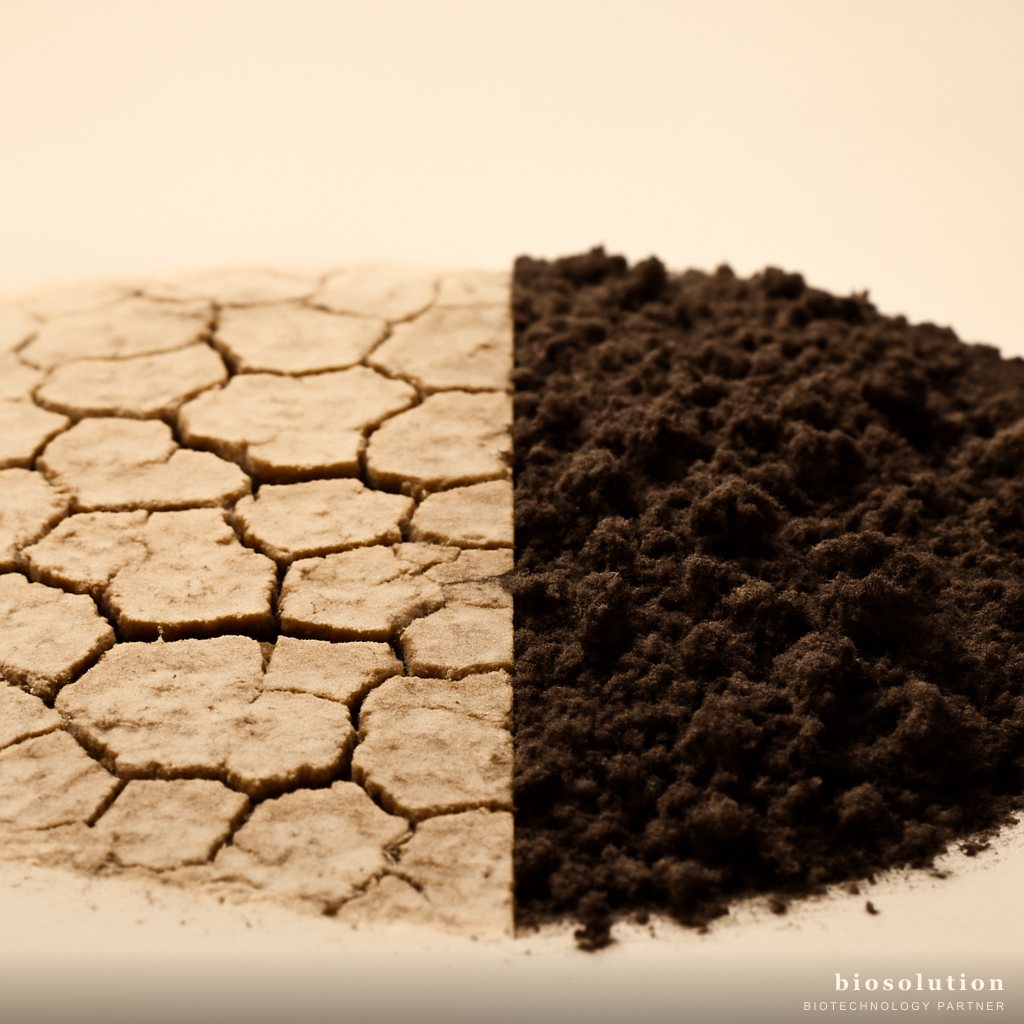
Synthetic chemical fertilizers, especially urea and KCl, leave high salt residues. These salts bind clay particles, destroying soil aggregates. Consequently, soil pores shrink, aeration is poor, and water infiltration is difficult. Soil becomes hard as rock when dry and muddy when wet.
Decline in Soil Microbial Population
Soil microbes such as bacteria and fungi play a crucial role in forming soil aggregates through the production of exopolysaccharides (EPS) and mycelium. Continuous use of chemical fertilizers and pesticides kills these microbes. The soil loses its natural "glue" that binds particles, causing its structure to collapse.
Low Cation Exchange Capacity (CEC)
CEC is the soil's ability to retain and release nutrients. Soil damaged by fertilizer overdose has low CEC, so nutrients are easily leached, and plants suffer from nutrient deficiency despite continuous fertilization.
Natural Solution: Soil Structure Improvement Formula
Composition and Role of Superior Microbes
The Soil Structure Improvement Formula contains three synergistic bacteria:
- Azotobacter sp.: Free nitrogen-fixing bacteria and EPS producer. EPS acts as a binder for soil particles, forming stable aggregates and increasing porosity.
- Azospirillum sp.: In addition to fixing nitrogen, this bacterium produces growth hormones like IAA that stimulate root development. Healthy roots penetrate hard soil and improve structure.
- Bacillus megaterium: Phosphate and potassium solubilizer, making fixed nutrients in the soil available again. This bacterium also produces enzymes that decompose organic matter.
Soil Improvement Mechanism
These three bacteria work synergistically:
- Forming soil aggregates: EPS from Azotobacter and mycelium from other bacteria bind soil particles into crumb aggregates.
- Increasing porosity: Stable aggregates create macro and micro pores, improving aeration and drainage.
- Enhancing water holding capacity: Decomposed organic matter and EPS absorb water like a sponge, reducing drought.
- Improving CEC: Organic colloids produced by microbes increase CEC, preventing nutrient leaching.
Field Trial Results: Conventional Farmers Transitioning to Organic
Field Trial Methodology
The field trial was conducted on a farmer's land in East Java that had been using high-dose chemical fertilizers for 10 years. Initial soil conditions: hard, cracked, pH 5.0, organic C 0.8%. Treatment: application of Soil Structure Improvement Formula at a dose of 10 ml/L water, drenched into the soil every 30 days for 3 times, at the start of the rainy season. Test crop: red chili.
Physical Soil Changes
After 3 months, the previously hard soil became loose. Tillage depth increased from 10 cm to 20 cm. Water infiltration increased by 40%, reducing puddling. Soil color became darker due to increased organic matter.
Increased Crop Productivity
Chili plants showed more vigorous growth: plant height increased by 25%, number of productive branches increased by 30%, and fruit weight per plant increased by 35%. Farmers reported a reduction in chemical fertilizer use by up to 50%.
Farmer Testimonial
Mr. Budi, a farmer in Malang, said: "Previously, my soil was hard as rock; when watered, the water flowed everywhere. After using the Soil Structure Improvement Formula, the soil became soft, water infiltrated, and my chili plants bore abundant fruit. I am now confident in transitioning to organic."
Proper Application Method
Dosage and Method
- Dosage: 10 ml per liter of water (1 liter of formula for 100 liters of water).
- Method: Drench onto the root zone or spray onto the soil surface during tillage.
- Frequency: Every 30 days, 3 times per growing season.
- Best time: Start of the rainy season or after tillage, so bacteria can adapt quickly.
Success Tips
- Ensure the soil is moist before application.
- Do not mix with high-dose chemical fertilizers simultaneously; allow a 3-5 day interval.
- Add organic matter such as compost to accelerate the process.
Advantages of Soil Structure Improvement Formula
Compared to Chemical Agents
Chemical agents like gypsum or lime can improve soil structure, but they are temporary and do not biologically enrich the soil. This biological formula provides long-term effects because microbes continue to multiply and improve the soil.
Environmentally Friendly
It leaves no harmful residues. Instead, it reduces dependence on chemical fertilizers, lowers greenhouse gas emissions, and enhances soil biodiversity.
Conclusion
Hard and dry soil due to chemical fertilizer overdose is not the end. With a biological approach using Biosolution's Soil Structure Improvement Formula, farmers can restore soil structure naturally. Field trial results prove that soil becomes loose, water holding capacity increases, and crop productivity significantly rises. It is time to transition to healthier and more sustainable agriculture.
Interested in trying? Consult your land conditions with the Biosolution team via WhatsApp or see the product Soil Structure Improvement Formula for more information.