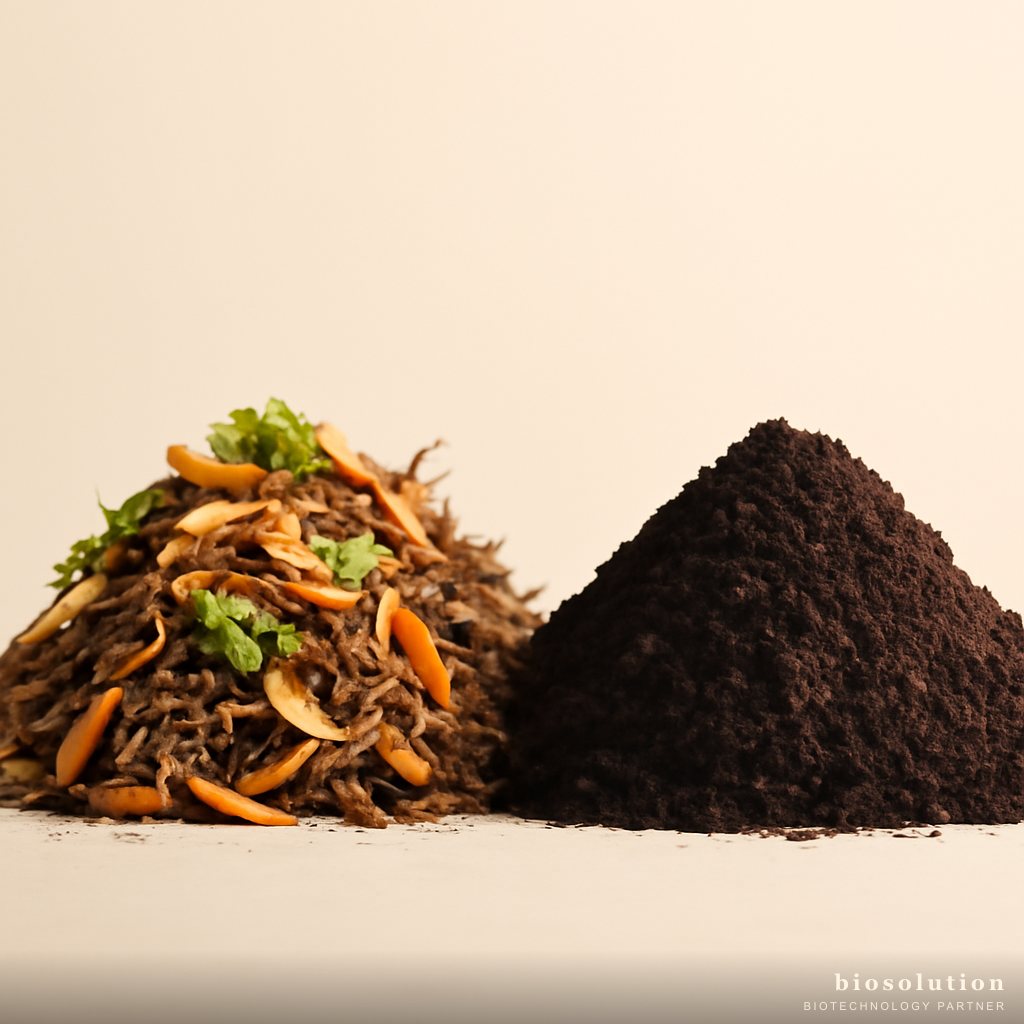
Rice Straw Decomposer: Key to Accelerating Decomposition into Quality Compost in 14 Days
Every rice harvest season, farmers face abundant piles of straw. Instead of burning it and polluting the air, rice straw can be processed into high-value compost. However, natural decomposition takes 6–8 weeks. This is where the role of rice straw decomposer—a biofertilizer containing superior microbes—becomes crucial. With the right product selection, the composting process can be shortened to just 14 days. This article will guide you in choosing the best biofertilizer based on scientific criteria and official certifications.
Why Is Rice Straw Decomposer Important for Post-Harvest Rice Farmers?
Rice straw has a complex lignocellulosic structure, consisting of cellulose, hemicellulose, and lignin. Decomposer microbes such as Aspergillus niger and Trichoderma viride can produce cellulase and ligninase enzymes that efficiently break down these bonds. Without microbial assistance, natural decomposition relies on indigenous microorganisms with limited populations, making the process slow.
Benefits of Rice Straw Decomposer
- Accelerates compost time: From 40–60 days to 14–21 days.
- Reduces straw burning: Saves costs and maintains air quality.
- Produces quality compost: C/N ratio below 20, rich in nutrients.
- Improves soil fertility: Compost enhances soil structure and biological activity.
For post-harvest rice farmers, using a decomposer is not just a waste solution but also a long-term investment in land productivity.
Criteria for an Effective Biofertilizer to Accelerate Decomposition in 14 Days
1. Superior and Synergistic Microbial Content
A good biofertilizer must contain microbes with synergistic lignocellulose-degrading ability. An example is the combination of Aspergillus niger (producer of cellulase and organic acids) with Trichoderma viride (fast lignocellulose decomposer). Both work together to break down tough straw fibers into simple compounds.
2. High Concentration and Viability
The product must have a sufficient microbial count (at least 10⁸ CFU/mL) and high viability during storage. Ensure the expiration date and storage conditions follow recommendations.
3. Ready-to-Use Formula with Efficient Dosage
An ideal biofertilizer has a low but effective dosage, e.g., 1 liter for 1 ton of raw material. Application is done by sprinkling onto the straw pile once, then turning every 5–7 days.
4. Accelerates C/N Ratio Reduction
Good decomposition is marked by a decrease in C/N ratio from >40 to <20 in a short time. An effective biofertilizer can achieve this target in 14–21 days.
5. Contains Complementary Microbes
In addition to main decomposers, the presence of microbes such as Thiobacillus sp., which oxidizes sulfur, helps lower compost pH, creating an optimal environment for microbial activity.
Certification and Quality Assurance of Rice Straw Decomposer
Indonesian National Standard (SNI)
Biofertilizer products circulating in Indonesia should have a permit from the Ministry of Agriculture and meet SNI 6729:2016 on biofertilizers. This certification ensures microbial content matches the label, is pathogen-free, and effective.
Laboratory and Field Efficacy Tests
Choose products that have been scientifically tested, both in the laboratory and field trials. Data such as decomposition time, C/N reduction, and crop yield increase should be transparent.
Legality and Distribution Permit
Ensure the biofertilizer is registered with the Ministry of Agriculture with a valid registration number. Avoid illegal products with unguaranteed quality.
Product Recommendation: Biosolution's Rice Straw & Organic Waste Decomposer Formula
One product that meets the above criteria is the Rice Straw & Organic Waste Decomposer Formula from Biosolution. This product is specially formulated to accelerate the decomposition of rice straw and other organic waste.
Superior Microbial Composition
- Aspergillus niger: Produces cellulase enzymes and organic acids that break down cellulose.
- Trichoderma viride: Fast lignocellulose decomposer, effective on lignin.
- Thiobacillus sp.: Sulfur oxidizer, helps lower compost pH.
Practical Application Method
- Dosage: 1 liter for 1 ton of straw or organic waste.
- Method: Sprinkle the solution evenly onto the straw pile.
- Frequency: One application per pile.
- Timing: Apply in the afternoon, turn the pile every 5–7 days.
Proven Performance
- Total composting time: 14–21 days.
- Efficient dosage ratio: 1 L : 1 ton.
- Final compost quality: C/N < 20.
- Time savings up to 50% compared to natural decomposition.
By using this product, farmers no longer need to burn straw, which harms the environment. The resulting compost is ready to be applied to the land to improve soil fertility.
Correct Application Method for Rice Straw Decomposer
Composting Steps with Decomposer
- Material preparation: Chop straw into 5–10 cm pieces to increase surface area.
- Pile creation: Make a pile 1–1.5 m high and 1–2 m wide.
- Decomposer application: Mix 1 liter of Rice Straw & Organic Waste Decomposer Formula into 10–20 liters of water, then sprinkle evenly over the pile.
- Covering: Cover the pile with a tarp to maintain moisture and temperature.
- Turning: Turn the pile every 5–7 days for aeration.
- Maturation: After 14–21 days, compost is ready if it is dark brown, crumbly, and odorless.
Success Tips
- Maintain moisture at 40–60% (squeeze a handful, a few drops of water appear).
- Ideal temperature 45–60°C during the thermophilic phase.
- Avoid excessive urea addition; just use the decomposer.
Case Study: Comparison of Natural Decomposition vs. with Decomposer
| Parameter | Natural Decomposition | With Biosolution Decomposer |
|---|---|---|
| Time | 6–8 weeks | 14–21 days |
| Final C/N | 25–30 | <20 |
| Compost volume | 40% of initial material | 50% of initial material |
| Odor | Putrid, ammonia | Earthy, fresh |
| Quality | Moderate | High |
Data shows that using a decomposer accelerates the process by up to 50% and produces higher quality compost.
Conclusion
Choosing the right rice straw decomposer is a strategic step for post-harvest rice farmers. Biofertilizers with superior microbes such as Aspergillus niger and Trichoderma viride, efficient dosage, and official certification guarantee success. The Rice Straw & Organic Waste Decomposer Formula from Biosolution offers a complete solution: fast (14–21 days), easy, and environmentally friendly. By applying it, you not only manage waste but also sustainably improve soil fertility. For more information or consultation, contact the Biosolution team via WhatsApp.
FAQ
What is a rice straw decomposer?
A rice straw decomposer is a biofertilizer containing microbes that produce cellulase and ligninase enzymes. These microbes break down the lignocellulosic fibers of straw into simple compounds, accelerating the composting process from 6–8 weeks to 14–21 days. Products like Biosolution's Rice Straw & Organic Waste Decomposer Formula contain Aspergillus niger, Trichoderma viride, and Thiobacillus sp. that work synergistically.
How to choose a good rice straw decomposer?
Choose a decomposer that contains superior microbes with high concentration (at least 10⁸ CFU/mL), has a distribution permit from the Ministry of Agriculture, and is proven effective in accelerating decomposition. Also consider efficient dosage, e.g., 1 liter for 1 ton of material. Products with a combination of Aspergillus niger and Trichoderma viride are generally more effective.
How long does it take to make compost from rice straw using a decomposer?
With the right decomposer, such as the Rice Straw & Organic Waste Decomposer Formula, composting time can be shortened to 14–21 days. This process involves turning the pile every 5–7 days and maintaining optimal moisture and temperature. The result is compost with C/N < 20, ready for application.
Is rice straw decomposer safe for the environment?
Yes, rice straw decomposer is environmentally friendly because it uses natural microbes that are harmless. Products like those from Biosolution help reduce straw burning, which causes air pollution. Additionally, the resulting compost improves soil structure and reduces dependence on chemical fertilizers.
Where can I buy quality rice straw decomposer?
Quality rice straw decomposer can be obtained through official Biosolution distributors or trusted agricultural stores. Ensure the product has a distribution permit and is stored according to recommendations. For consultation and ordering, contact the Biosolution team via WhatsApp or visit the product page Rice Straw & Organic Waste Decomposer Formula.