Urea Fertilizer Substitute: 5 Complete Plant Nutrition Formulas for Cost-Effective Farming
Urea fertilizer is the main source of nitrogen for plants, but its price continues to soar and overuse damages the soil. Many conventional farmers are starting to look for urea fertilizer substitutes that are more economical and environmentally friendly. Nitrogen-fixing biofertilizers offer a real solution: they provide nitrogen from the air through microbes while improving soil structure. This article thoroughly examines the cost comparison between conventional farming relying on urea and a biological approach using Biosolution's 5-in-1 Liquid Biofertilizer Formula.
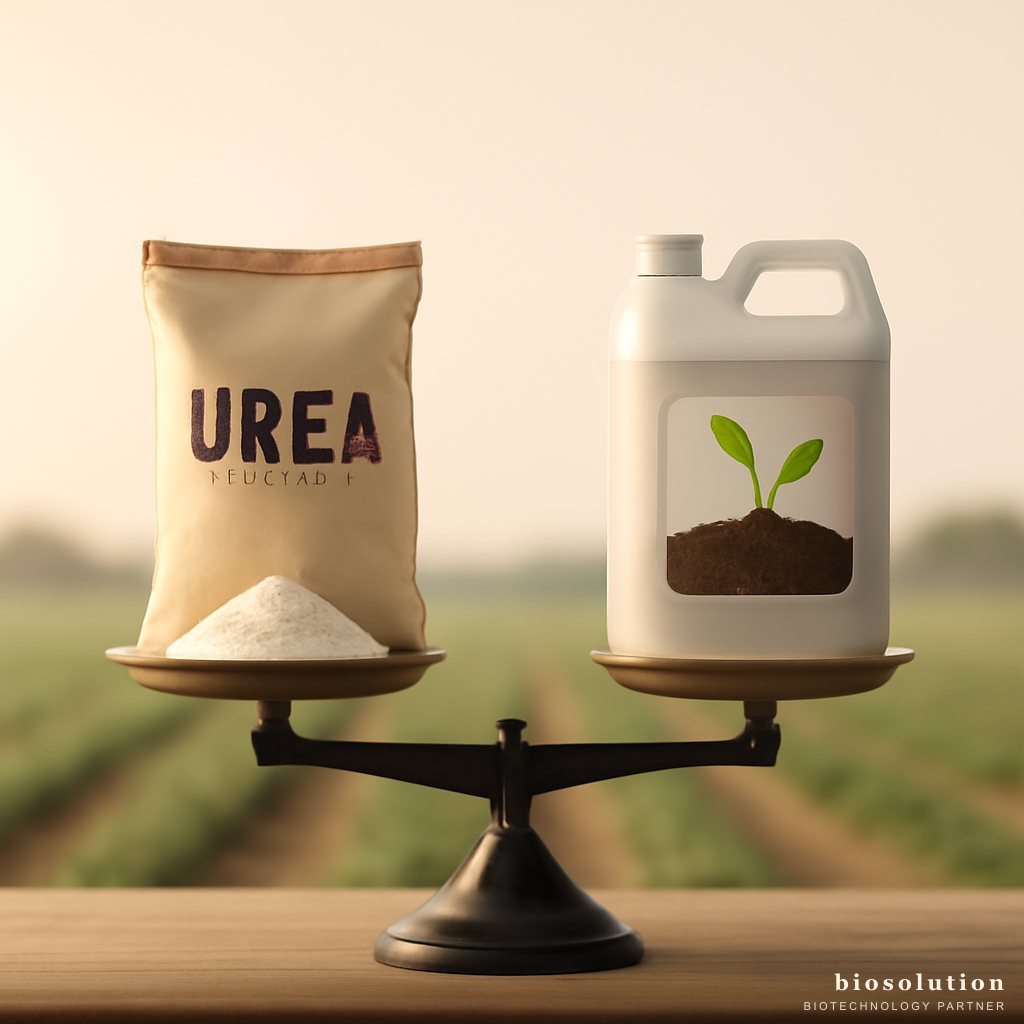
Cost of Urea Fertilizer vs Biofertilizer: Calculate Yourself
Cost Components of Conventional Urea Fertilizer
Urea fertilizer (46% N) currently ranges from Rp2,500–3,000 per kg. For rice, the recommended urea dosage is 200–250 kg per hectare per season, so the cost of urea per hectare reaches Rp500,000–750,000. This does not include application costs and long-term negative impacts such as soil acidification and water pollution.
Cost of N-Fixing Biofertilizer
The 5-in-1 Liquid Biofertilizer Formula product (1 liter packaging) is sold for around Rp100,000–150,000. The dosage is 5–10 ml per liter of water, applied every 10–14 days for 3–5 times per season. For 1 hectare, the requirement is about 2–3 liters per season, totaling Rp200,000–450,000. With a 50% reduction in urea, the cost of urea drops to Rp250,000–375,000. The total cost of biofertilizer + urea = Rp450,000–825,000, which is still lower than urea alone (Rp500,000–750,000) per season. However, the long-term benefits are much greater.
Long-Term Cost Efficiency
Regular use of biofertilizer improves soil fertility, so the urea dosage can be further reduced by up to 70% in the following season. Application costs are also lower because it can be watered or sprayed without special equipment. With crop yields increasing by 20–30%, farmers gain double benefits: input savings and output increases.
Mechanism of Nitrogen Fixation by Superior Microbes
Nitrogen-fixing biofertilizers work through symbiosis or association with plants. Biosolution's product contains two main N-fixing strains: Rhizobium sp. and Azospirillum sp.. Rhizobium symbioses with legume roots forming root nodules, while Azospirillum lives around the roots of gramineae (rice, corn) and fixes N₂ from the air. Both convert atmospheric nitrogen (N₂) into ammonia (NH₃) that plants can absorb. This process significantly reduces the need for synthetic urea fertilizer.
Yield Comparison: Conventional vs Biological
Rice Field Trial Data
Field trials on farmers' land showed that using biofertilizer with a 50% reduction in urea produced 7.2 tons of dry grain per hectare, while full urea (100%) produced 6.8 tons per hectare. This means an increase of about 6% despite halving the urea. For corn, yield increased by 20% with a 40% reduction in urea.
Factors Driving Yield Increase
In addition to nitrogen, biofertilizer provides soluble phosphate (by Bacillus subtilis), root-stimulating phytohormones, and protection from pathogens (by Pseudomonas fluorescens and Trichoderma sp.). This combination makes plants healthier, roots longer, and nutrient uptake more efficient. As a result, productivity increases without the need for excess chemical fertilizers.
Effective and Cost-Efficient Biofertilizer Application Methods
Drenching and Spraying Methods
The 5-in-1 Liquid Biofertilizer Formula is applied by drenching the root zone or spraying onto the soil. Dosage: 5–10 ml per liter of water, applied in the morning or evening (avoid strong UV light). Frequency: 3–5 times per growing season at intervals of 10–14 days. Very practical and requires no special equipment.
Tips for Maximizing Efficiency
- Use together with organic fertilizer (compost) to increase microbial populations.
- Reduce urea gradually: first season reduce by 30%, second season by 50%, and so on.
- Ensure the soil has adequate moisture during application for microbial activity.
- Store the product in a cool, dark place to maintain viability up to 10⁸ CFU/ml per strain.
Additional Benefits: Soil and Environmental Improvement
Reducing Greenhouse Gas Emissions
Urea fertilizer produces N₂O emissions that are 300 times stronger than CO₂. By reducing urea by 50%, N₂O emissions drop significantly. Biofertilizer actually increases soil organic matter and sequesters carbon.
Restoring Degraded Soil
The microbes in the product help soil aggregation, increase porosity, and reduce erosion. The soil becomes looser and naturally fertile. Farmers using biofertilizer report decreasing needs for chemical fertilizers from season to season.
Conclusion
Switching to nitrogen-fixing biofertilizers like the 5-in-1 Liquid Biofertilizer Formula is a smart step to reduce urea fertilizer use, lower production costs, and increase crop yields. The cost comparison shows that in one season, direct savings are already noticeable, let alone in the long term. For optimal results, combine with good agricultural practices and consult your specific land needs. Contact the Biosolution team via WhatsApp for more information or see the product Complete Plant Nutrition Formula and sustainable farming solutions.
FAQ
Can biofertilizer completely replace urea fertilizer?
Not completely. Biofertilizer provides nitrogen from the air, but the amount depends on microbial populations and soil conditions. In the initial application, it is recommended to reduce urea by 30–50% and evaluate. In subsequent seasons, the reduction can be increased up to 70% if the soil is already fertile. Biofertilizer works optimally as a supplement, not a total substitute.
How much cost can be saved per hectare?
If urea costs Rp2,500/kg and the dosage is 250 kg/ha, the cost of urea is Rp625,000. With biofertilizer at Rp300,000/ha and urea reduced by 50% (Rp312,500), the total cost is Rp612,500 — saving Rp12,500. However, if yields increase by 20%, the net profit is much greater. Long-term savings can reach Rp200,000–400,000 per hectare per season.
Is this product safe for all plants?
Yes, this product is formulated for all plants, especially rice, corn, soybeans, and horticulture. The Rhizobium content is suitable for legumes, while Azospirillum is for gramineae. Bacillus and Pseudomonas are non-pathogenic and safe for humans and the environment. Follow the recommended dosage.
How should biofertilizer be stored to keep it active?
Store in a cool place (15–25°C) and away from direct sunlight. Do not freeze. Keep the container tightly closed. Microbial viability is maintained for up to 6 months under proper storage. After opening, use within 1 month.
When is the best time to apply biofertilizer?
Apply in the morning before 10 AM or in the afternoon after 4 PM, when UV light is low. Avoid application during heavy rain as microbes can be washed away. For maximum results, apply when the soil is moist and after basic organic fertilization.