Urea Fertilizer Substitute: N-Fixing Biofertilizer Proven to Reduce Urea by 50%
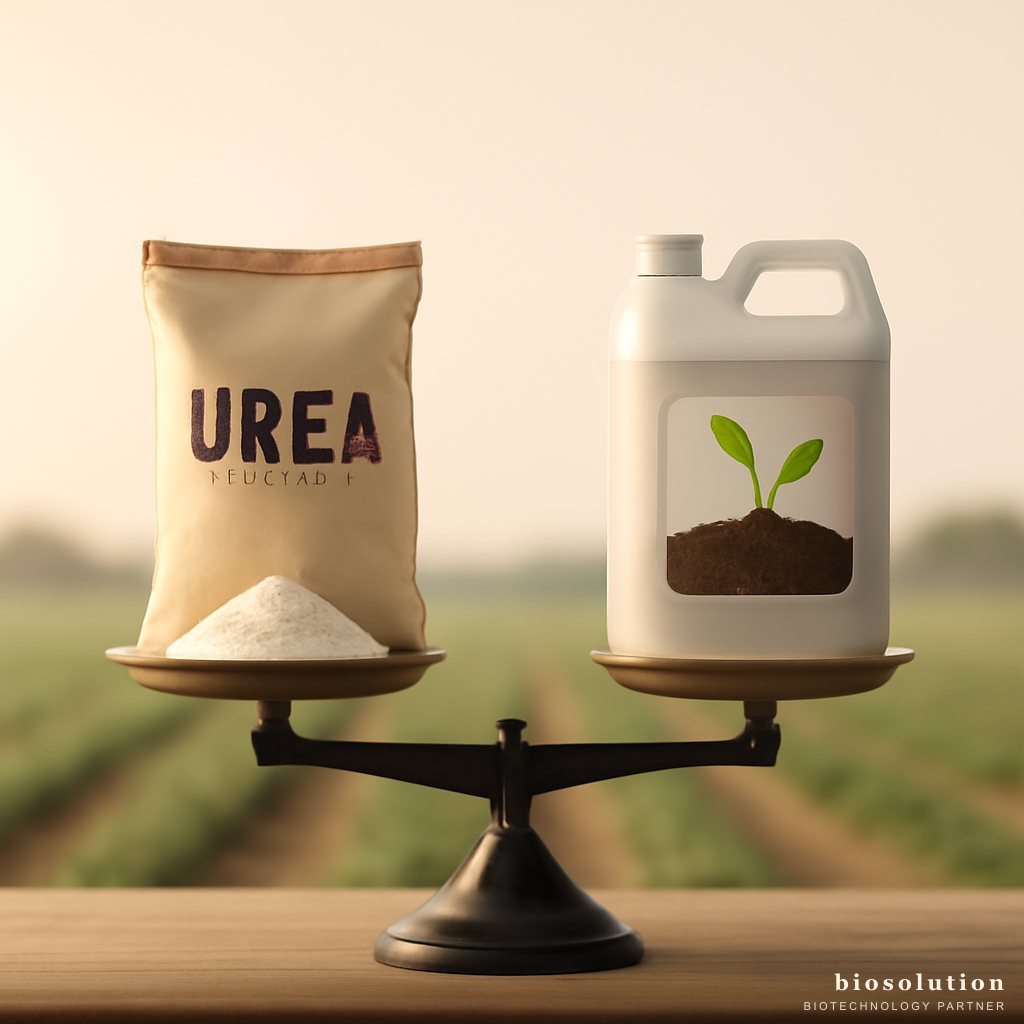
Urea fertilizer is the main source of nitrogen for plants, but its price continues to soar and excessive use damages soil and the environment. Conventional farmers are often trapped in dependence on synthetic chemical fertilizers. Now a natural solution is available in the form of N-fixing biofertilizer that can serve as a partial urea fertilizer substitute. Biosolution's 5-in-1 Liquid Biofertilizer Formula offers a consortium of superior microbes that fix nitrogen from the air, dissolve phosphate, and improve overall soil health. This article presents field trial results from conventional farmers that prove the product's effectiveness.
Why Conventional Farmers Need to Switch to Biofertilizer?
Conventional farmers have relied on urea fertilizer as the main nitrogen source for decades. However, several fundamental issues drive the need for alternatives:
Rising Production Costs
Both subsidized and non-subsidized urea prices fluctuate and tend to increase. Ministry of Agriculture data shows that fertilizer costs can reach 25-30% of total food crop production costs. By reducing urea use by 50%, farmers can significantly save costs.
Soil Degradation from Over-Fertilization
Continuous use of urea without organic matter causes soil acidity, damaged soil structure, and decreased soil microbial populations. As a result, soil becomes 'addicted' to chemical fertilizers and crop productivity stagnates.
Environmental Pollution
Nitrogen from urea that is not absorbed by plants leaches as nitrate (NO3-) contaminating groundwater, or volatilizes as ammonia (NH3) and nitrous oxide (N2O) gas, contributing to global warming.
N-fixing biofertilizer offers the right solution. By utilizing Rhizobium sp. and Azospirillum sp. bacteria, nitrogen from the air is converted into ammonium ready for plant uptake. This process is natural, environmentally friendly, and sustainable.
How Does the 5-in-1 Liquid Biofertilizer Formula Work?
The 5-in-1 Liquid Biofertilizer Formula contains five superior microbial strains that work synergistically. Here are the mechanisms of each:
Rhizobium sp.: Symbiotic N-Fixer
These bacteria form root nodules on legume plants (soybean, mung bean, etc.) and some other plants. Inside the nodules, Rhizobium fixes N2 from the air and supplies it to the host plant. For non-legume plants, this role is complemented by Azospirillum.
Azospirillum sp.: Associative N-Fixer
Azospirillum lives around the roots of gramineous plants (rice, corn, wheat) and fixes N2 associatively. This microbe also produces phytohormones like IAA that stimulate root growth.
Bacillus subtilis: Phosphate Solubilizer and PGPR
Bacillus subtilis solubilizes bound phosphate in soil into forms available to plants. Additionally, this bacterium produces growth hormones and enzymes that strengthen the root system.
Pseudomonas fluorescens: Pathogen Antagonist
Pseudomonas fluorescens produces siderophores that bind iron, causing soil pathogens like Fusarium and Pythium to suffer iron deficiency and have suppressed growth. This helps prevent wilt and root rot diseases.
Trichoderma sp.: Biocontrol and Decomposer
The beneficial fungus Trichoderma controls soil pathogens through parasitism and competition mechanisms. Trichoderma also decomposes organic matter into humus that improves soil structure.
The combination of these five microbes in one product ensures the availability of N, P, K, and micronutrients, while protecting plants from disease. Each strain has a minimum density of 10⁸ CFU/ml, ensuring effectiveness.
Field Trial Results: 50% Urea Reduction Without Yield Loss
Field trials were conducted in the 2024 growing season on conventional farmer land in West Java. The test crop was Ciherang rice variety. Treatments were divided into two: (1) control plot using standard urea dose (250 kg/ha), and (2) treatment plot using 50% urea (125 kg/ha) + 5-in-1 Liquid Biofertilizer Formula at a dose of 10 ml/liter water, applied as a drench every 10 days for a total of 5 applications.
Growth and Yield Parameters
- Plant height: The biofertilizer treatment showed plant height equivalent to the control (average 95 cm vs 97 cm).
- Number of productive tillers: The biofertilizer treatment had 18 productive tillers per hill, while the control had 16 tillers.
- Harvested dry grain weight (HDGW): The biofertilizer treatment reached 6.8 tons/ha, while the control was 6.5 tons/ha. This means that even though urea was reduced by 50%, yield actually increased by 4.6%.
- Tissue N content: Leaf analysis showed that N content in the biofertilizer treatment was not significantly different from the control, indicating that N supply from biological fixation was sufficient.
Additional Effects on Soil
After one growing season, the soil in the biofertilizer plot showed:
- Increased soil microbial populations (total bacteria, phosphate solubilizers, and N-fixers) by up to 10 times.
- Soil pH rose from 5.2 to 5.8 (closer to neutral).
- Organic carbon content increased by 0.2% due to organic matter decomposition by Trichoderma.
Farmers involved in the field trial expressed satisfaction because fertilizer costs were drastically reduced and plants were healthier. "I saved half on fertilizer costs, but the rice yield was even higher. The soil also became looser," said Mr. Sutrisno, a participating farmer.
Proper Application of 5-in-1 Liquid Biofertilizer Formula
For optimal results, application must be done correctly:
- Dosage: 5–10 ml per liter of water. For one hectare of rice, about 5 liters of product is needed per growing season.
- Method: Drench around the root zone or spray onto the soil. Avoid spraying directly on leaves because microbes are more active in the rhizosphere.
- Frequency: Repeat every 10–14 days, for a total of 3–5 applications per growing season. Start the first application when plants are 7–10 days after transplanting.
- Timing: Apply in the morning before 10 AM or in the afternoon after 4 PM to avoid UV rays that can kill microbes.
- Storage: Store in a cool, dark place. Avoid direct sunlight. The product remains stable for 6 months at 25°C.
Advantages of Using Biofertilizer Compared to Chemical Fertilizer
| Parameter | Urea Fertilizer | N-Fixing Biofertilizer |
|---|---|---|
| N Source | Synthetic (factory) | Biological (N2 fixation) |
| Efficiency | 30-50% absorbed | Nearly 100% absorbed through symbiosis |
| Soil impact | Acidic, damages structure | Improves structure, increases OM |
| Cost per season | IDR 1,500,000 – 2,000,000/ha | IDR 300,000 – 500,000/ha |
| Pollution risk | High (NO3, N2O) | Low (natural cycle) |
Using biofertilizer also reduces greenhouse gas emissions. Every kilogram of N from urea produces 0.01 kg N2O, while biological fixation produces no N2O emissions.
Farmer Testimonials: "Soil Becomes Healthy, Yield Increases"
Here are some testimonials from farmers who have used the 5-in-1 Liquid Biofertilizer Formula:
"I used half the urea dose, plus this biofertilizer. The rice yield actually increased by 2 sacks per plot. The soil also became not hard. I will continue using it." – Mr. Ahmad, rice farmer in Subang.
"For corn, I only used 100 kg urea per hectare (usually 200 kg) plus biofertilizer. The cobs were big, yield 8.5 tons of dry shelled corn. Previously only 7 tons." – Mr. Budi, corn farmer in Garut.
"My chili plants became more resistant to wilt. Usually every season some would die from Fusarium. Now almost none." – Mrs. Sari, chili farmer in Brebes.
Conclusion
N-fixing biofertilizers like the 5-in-1 Liquid Biofertilizer Formula have been scientifically and empirically proven to serve as a partial urea fertilizer substitute. By reducing urea use by up to 50%, conventional farmers can lower production costs, improve soil health, and maintain or even increase crop yields. The consortium of Rhizobium, Azospirillum, Bacillus, Pseudomonas, and Trichoderma works synergistically to provide nitrogen, phosphate, growth hormones, and disease protection. For optimal results, regular and timely application is highly recommended.
Interested in trying? Visit the Complete Plant Nutrition Formula product page or consult for free with our team via WhatsApp. Together with Biosolution, realize productive and environmentally friendly agriculture.