Anti Ganoderma Palm BSR: Biocontrol of Basal Stem Rot with 3 Superior Strains
Basal Stem Rot (BSR) caused by the pathogenic fungus Ganoderma boninense is the most serious threat to oil palm plantations in Indonesia. Losses from BSR include not only reduced Fresh Fruit Bunch (FFB) production but also premature tree death, forcing early replanting. In this context, biological control (biocontrol) strategies using antagonistic agents are becoming a sustainable solution increasingly adopted by large-scale plantations. Biosolution presents the Anti-Ganoderma Palm Formula, a BSR biocontrol product with a consortium of three superior microbial strains: Trichoderma harzianum, Gliocladium virens, and Bacillus subtilis. This article thoroughly examines the mechanism, application, and advantages of this formula as an effective and environmentally friendly anti-ganoderma palm BSR solution.
Why Is Palm BSR Difficult to Control?
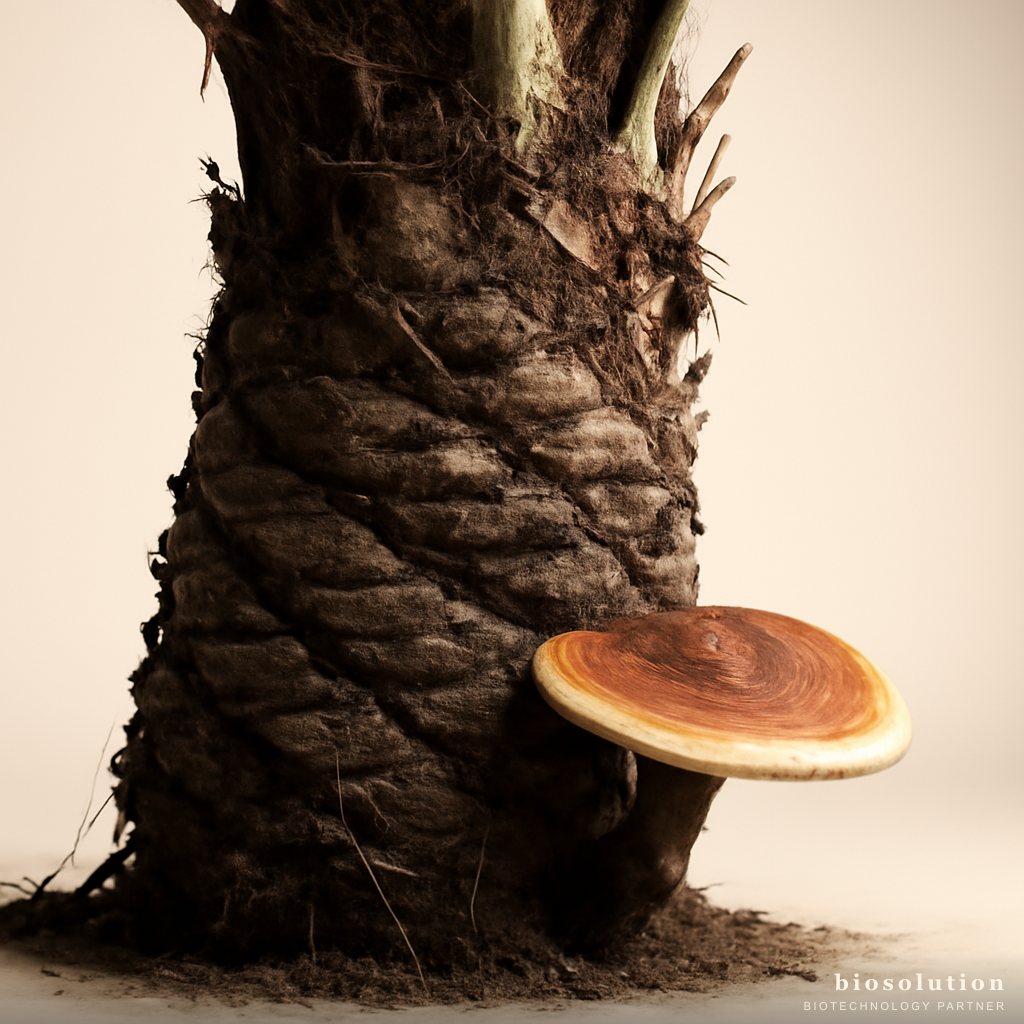
BSR is caused by Ganoderma boninense, a basidiomycete fungus that attacks the roots and base of the oil palm trunk. This pathogen produces lignin-degrading enzymes (lignin peroxidase, manganese peroxidase, laccase) that destroy vascular tissue, disrupting water and nutrient transport. Early symptoms are often invisible until the infection is severe, marked by unopened spear leaves, hanging fronds, and the appearance of fruiting bodies (basidiocarps) at the trunk base.
The uniqueness of Ganoderma lies in its ability to survive in root and trunk residues in the soil for years. Chemical fungicides often fail due to limited penetration into lignified tissues and pathogen resistance. Therefore, a biocontrol approach targeting competition, mycoparasitism, and induced systemic resistance becomes a strategic choice.
Anti-Ganoderma Palm Formula: Consortium of 3 Strains
This product is specifically formulated for B2B (plantation grade) oil palm plantations with three synergistically working strains:
1. Trichoderma harzianum — Superior Mycoparasite
Trichoderma harzianum is a well-known antagonistic fungus for its ability to parasitize Ganoderma hyphae. Its mechanisms include:
- Direct mycoparasitism: T. harzianum coils around Ganoderma hyphae, penetrates the cell wall with chitinase, β-1,3-glucanase, and protease enzymes, and absorbs the pathogen's cell contents.
- Nutrient and space competition: Rapid growth dominates the rhizosphere, reducing carbon and nitrogen sources for Ganoderma.
- Production of volatile metabolites: Compounds such as 6-pentyl-α-pyrone (6-PP) inhibit Ganoderma growth in vitro and in planta.
2. Gliocladium virens — Antibiotic Producer
Gliocladium virens (synonym Trichoderma virens) produces the antibiotics gliotoxin and gliovirin, which are toxic to Ganoderma. Gliotoxin disrupts protein synthesis and causes pathogen cell lysis. Additionally, G. virens produces lytic enzymes that enhance the mycoparasitic effect.
3. Bacillus subtilis — Plant Resistance Inducer
This Gram-positive bacterium triggers Induced Systemic Resistance (ISR) in oil palm via the jasmonic acid/ethylene pathway. B. subtilis also produces lipopeptides (surfactin, iturin, fengycin) with antifungal and bactericidal properties. In the rhizosphere, B. subtilis forms biofilms that protect roots from pathogen colonization.
These three strains work complementarily: Trichoderma and Gliocladium directly suppress the pathogen, while Bacillus strengthens host defense. This combination minimizes resistance risk and increases biocontrol efficiency.
Integrated Biocontrol Mechanism
Application of the Anti-Ganoderma Palm Formula results in several protective mechanisms:
- Mycoparasitism and Antibiosis: Trichoderma harzianum and Gliocladium virens actively parasitize and lyse Ganoderma hyphae.
- Rhizosphere Competition: High populations of antagonistic agents (minimum 10⁶ CFU/g) displace Ganoderma from the root zone.
- Induced Systemic Resistance: Bacillus subtilis triggers the production of defense compounds such as phenolics and PR-proteins in palm tissues.
- Inoculum Degradation: Enzymes from Trichoderma and Gliocladium break down Ganoderma residues in the soil, reducing infection sources.
Product Application: Drenching and Trunk Injection
The product is applied every 3 months at the following doses:
- Drenching: 50 ml per tree dissolved in 5-10 liters of water, evenly drenched in the weeded circle (1 m radius from the trunk base).
- Trunk injection: 20 ml per tree injected into the trunk at a height of 30-50 cm from the ground, at a 45° angle.
The best application time is in the morning before 10 AM, when humidity is still high and temperature is not too hot. For trees already showing early BSR symptoms, trunk injection combined with drenching yields optimal results.
Test Results: BSR Progression Suppression Up to 60%
Field trials in oil palm plantations in Sumatra and Kalimantan showed that routine application of the Anti-Ganoderma Palm Formula can:
- Suppress BSR progression by 40–60% compared to untreated controls.
- Extend the economic life of oil palm trees by 5–8 years, allowing delayed replanting and more optimal land investment.
- Reduce premature replanting losses, which can reach 30% of total production costs.
These data are supported by research from the University of North Sumatra and IPB University, which recorded the effectiveness of the Trichoderma + Bacillus consortium in suppressing BSR incidence by up to 55% (Source: Indonesian Journal of Phytopathology, 2023).
Advantages Over Chemical Fungicides
| Aspect | Chemical Fungicides | Anti-Ganoderma Palm Formula |
|---|---|---|
| Mechanism | Direct toxic | Multi-mechanism biocontrol |
| Resistance | Prone to pathogen resistance | Low (multi-target) |
| Environmental impact | Residue, non-target | Environmentally friendly, safe for rhizosphere microflora |
| Sustainability | Short-term | Long-term, improves soil health |
Recommendations for Integrated BSR Management
Integrate the Anti-Ganoderma Palm Formula into an Integrated Pest and Disease Management (IPDM) program for oil palm:
- Sanitation: Clean up trunk and root residues from replanting areas.
- Regular monitoring: Visual inspection every 3 months for early detection.
- Biocontrol application: Start from the mature plant stage (TM) or when early symptoms appear.
- Drainage improvement: Avoid waterlogging that triggers Ganoderma development.
Conclusion
Basal Stem Rot caused by Ganoderma boninense does not have to be an uncontrollable threat. With a biocontrol approach using a consortium of Trichoderma harzianum, Gliocladium virens, and Bacillus subtilis in the Anti-Ganoderma Palm Formula, oil palm plantations can significantly suppress BSR progression, extend the economic life of trees, and reduce economic losses. This product is an effective, safe, and sustainable anti-ganoderma palm BSR solution for large-scale plantations.
For more information on dosage and application methods suitable for your plantation conditions, consult directly with the Biosolution technical team via WhatsApp. Also, get related products such as Anti-Ganoderma Palm Formula for optimal protection. Read our article on ganoderma biocontrol in oil palm for deeper insights.