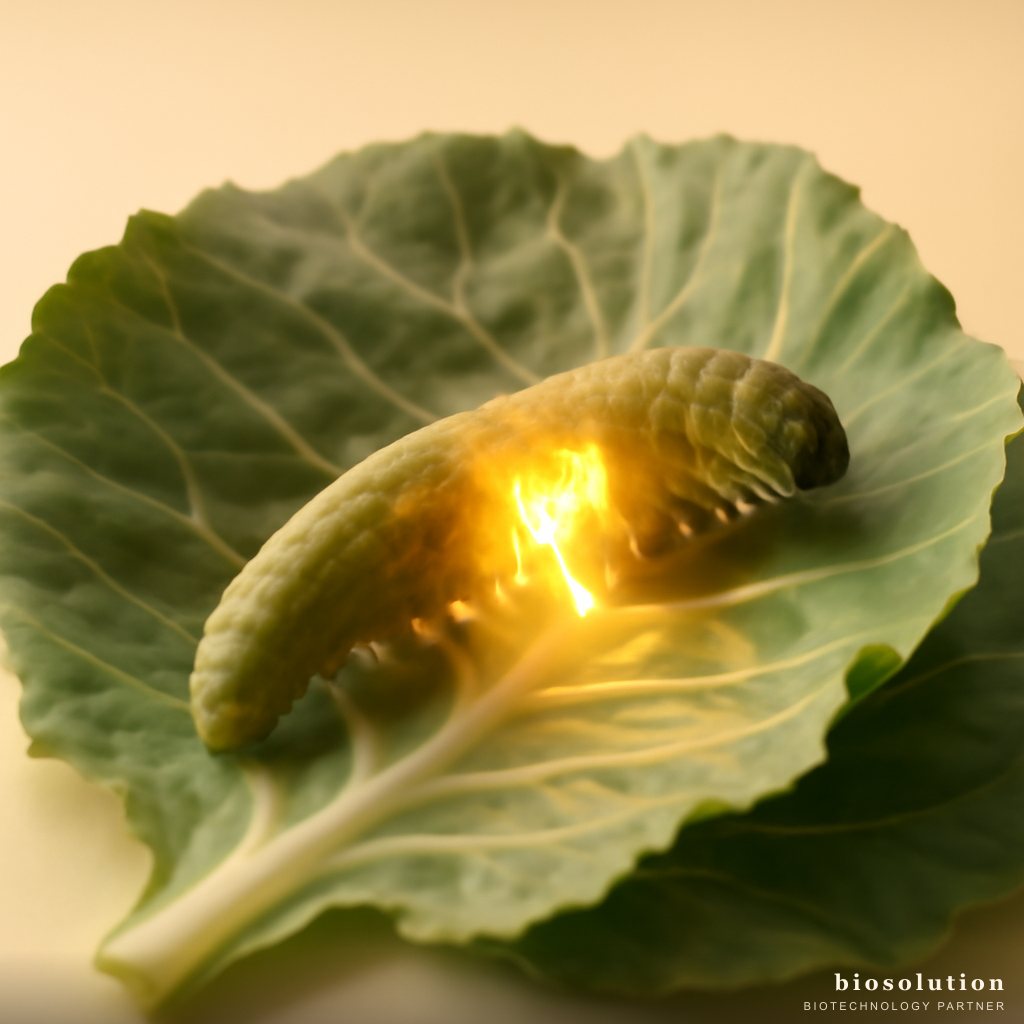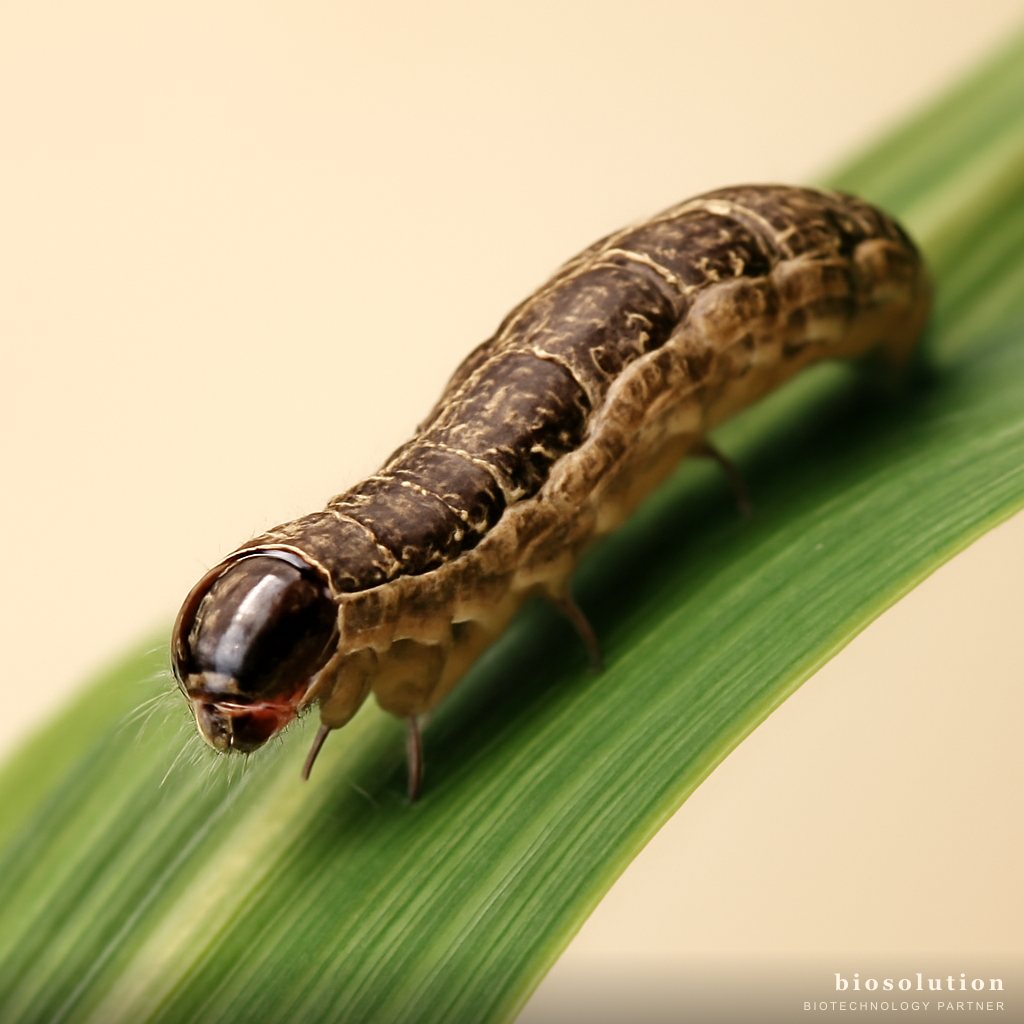
Controlling Fall Armyworm with Anti-Caterpillar Formula: A Biological Application Guide
Fall armyworm (Spodoptera frugiperda) or FAW remains a major challenge for farmers in Indonesia. This pest can damage corn plants from vegetative to generative stages, causing yield losses of 30–50% if not controlled. To control fall armyworm effectively and sustainably, Biosolution presents Anti-Caterpillar Formula for Rice & Corn, a biological product combining two superior biological agents: Bacillus thuringiensis and Beauveria bassiana. This article will technically discuss application methods, dosage, spray timing, and adjuvant combinations for maximum control.
Why Anti-Caterpillar Formula is Effective Against Fall Armyworm?
Anti-Caterpillar Formula for Rice & Corn is specifically formulated to control fall armyworm and tobacco cutworm (Spodoptera litura). This product contains two entomopathogenic microbes that work synergistically:
- Bacillus thuringiensis: This bacterium produces protein crystals (δ-endotoxin) toxic to Lepidoptera larvae. When larvae ingest leaves containing crystals, the endotoxin activates poison in the gut, causing larvae to stop feeding and die within 24–48 hours.
- Beauveria bassiana: An entomopathogenic fungus that infects larvae and pupae through contact. Fungal mycelium penetrates the cuticle, produces beauvericin toxin, and eventually kills the insect within 3–7 days. The advantage of B. bassiana is its ability to infect pupal stages often missed by chemical insecticides.
The combination of these two biological agents provides dual mortality mechanisms: oral (Bt) and contact (Beauveria). This makes it difficult for pests to develop resistance and ensures broader control, including larvae hiding in leaf whorls.
Proper Dosage and Application Method for Anti-Caterpillar Formula
To effectively control fall armyworm, application must be done with correct dosage and method. Here is the official guide from Biosolution:
Dosage
- 3 ml per liter of water (3 ml/L). For a 14-liter spray tank, use 42 ml of product; for 16 liters, use 48 ml.
Application Method
- Spot spray on target plant parts: growing points, leaf whorls, and areas around eggs or young larvae. Spray evenly until wet but not dripping.
- Primary target: instar 1–3 larvae still on leaf surfaces or inside whorls. Instar 4–6 larvae are more tolerant, so application should be done when populations are still low.
Frequency and Interval
- Every 5–7 days. This interval matches the FAW life cycle of about 30–40 days. Regular application cuts off new generations and suppresses populations.
- Reapply after heavy rain as biological agents can be washed off.
Best Application Time
- Late afternoon (3:00–5:00 PM) or when the sun is not too intense. Lower temperatures and higher humidity increase B. bassiana viability and B. thuringiensis activity. Avoid application during strong winds or rain.
Adjuvant Combinations to Enhance Efficacy
Adjuvants are additives mixed in the spray tank to improve biopesticide performance. Recommended adjuvants for Anti-Caterpillar Formula:
Sticker (Nonionic Surfactant)
- Dosage: 0.5–1 ml/L water. Surfactants reduce water surface tension so spray droplets spread more evenly on waxy leaf surfaces. Products like Agristick or alkyl polyglycoside-based surfactants can be used.
- Benefits: Improves adhesion and spray coverage, especially on slippery corn leaves.
Wetting Agent
- Dosage: 0.5 ml/L. Helps penetration into leaf whorls where larvae hide. Without wetting agent, much spray only hits outer surfaces.
UV Protectant
- Dosage: as per label. B. thuringiensis is sensitive to UV light. UV protectants like kaolin (5 g/L) or lignin extract can be added to extend field persistence.
Note: Do not mix with chemical fungicides or bactericides as they can kill biological agents. Ensure adjuvants used are compatible with biological products.
Critical Application Timing: When to Spray?
To optimally control fall armyworm, recognize critical attack phases:
Early Vegetative Phase (0–21 DAP)
- Symptoms: Young leaves with holes, damaged growing points, sawdust-like frass in leaf whorls.
- Action: Start application when 1–2 egg masses or instar 1 larvae per plant are found. Spray onto growing points and leaf whorls.
Generative Phase (45–60 DAP)
- Symptoms: Damaged ears, holes in ears, larvae inside ears.
- Action: Spray onto silk and ear base. Use sufficient spray pressure for penetration into ears.
Principle: Early application on young larvae (instar 1–2) yields best results. Larger larvae are more tolerant to Bt due to developed detoxification enzymes.
Advantages of Anti-Caterpillar Formula Over Chemical Insecticides
Here are the advantages of this biological product in controlling fall armyworm:
- No cross-resistance: Dual mode of action (oral + contact) makes it difficult for pests to become resistant. In contrast, continuous chemical insecticide use has led to FAW resistance to pyrethroids and organophosphates in some areas.
- Safe for workers and food chain: Leaves no harmful residues on corn, safe for consumption. Farmers can re-enter fields immediately after spray dries.
- Friendly to natural enemies: Predators and parasitoids like Trichogramma spp. and Cotesia spp. are not directly affected, so natural control continues.
- Reduces chemical dependence: With regular application, FAW populations can be suppressed below economic thresholds, reducing long-term production costs.
Case Study: Successful FAW Control in the Field
In several corn centers in East Java and South Sulawesi, farmers who disciplinedly applied Anti-Caterpillar Formula reported a 70% reduction in attack intensity after 3–4 applications. Key success factors:
- Application started from early vegetative phase.
- Used sticker adjuvant to reach leaf whorls.
- Rotated with Caterpillar & Borer Control Formula (Bt) in the next planting season to prevent pest adaptation.
Also read related article: Understanding Fall Armyworm Life Cycle.
Conclusion
Controlling fall armyworm biologically with Anti-Caterpillar Formula for Rice & Corn is a smart and sustainable solution. This product combines Bacillus thuringiensis and Beauveria bassiana that work synergistically to control larvae and pupae. With a dosage of 3 ml/L, afternoon application every 5–7 days, and addition of sticker and UV protectant adjuvants, farmers can effectively suppress FAW populations without harming the environment. For optimal results, conduct regular monitoring and apply from early attack. If you need further consultation on corn pest control strategies, contact the Biosolution team via WhatsApp at 0811-XXX-XXXX or visit the product page Anti-Caterpillar Formula.
FAQ
Q: Is Anti-Caterpillar Formula safe for livestock that eat corn? A: Yes, it is safe. This product is microbe-based and leaves no toxic residues. Bacillus thuringiensis and Beauveria bassiana are specific to target insects and harmless to mammals, poultry, or fish. Sprayed corn can be fed to livestock after spray dries.
Q: Can it be mixed with foliar fertilizers or chemical pesticides? A: It is best not to mix with chemical fungicides or bactericides as they can kill biological agents. However, it can be mixed with organic foliar fertilizers or compatible adjuvants. Conduct a small-scale compatibility test before bulk mixing.
Q: How long does Anti-Caterpillar Formula persist in the field? A: Without UV protectant, persistence is about 24–48 hours under direct sunlight. With UV protectant (e.g., kaolin), persistence can reach 3–5 days. Reapplication after rain or every 5–7 days is still necessary.
Q: Is this product effective for armyworm on rice? A: Yes, this product is formulated for Spodoptera frugiperda (fall armyworm) and S. litura (tobacco cutworm) which also attack rice. Dosage and application method are the same, but spray targets are leaves and stem bases of rice.
Q: How to store the product after mixing with water? A: The spray mixture should be used within 2–3 hours. Do not store as microbial viability decreases. Store unopened product in a cool place (4–10°C) and avoid direct sunlight.