Dosage and Application Schedule of Beauveria bassiana Spray for Biological Pest Control
Pest control using biological agents is increasingly popular among modern farmers who want healthy and environmentally friendly harvests. One leading product is the Broad-Spectrum Biological Insecticide Formula from Biosolution, containing Beauveria bassiana and Metarhizium anisopliae. However, successful application depends heavily on the correct dosage and application schedule of Beauveria bassiana spray. This article will thoroughly discuss technical guidelines for applicator farmers to achieve 80–85% pest control efficacy, as claimed by the product.
Why Are Dosage and Application Schedule of Beauveria bassiana Spray Important?
Beauveria bassiana spray cannot be applied haphazardly. The spores of this entomopathogenic fungus require supportive environmental conditions to germinate and infect target pests. Too low a dosage results in suboptimal effectiveness, while excessive dosage wastes costs without significant improvement. The application schedule is also crucial because pests have dynamic life cycles and populations.
Mechanism of Action of Beauveria bassiana and Metarhizium anisopliae
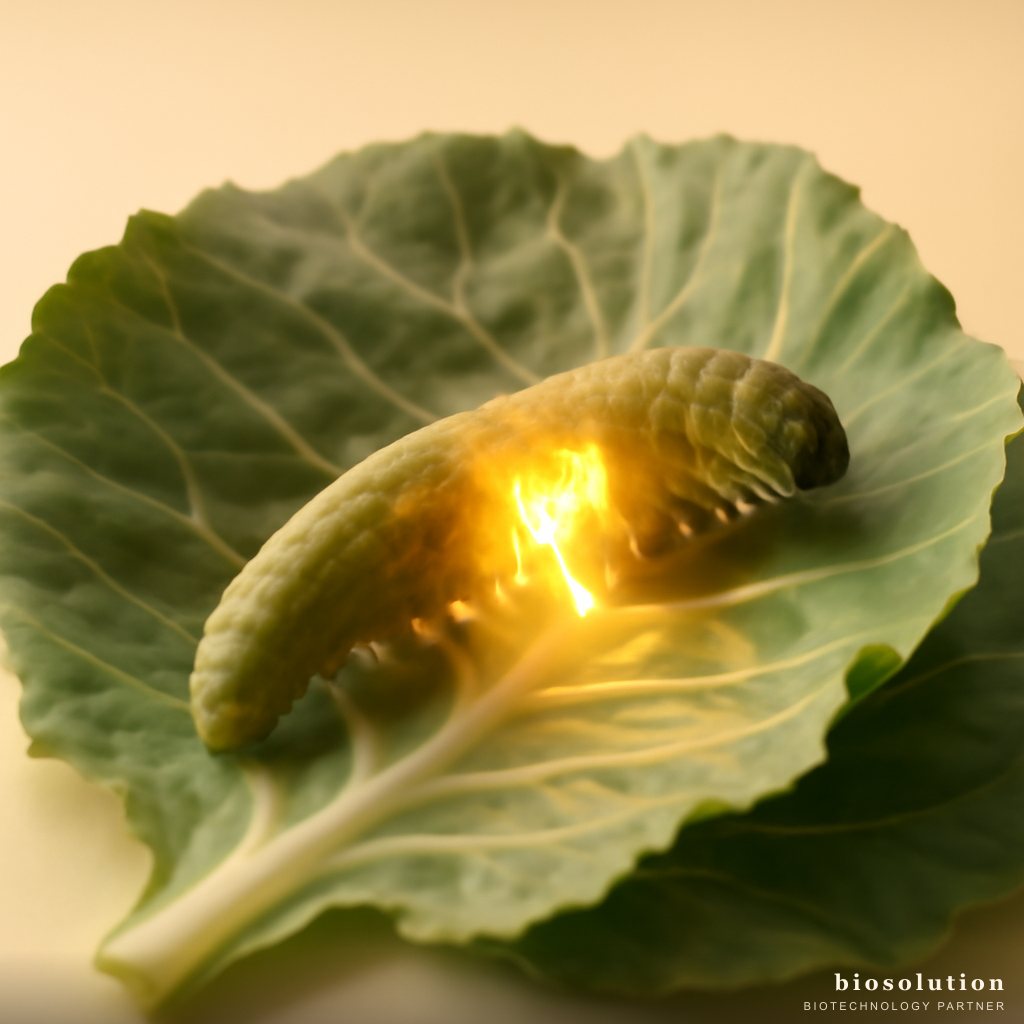
Both fungi work by contact. Spores that attach to the insect cuticle germinate and penetrate the host's body through protease and chitinase enzymes. Once inside, mycelium grows and destroys internal tissues, causing death within 3–7 days. Infected insect carcasses then produce new spores that can infect other pests nearby, creating a chain effect.
Environmental Factors Affecting Efficacy
Relative humidity (RH) above 70% is ideal for spore germination. Optimal temperature ranges from 25–30°C. Therefore, spraying should be done in the late afternoon when humidity is high and sunlight is not too intense. Avoid application during heavy rain as spores can be washed off.
Recommended Dosage of Broad-Spectrum Biological Insecticide Formula
Biosolution's product containing Beauveria bassiana and Metarhizium anisopliae has a concentration of 10⁶ CFU/ml per strain. The recommended dosage is:
- Liquid formulation (EC): 2–3 ml per liter of water.
- Powder formulation (WP): 3–5 grams per liter of water.
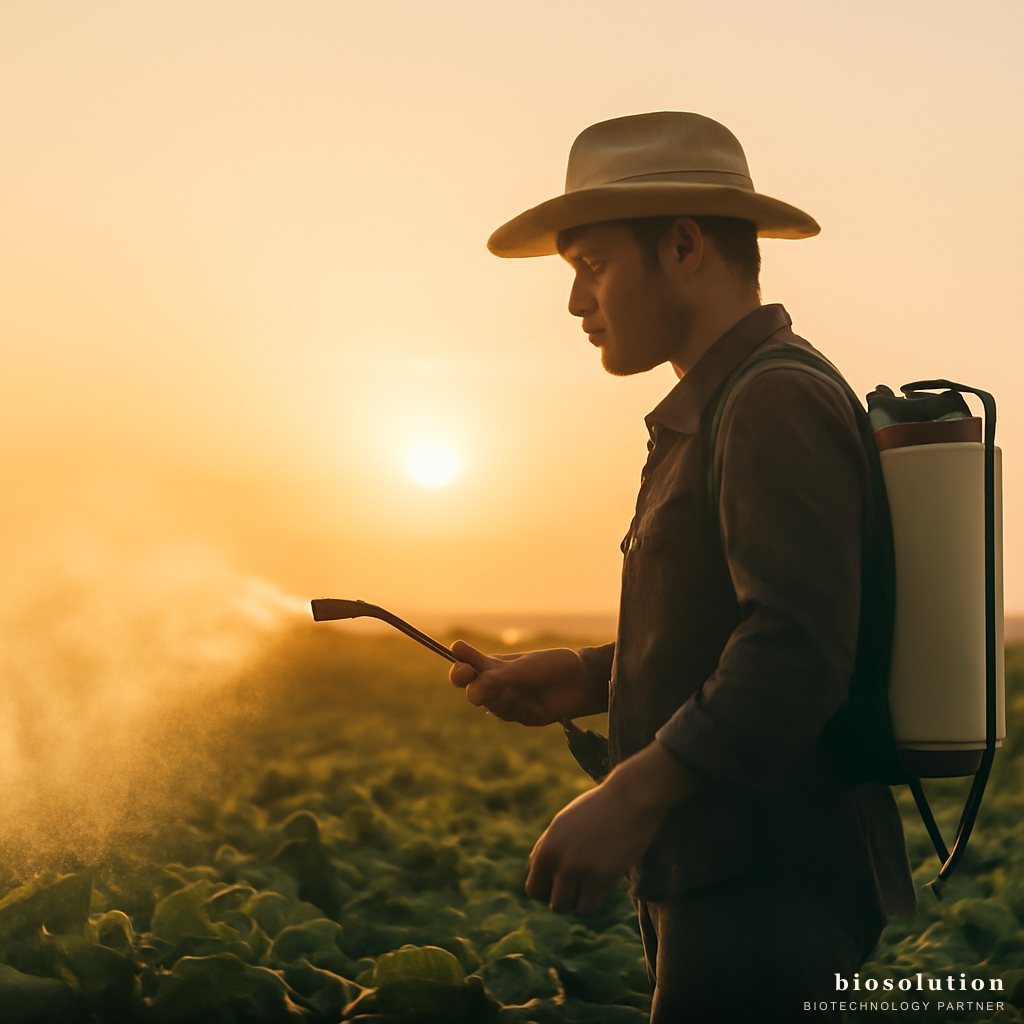
This mixture is sprayed evenly over all parts of the plant, especially the underside of leaves where pests often hide. Spray volume is adjusted according to plant growth stage; an average of 400–600 liters per hectare for annual crops.
Calculation of Requirements per Hectare
For example, for rice in the vegetative stage with a spray volume of 500 L/ha and a liquid product dosage of 2 ml/L, the product requirement per hectare = 500 L × 2 ml = 1000 ml or 1 liter. If using WP at a dosage of 4 g/L, the requirement = 500 × 4 = 2000 g or 2 kg.
Proper Application Schedule
Spraying frequency is recommended every 7–10 days when pest populations begin to increase. Routine monitoring using traps or visual observation is very important. The first application should be done when pest populations are still low (control threshold) to prevent outbreaks.
Best Application Time
- Morning (06.00–09.00) if dew is still present and humidity is high.
- Late afternoon (15.00–17.00) when temperature starts to drop and humidity rises.
Avoid spraying at midday because UV rays can damage spores.
Effective Spray Application Techniques
Sprayer Preparation
Use a knapsack sprayer or motorized sprayer with a cone nozzle that produces fine droplets. Ensure the tank is clean from chemical pesticide residues that can inhibit spores.
How to Prepare Spray Solution
- Fill the tank with clean water to half capacity.
- Add the recommended dosage of product.
- Stir until homogeneous.
- Add water to the final volume.
- Spray immediately after mixing (maximum 2 hours).
Thorough Spraying
Direct the nozzle to all parts of the plant: stems, upper and lower leaves, and growing points. Ensure no parts are missed. Walking speed and spray pressure should be adjusted for even coverage.
Advantages of Biosolution's Biological Insecticide Formula
This product has several advantages that support successful control:
- High efficacy: 80–85% against target pests such as caterpillars, beetles, and planthoppers.
- Zero residue: Safe for vegetables and fruits harvested daily.
- IPM compatible: Can be combined with other biological agents or botanical pesticides.
- Safe for workers and environment: Leaves no harmful toxins.
Case Study: Application on Chili Plants
Farmers in West Java applied Beauveria bassiana spray at a dosage of 3 ml/L every 7 days when aphid and thrips populations began to increase. As a result, pest attacks decreased drastically after 2 applications, and chili production increased by 20% compared to the previous season using chemical pesticides. Another advantage was lower control costs because reapplication every 3 days was not needed.
Conclusion
Successful pest control using the correct dosage of Beauveria bassiana spray depends heavily on adherence to proper dosage and application schedule. Biosolution's Broad-Spectrum Biological Insecticide Formula provides an effective solution with a dosage of 2–3 ml/L (liquid) or 3–5 g/L (powder), applied every 7–10 days in the late afternoon. With proper techniques, farmers can naturally suppress pest populations without chemical residues. For further consultation, contact Biosolution's technical team via WhatsApp.
FAQ
What is the dosage of Beauveria bassiana spray for rice plants?
The recommended dosage is 2–3 ml per liter of water for liquid formulation, or 3–5 grams per liter for powder. Spray volume is adjusted according to plant age, averaging 400–600 liters per hectare. Spray every 7–10 days when pest populations begin to increase.
When is the best time to apply Beauveria bassiana?
The best time is late afternoon (3:00–5:00 PM) when humidity is high (>70%) and temperature is not too hot. Morning is also possible if dew is still present. Avoid midday because UV rays can kill spores.
Is Beauveria bassiana safe for plants and humans?
Very safe. Beauveria bassiana is an entomopathogenic fungus that only attacks insects. This product leaves no harmful residues on harvested crops and is non-toxic to humans, animals, or the environment.
How to store unused product?
Store in a cool, dry place, protected from direct sunlight. Ideal storage temperature is 4–10°C. Do not expose the product to extreme temperatures as it can reduce spore viability.
Can it be mixed with chemical pesticides?
It is best not to mix with chemical fungicides as they can inhibit spores. However, it can be combined with botanical insecticides or other biological agents such as Bacillus thuringiensis. Conduct a compatibility test on a small scale first.