Livestock Waste Odor Decomposer: Bioremediation Integration with Existing WWTP Systems
Pungent odors from livestock waste are not just a comfort issue but also an indicator of environmental pollution that can trigger social conflicts and legal sanctions. For farmers, effective waste management is a priority. One increasingly popular solution is the use of microbial-based livestock waste odor decomposers. However, how can they be integrated with existing Wastewater Treatment Plant (WWTP) systems? This article thoroughly discusses an integrated bioremediation approach, combining microbial decomposers with conventional waste treatment infrastructure for optimal results.
Why Must Livestock Waste Odor Be Addressed?
Livestock waste, especially manure, contains complex organic compounds such as proteins, fats, and carbohydrates. Without proper management, anaerobic microorganisms decompose them, producing foul-smelling gases like ammonia (NH₃), hydrogen sulfide (H₂S), and mercaptans. These odors are not only disturbing but also harmful to livestock and human health. Ammonia can cause respiratory tract irritation, while hydrogen sulfide in high concentrations is toxic. Additionally, these gases contribute to greenhouse gas emissions.
Environmental regulations in Indonesia, such as the Minister of Environment and Forestry Regulation No. P.68/Menlhk/Setjen/Kum.1/2016 on Emission Quality Standards for Livestock Businesses and/or Activities, mandate odor control. Therefore, farmers need to adopt effective and economical technologies. The use of microbial decomposers is a suitable choice because they work naturally and can be integrated with existing waste treatment systems.
Mechanism of Microbial Decomposers as Odor Decomposers
Products like Biosolution's Organic Waste Decomposer Formula contain a consortium of superior microbes, including Streptomyces sp., Bacillus, and Aspergillus. Streptomyces sp. acts as a producer of enzymes and natural antibiotics that help break down complex compounds while suppressing pathogen growth. Meanwhile, Bacillus and Aspergillus are highly efficient decomposers of organic matter.
Their working mechanism includes:
- Production of extracellular enzymes: Microbes secrete enzymes such as protease, lipase, and cellulase that break down proteins, fats, and cellulose into simple molecules.
- Competition and antagonism: Beneficial microbes dominate space and nutrients, inhibiting the growth of odor-producing putrefactive bacteria.
- Bioremediation: Odorous compounds like ammonia and H₂S are converted into odorless or stable forms.
The recommended application dose is 1 L per m³ of waste, simply sprinkled onto the waste pile in the afternoon. One application per pile is effective for significantly reducing odor and reducing waste volume by 30–50%.
Integration with Existing WWTP Systems: A Bioremediation Approach
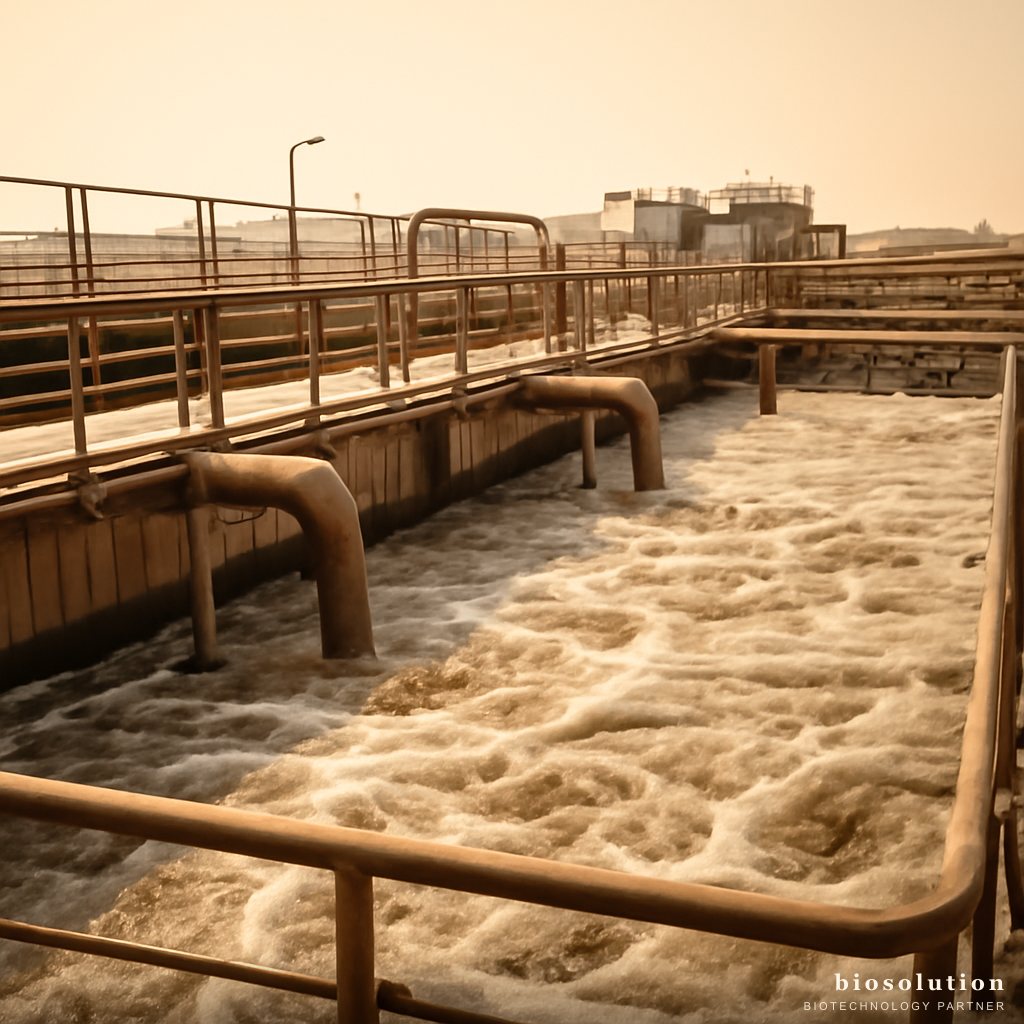
Conventional WWTP systems typically consist of a collection tank, aeration tank, and sedimentation tank. However, WWTPs often cannot fully handle high organic loads and odor-causing compounds. This is where microbial decomposers act as biological boosters.
Integration Steps:
- Pre-treatment: Add the Organic Waste Decomposer Formula to the initial collection tank (equalization tank) at a dose of 1 L per m³. Let it sit for 24–48 hours to initiate initial decomposition and reduce organic load.
- Application in aeration tank: After that, reapply in the aeration tank to accelerate the degradation of dissolved organic compounds. Aerobic microbes in the consortium will work optimally with oxygen supply from the aerator.
- Monitor pH and temperature: Ensure pH remains neutral (6–8) and temperature does not exceed 45°C to maintain microbial activity.
- Sludge management: The resulting sludge can be composted with additional decomposer to produce organic fertilizer.
Benefits of this integration include:
- Increased treatment efficiency: Hydraulic retention time can be shortened.
- Faster odor elimination: Microbes directly target odor-causing compounds.
- Reduced sludge volume: More complete decomposition results in less residue.
- Lower operational costs: Reduces the need for chemicals and frequency of desludging.
Case Study: Implementation in a Medium-Scale Cattle Farm
A cattle farm in East Java with 100 head of cattle faced odor complaints from nearby residents. They had a simple WWTP consisting of an anaerobic pond and aeration. After integrating the Organic Waste Decomposer Formula, odor was drastically reduced within 1 week. Wastewater parameters showed a decrease in BOD from 3,000 mg/L to 800 mg/L, and ammonia from 150 mg/L to 30 mg/L. Sludge volume decreased by 40%, and the remaining sludge could be directly used as fertilizer after composting.
The farmer reported no significant changes to the existing WWTP system, only the addition of decomposer application points. The additional cost for product purchase was around IDR 500,000 per month, much cheaper than environmental fines or compensation to residents.
Advantages of Biosolution's Organic Waste Decomposer Formula
This product is specifically formulated to handle livestock organic waste. Some of its advantages:
- Synergistic consortium: The combination of Streptomyces, Bacillus, and Aspergillus works under various conditions.
- Easy to apply: Simply sprinkle; no special equipment needed.
- Fast results: Odor reduces within 24–48 hours.
- Environmentally friendly: Contains no harmful chemicals, safe for livestock and humans.
- Meets standards: Compost results comply with SNI and are safe for soil.
For more information about this product, visit the Organic Waste Decomposer Formula page.
Challenges and Solutions in Integration
Although integration is relatively easy, some challenges may arise:
- Fluctuating wastewater quality: Extreme pH or temperature changes can inhibit microbes. The solution is to adjust the dose or add a buffer.
- Presence of antibiotics or disinfectants: Animal drug residues can kill microbes. Avoid excessive use of disinfectants in waste areas.
- Lack of farmer understanding: Education on application methods and monitoring is needed. Biosolution provides guides and technical support.
Conclusion
Integrating livestock waste odor decomposers with existing WWTP systems is a smart and economical solution to address odor and pollution problems. By utilizing microbial decomposers like the Organic Waste Decomposer Formula, farmers can increase waste treatment efficiency, reduce environmental impact, and even produce valuable by-products. This step aligns with sustainable agriculture principles and regulatory compliance.
If you are interested in implementing this solution on your farm, feel free to consult with Biosolution's expert team via WhatsApp. Also visit the Organic Waste Decomposer Formula page for product details and ordering.
FAQ
What is a livestock waste odor decomposer?
A livestock waste odor decomposer is a product containing microorganisms capable of decomposing odor-causing organic matter in livestock waste. These microbes produce enzymes that break down complex compounds into simple, odorless compounds, thereby reducing odors from ammonia, hydrogen sulfide, and other gases.
How to integrate microbial decomposers with existing WWTP?
Integration is done by adding the decomposer to the initial collection tank or aeration tank of the WWTP. The recommended dose is 1 L per m³ of waste, applied periodically. The microbes work together with the existing treatment system to accelerate decomposition and reduce odor.
Are microbial decomposers safe for livestock and humans?
Yes, the microbes used, such as Streptomyces sp., Bacillus, and Aspergillus, are non-pathogenic microorganisms that are safe. This product contains no harmful chemicals, making it safe for livestock, humans, and the environment.
How long does it take for odor to reduce after application?
Odor usually begins to reduce within 24–48 hours after application. Significant reduction is seen within 3–7 days depending on waste volume and environmental conditions.
Can this product be used for all types of livestock waste?
This product is formulated for organic livestock waste such as cattle, chicken, pig, and goat manure. Optimal results are achieved with waste high in organic content. For waste with high chemical or antibiotic content, consultation with an expert is recommended.