Wastewater BOD COD Reduced to Quality Standards: 7 Effective Liquid Waste Bioremediation Formulas
Industrial environmental managers face a major challenge: ensuring discharged wastewater meets environmental quality standards. BOD (Biochemical Oxygen Demand) and COD (Chemical Oxygen Demand) are key indicators that often exceed thresholds, resulting in hefty fines and reputational damage. However, with the right bioremediation approach, reducing BOD COD to quality standards is no longer a dream. This article thoroughly explores how liquid waste bioremediation formulas can be a reliable solution, complete with post-application monitoring guidelines for BOD, COD, and odor.
Why Are BOD and COD Critical Parameters in Wastewater Quality Standards?
BOD measures the amount of oxygen required by microorganisms to decompose organic matter in water, while COD measures the total oxygen needed to chemically oxidize organic and inorganic matter. Both are benchmarks for organic pollution that directly impacts aquatic ecosystems. Industrial wastewater with high BOD/COD causes decreased dissolved oxygen, aquatic life mortality, and unpleasant odors.
The government, through the Ministry of Environment and Forestry Regulation (Permen LHK), sets wastewater quality standards for various industrial sectors. For example, for the textile industry, the maximum BOD standard is 30 mg/L and COD 150 mg/L. Violations of these thresholds can result in administrative to criminal sanctions. Therefore, effective wastewater management is a top priority.
Conventional treatment methods such as coagulation-flocculation and activated sludge often require high costs and hazardous chemicals. This is where bioremediation offers an environmentally friendly alternative that is more economical in the long run.
Bioremediation Mechanism: Role of Decomposing Bacterial Consortium and Aspergillus niger
Bioremediation harnesses the natural ability of microorganisms to degrade organic pollutants into simpler, harmless compounds. The Industrial Liquid Waste Bioremediation Formula from Biosolution contains a consortium of decomposing bacteria that work synergistically to break down long carbon chains, fats, proteins, and carbohydrates. Additionally, Aspergillus niger is added, a mold that produces extracellular enzymes such as amylase, cellulase, and protease that accelerate the hydrolysis of complex substrates.
The degradation process occurs in two stages: first, enzymes from Aspergillus niger break down large molecules into smaller fragments; second, decomposing bacteria assimilate these fragments into biomass and release CO2 and H2O. As a result, BOD and COD decrease drastically. Another advantage is odor reduction because odor-causing compounds such as ammonia and hydrogen sulfide are also degraded.
7 Bioremediation Formulas to Reduce BOD/COD of Industrial Wastewater
Here are seven approaches that can be applied in a wastewater bioremediation strategy:
1. Direct Dosing into WWTP Ponds
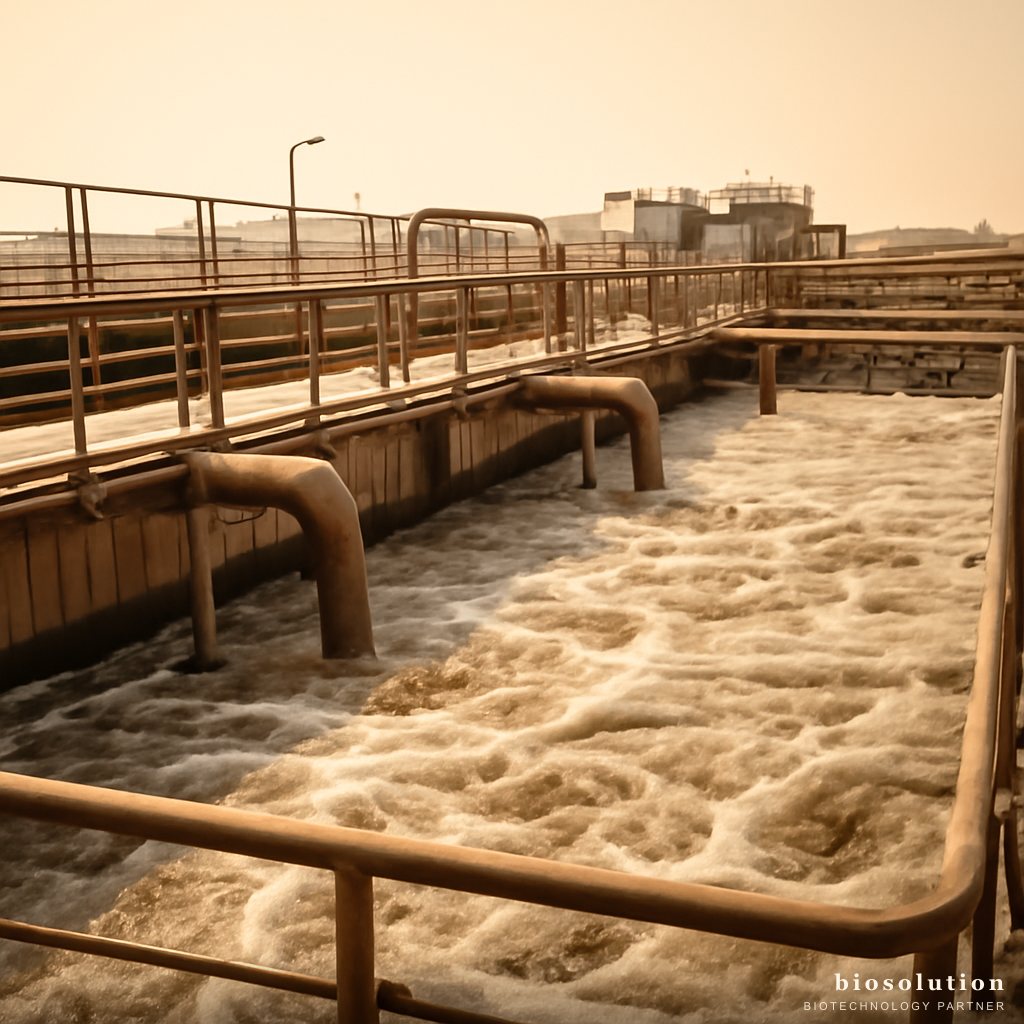
The simplest method: pour the bioremediation formula directly into the inlet of aeration ponds or facultative ponds. Initial dose is 100–500 ml per m³ of wastewater volume, depending on pollution level. Apply weekly for maintenance.
2. Periodic Bioaugmentation
Periodically add the bacterial consortium to maintain active microbial populations. This is important when organic load fluctuates or during shock loading.
3. Aeration Optimization
Aerobic bioremediation requires sufficient oxygen. Ensure dissolved oxygen supply is at least 2 mg/L for aerobic bacteria to work optimally. Use diffusers or surface aerators.
4. pH and Temperature Regulation
Microbes work optimally at pH 6.5–8.0 and temperature 25–35°C. Monitor and correct if necessary.
5. Nutrient Addition
If the C:N:P ratio is unbalanced, add nitrogen and phosphorus sources (e.g., urea, TSP) to support bacterial growth.
6. Use of Biofilm Media
Provide media such as bioballs or pumice stones for microbes to attach. This increases biomass concentration and degradation efficiency.
7. Post-Application Parameter Monitoring
The most crucial step: regularly measure BOD, COD, and odor intensity after application. This data serves as the basis for evaluation and dose adjustment.
Post-Application Monitoring: BOD, COD, and Odor as Success Indicators
After applying the bioremediation formula, monitoring bridges expectations and reality. Key parameters to monitor include:
BOD and COD
Collect samples at the WWTP outlet at least once a week. Measurement methods refer to SNI 6989.72:2009 for BOD and SNI 6989.73:2009 for COD. Target reduction is at least 70–90% from inlet. If not achieved, evaluate dose, retention time, or environmental conditions.
Odor
Typical wastewater odors such as ammonia, hydrogen sulfide, or volatile organic compounds (VOCs) can be measured qualitatively using a hedonic scale or quantitatively with an olfactometer. Effective bioremediation will suppress odors to non-disturbing levels.
With routine monitoring, environmental managers can take quick corrective actions, prevent quality standard violations, and optimize operational costs.
Case Study: Successful BOD/COD Reduction to Meet Quality Standards
A food processing plant in West Java faced average BOD of 250 mg/L and COD of 600 mg/L, exceeding the quality standards of BOD 100 mg/L and COD 300 mg/L. After using the Biosolution Industrial Liquid Waste Bioremediation Formula at a dose of 300 ml/m³ weekly, within 4 weeks BOD dropped to 45 mg/L and COD to 180 mg/L. Ammonia odor also significantly reduced. The plant successfully avoided environmental fines and saved up to 40% on chemical costs.
Advantages of Biosolution Industrial Liquid Waste Bioremediation Formula
This formula is specifically designed for industrial wastewater with a tested consortium of decomposing bacteria and Aspergillus niger. Its advantages include:
- Effectively reduces BOD/COD to meet quality standards.
- Naturally reduces odor.
- Reduces use of hazardous chemicals.
- Fast ROI due to reduced treatment costs and fines.
- Easy to apply without major WWTP modifications.
Conclusion
Reducing BOD COD of wastewater to quality standards is not impossible. With the right bioremediation approach, disciplined post-application monitoring, and superior products like the Industrial Liquid Waste Bioremediation Formula, environmental managers can achieve environmental compliance and cost efficiency. Don't let waste be a burden—turn it into an asset through environmentally friendly technology.
For more information and free consultation, contact our team via WhatsApp or see the product Industrial Liquid Waste Bioremediation Formula. Also get solutions for other waste treatment divisions on the waste solutions page. Read related articles about industrial WWTP management.